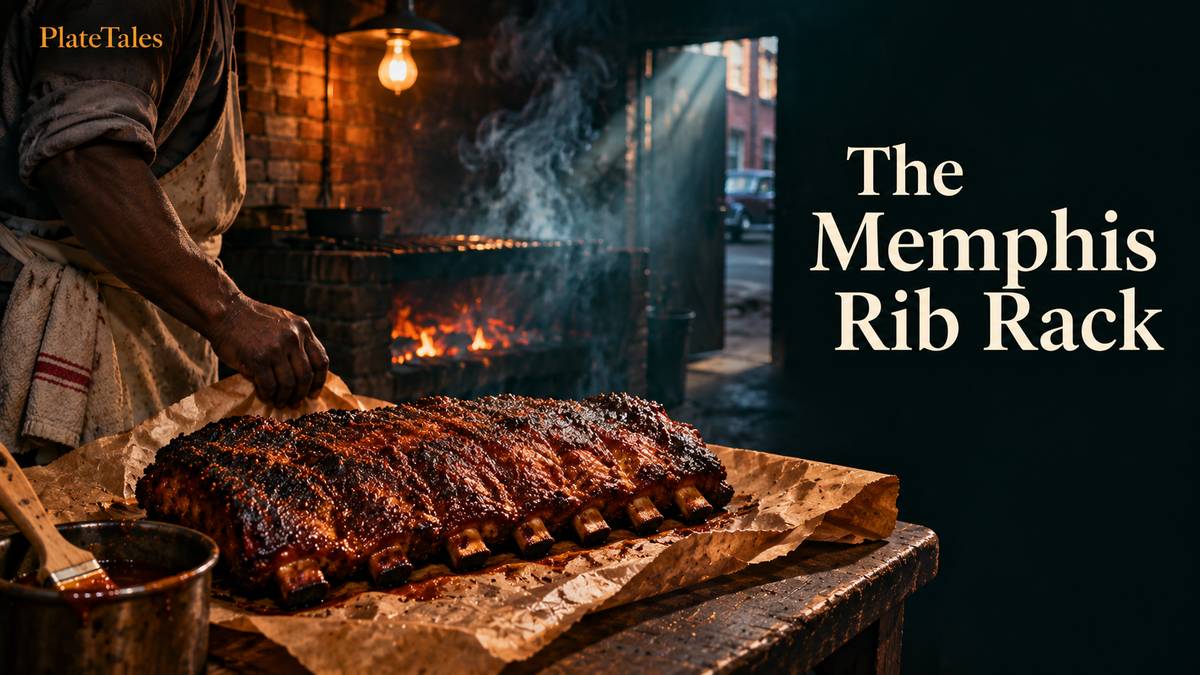
Barbecue ribs begin with a word, not a cut of meat. The word comes from Spanish barbacoa, which Spanish writers took from the Taino people of the Caribbean, who used it for a wooden frame set over a fire. The rack of pork ribs that Americans now call barbecue is a much later arrival: its best-documented moment is a basement in Memphis in 1948.
A Taino word for a wooden frame
After Columbus landed in 1492, Spaniards found the Taino cooking and drying food on a wooden framework raised over a fire. The Spanish wrote the word as barbacoa. It passed into Portuguese, French and English, and at first the word named the frame, not the food.
English writers picked it up in the seventeenth century. The earliest English uses refer to sleeping platforms and to drying fish or meat on frames, and not to a party or a sauce. By 1755 Samuel Johnson's dictionary listed "to barbecue" as a verb for dressing a whole hog.
A popular story says the word comes from the French phrase barbe a queue, "beard to tail", describing a whole animal roasted on a spit. Etymologists do not support it. The Caribbean root is the accepted one.
Barbecue ribs history: a cut nobody wanted
Ribs were once treated as scrap meat, which is how the Rendezvous's own history describes them in the 1950s.
That is the background to the story the Rendezvous tells about itself. Charlie Vergos co-owned a meat-and-three restaurant called Wimpy's in Memphis with his brother-in-law. After a disagreement, according to the restaurant's own history, he moved into a basement in 1948 and opened a snack spot selling ham sandwiches and beer. The basement sits in an alley across from the Peabody Hotel.
Business was good, but Vergos wanted a bigger menu. The restaurant says he turned to ribs, which were then regarded as scrap meat. This is the family's account and it is the only detailed one available, so treat it as the restaurant's story and not as an independent record. For the barbecue itself, see how it compares with pulled pork, the other great pork tradition of the American South.
The Memphis dry rub at the Rendezvous
The Rendezvous did not slow-smoke its ribs. Vergos had turned an old elevator shaft in the basement into a cooking space, and according to the restaurant he put the racks about 18 inches from the fire and grilled them for roughly an hour and a quarter. A vinegar wash kept them moist.
The seasoning came from his father's Greek chili recipe, with paprika added to give the ribs the color customers expected of barbecue. That is why the Rendezvous rub tastes of oregano and garlic as much as of smoke.
The Southern Foodways Alliance, which interviewed John Vergos in 2008 for its Memphis barbecue project, tells it slightly differently. In its summary, John Vergos was born in 1948, the year his father opened the Rendezvous, and the charcoal-grilled ribs began in the mid-1950s after Charlie found an old coal chute in the basement. The restaurant's own page puts the shift to ribs in the late 1950s and mentions an elevator shaft, not a coal chute. Accounts differ on the year and on the hardware. Both agree on the Greek spice mix, the vinegar and the charcoal.
The Southern Foodways Alliance describes the ribs as eaten without extra barbecue sauce. That is where the name "dry" comes from: the seasoning goes on before cooking, and the ribs reach the table without a sauce brushed over them. Memphis joints also serve "wet" ribs, brushed with sauce while they cook.
After the Second World War, barbecue in Memphis turned into a business of small restaurants with purpose-built pits,. Vergos is a leading name from that era, but the sources opened here do not say he invented the dry rub; they date his restaurant and describe his method. The Rendezvous page claims the ribs and their seasoning as the family's own, and the name has stuck to them.
What is a St. Louis style rib?
St. Louis style is a butcher's cut before it is a cooking style. The sternum bone, the cartilage and the rib tips are trimmed away from a rack of spare ribs, which leaves an almost rectangular slab. The United States Department of Agriculture later put the name into its meat specifications as "Pork Ribs, St. Louis Style".
The usual account, repeated in reference works, is that butchers and meatpackers in the St. Louis area adopted the trimmed rack after the Second World War to remove fat and gristle, and sold it at a premium. Meatpackers later promoted the cut to set themselves apart from competitors. The detail about who first made the cut is thin. Nobody has produced a named butcher or a dated invoice, so treat claims of one inventor with suspicion.
The trimmings were not wasted. The rib tips, cut off to make the rectangle, became a dish in their own right in some cities, cooked and sold as tips.
St. Louis itself has a separate barbecue history. Louis Maull is credited with creating a bottled barbecue sauce there in 1926, and in the 1950s pork butt became a local staple after a grocery chain began selling it. Kansas City, close by, shaped much of the local style. If you want the beef side of the American pit, Texas brisket tells it.
Spare ribs, baby backs and the names on the menu
A trimmed St. Louis rack is a spare rib rack with the tips, cartilage and sternum removed. Spare ribs carry more fat than baby backs, which some cooks say makes them more tender.
This article does not trace the first appearance of "baby back" on a menu or the origin of "spare rib", because the sources opened for it do not settle either question. Where they differ in practice is the butcher's cut, not the recipe.
Why the rib rack ended up as the main dish
A rib rack suits a small restaurant. The Rendezvous grills it in about an hour and a quarter, and a rack is easy to portion and sell. A plate of ribs is often paired with coleslaw, a pairing found at many American barbecue tables.
For more stories in this vein, browse cultural identity. In Memphis, the Vergos family took a cut the trade undervalued, a basement with a coal chute or an elevator shaft, and a Greek chili seasoning, and turned them into a signature dish.
The Rendezvous still serves its ribs from the same alley, and its address is 52 South Second Street. In the years since, the Memphis City Council has named the alley "Charlie Vergos' Rendezvous Alley."
Questions people ask
Where does the word barbecue come from?
Barbecue comes from the Spanish word barbacoa, which Spanish writers borrowed from the Taino people of the Caribbean, who used it for a wooden frame set over a fire. English writers began using the word in the 1600s, and by 1755 Samuel Johnson's dictionary defined "to barbecue" as dressing a whole hog.
What is a St. Louis style rib?
A St. Louis style rib is a rack of pork spare ribs with the sternum bone, cartilage and rib tips trimmed away, leaving a nearly rectangular slab. The cut is credited to meatpackers in the St. Louis area after the Second World War, and the United States Department of Agriculture lists it as "Pork Ribs, St. Louis Style".
What makes Memphis ribs dry?
Memphis dry ribs are rubbed with salt and spices before cooking and served without a sauce brushed on them, while wet ribs are basted with sauce as they cook. At Charlie Vergos' Rendezvous, which opened in Memphis in 1948, the rub is built on a Greek chili seasoning with paprika.
When did the Rendezvous start serving ribs?
Charlie Vergos opened the Rendezvous in a Memphis basement in 1948, selling ham sandwiches and beer. The restaurant's own history places the move to ribs in the late 1950s, while the Southern Foodways Alliance summary of an interview with his son John Vergos places it in the mid-1950s.
Filed under Cultural Identity
Want more stories like this?
One food history story, every week. No spam, just the stories behind what the world eats.