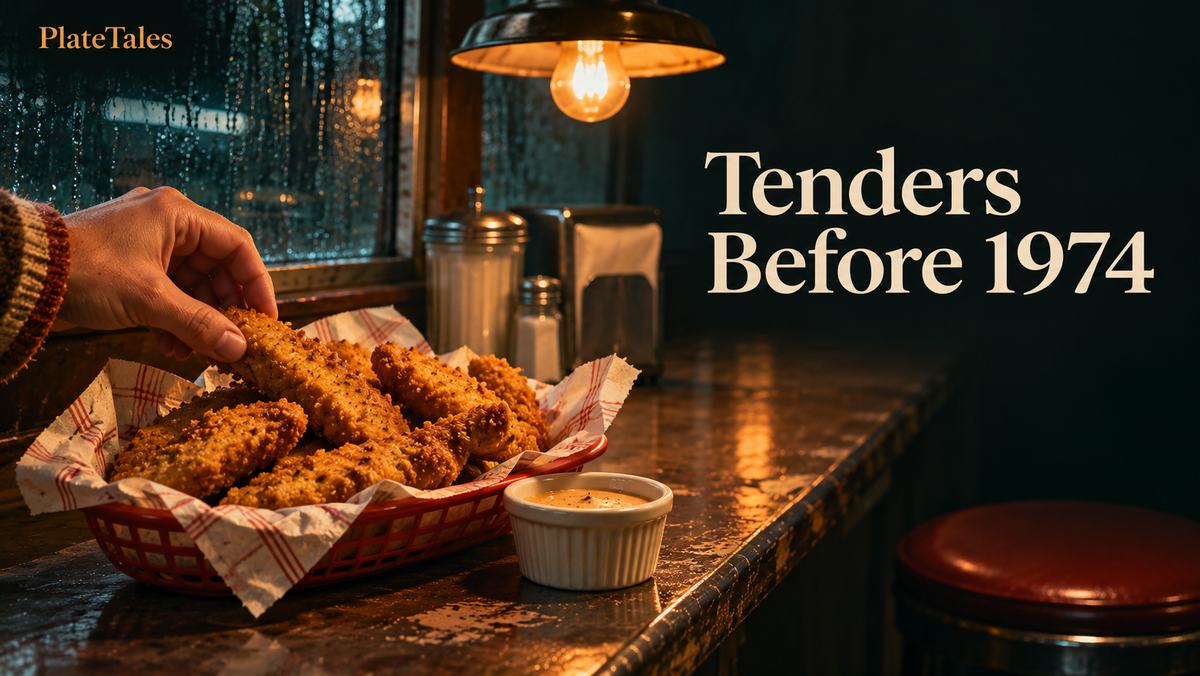
Chicken tenders have an official birthday, and a paper trail that disagrees with it. A restaurant in Manchester, New Hampshire, the Puritan Backroom, says it first served chicken tenders in 1974. A Pennsylvania newspaper advertised "French Fried Chicken Fingers" eight years earlier, in 1966. Both can be true, because the word and the dish are not the same thing.
The 1974 claim from Manchester
The Puritan began as a candy and ice cream shop. Greek emigrants Arthur Pappas and Louis Canotas opened it as the Puritan Confectionery Company in 1917. In 1974 their children built a sit-down restaurant behind the shop, and that room became the Puritan Backroom.
Chris Pappas, a family member who later went into politics, gave the family version in an email quoted in 2015 by the blogger behind Cow Hampshire. When the Backroom opened, the kitchen was serving boneless chicken breasts cut from larger portions. Trimming those breasts left small strips of meat. Instead of throwing them out, the cooks marinated and fried them. "That was the origin of our chicken tenders in 1974," the email says.
The numbers in that email are specific. Tenders were on the menu by the end of the first year, and the restaurant sold 12,000 pounds of them in the week before Christmas the previous year. A USA Today profile in December 2015 carried the claim to a wider audience, and the restaurant's own news page quotes that profile's wording that it "is believed to be the birthplace of the chicken tender."
An archived copy of the restaurant's website, cited by the blogger, was blunter: "Chicken tenders actually originated at the Puritan." Between the website and the later quote, the confidence varies, and the email itself carries an impossible date (31 September 2015), so even the paper trail for the family account is a little loose.
Note the hedge in the newspaper wording. The restaurant itself describes the claim as a belief.
Chicken fingers were already on menus
The Cow Hampshire blogger went looking in old newspapers and found an advertisement in the Standard-Speaker of Hazleton, Pennsylvania, dated 12 February 1966. Mussari's Sun Valley Restaurant, on the highway between Hazleton and Wilkes-Barre, was offering "French Fried Chicken Fingers." That is eight years before the Backroom opened, and it describes a fried product.
A 2023 search by Taste magazine pushed the trail back further, with caveats. The 1948 write-up of a Saugus, Massachusetts, restaurant is the earliest mention of fried chicken fingers that Taste found, calling them "deliciously crisp." A 1909 card-party menu in a Columbia, South Carolina, newspaper listed chicken fingers as a course, but with no recipe, so nobody can say what they were. A 1952 St. Louis recipe called "chicken fingers" turned out to be squares of pie crust topped with shredded chicken in a soup mixture and then fried.
The Cow Hampshire post turned up more oddities. A newspaper in Elizabeth City, North Carolina, printed a "Chicken Fingers" recipe in 1893, but it was a cold finger sandwich. In 1942 several papers ran "chicken finger" sandwich recipes. A 1961 article in Wellsville, New York, listed chicken fingers among poultry products without describing them. Baby-food makers advertised "Chicken Sticks" for toddlers in 1964, and the blog also relays a report that a man named Robert Baker devised "chicken sticks" in the 1950s and published the idea without a patent.
| Year | Place | What the record shows |
|---|---|---|
| 1909 | Columbia, South Carolina | "Chicken fingers" on a card-party menu, no description |
| 1948 | Saugus, Massachusetts | Fried chicken fingers praised as crisp |
| 1952 | St. Louis | A recipe called chicken fingers, made on pie crust |
| 1966 | Hazleton, Pennsylvania | Newspaper ad for French fried chicken fingers |
| 1974 | Manchester, New Hampshire | Family says tenders first served |
Chicken tenders, fingers and strips
So is there a difference? The Manchester restaurant says there is, at least in name. Asked by the Taste writer about the older fingers, the restaurant's answer was a short one: "Chickens don't have fingers." It said it knew of no earlier maker of tenders.
That points to a narrower claim than "invented the chicken tender." What the Puritan can credibly say is that it put the word "tenders" on a menu in 1974 and built a local following around the product. The Cow Hampshire blogger reached a similar reading: fried chicken fingers were being advertised by 1966, so the 1974 claim applies to the term.
The word matters because a name is the only thing a menu can claim. Nobody holds a patent on a trimmed piece of breast,. A restaurant can only be first to call something by a new name, or first to sell it in volume.
The names also point at different cuts. Chicken tenders, as the word is used in the Puritan's account, came from the narrow muscle beside the breast and from trimmings. Older ads for fingers and strips rarely say which cut they used.
The Taste writer called the origin story "a mess," with "no one truth," and argued that nobody invented chicken fingers, which were probably around long before anyone wrote them down.
For the wider family of fried chicken, see the history of Southern fried chicken. For boneless chicken shaped and sold in pieces, see who invented chicken nuggets.
Chicken tenders in print, 1982 onward
The Taste writer also found a 1982 menu from an inn in Aurora, Ohio, that listed "Fried Chicken Tenders." That is the earliest printed use of the exact phrase the search turned up, and it comes eight years after Manchester, from Ohio. It does not prove the term spread from the Puritan, only that it was on menus in the early 1980s.
The Puritan version is a story of a trimming turned into a menu item. Other stories in that vein are collected under accidental inventions, and a neighbor in the sauce-and-fried-chicken world is the Buffalo wing.
The Taste writer, after all that digging, invited readers to send primary evidence of "chicken tenders" sold before 1974 and had not found any. That absence is the strongest point in the Puritan's favor, though an absence in the papers one writer could search is only that.
Questions people ask
Who invented chicken tenders?
The Puritan Backroom in Manchester, New Hampshire, says it first served chicken tenders in 1974, made from trimmings of boneless breasts that were marinated and fried. The claim comes from the restaurant and the Pappas family. Fried chicken fingers were advertised in Pennsylvania in 1966, so the claim fits the word "tenders" best.
Are chicken tenders the same as chicken fingers?
Today most menus use the names interchangeably. In the historical record they are not identical. Chicken fingers appear in newspapers from 1909 on, sometimes as sandwiches or pie-crust squares, while the Manchester restaurant says it chose "tenders" in 1974 and that "chickens don't have fingers."
Were chicken fingers around before 1974?
Yes. A newspaper in Hazleton, Pennsylvania, ran an ad for French fried chicken fingers on 12 February 1966, and a Saugus, Massachusetts, restaurant was praised for crisp fried chicken fingers in 1948. Earlier uses from 1893 to 1952 describe other dishes, such as cold sandwiches and pie-crust squares.
What is the Puritan Backroom?
It is a family restaurant in Manchester, New Hampshire, built in 1974 behind the Puritan Confectionery Company, a candy and ice cream shop opened in 1917 by Greek emigrants Arthur Pappas and Louis Canotas.
Filed under Accidental Inventions
Want more stories like this?
One food history story, every week. No spam, just the stories behind what the world eats.