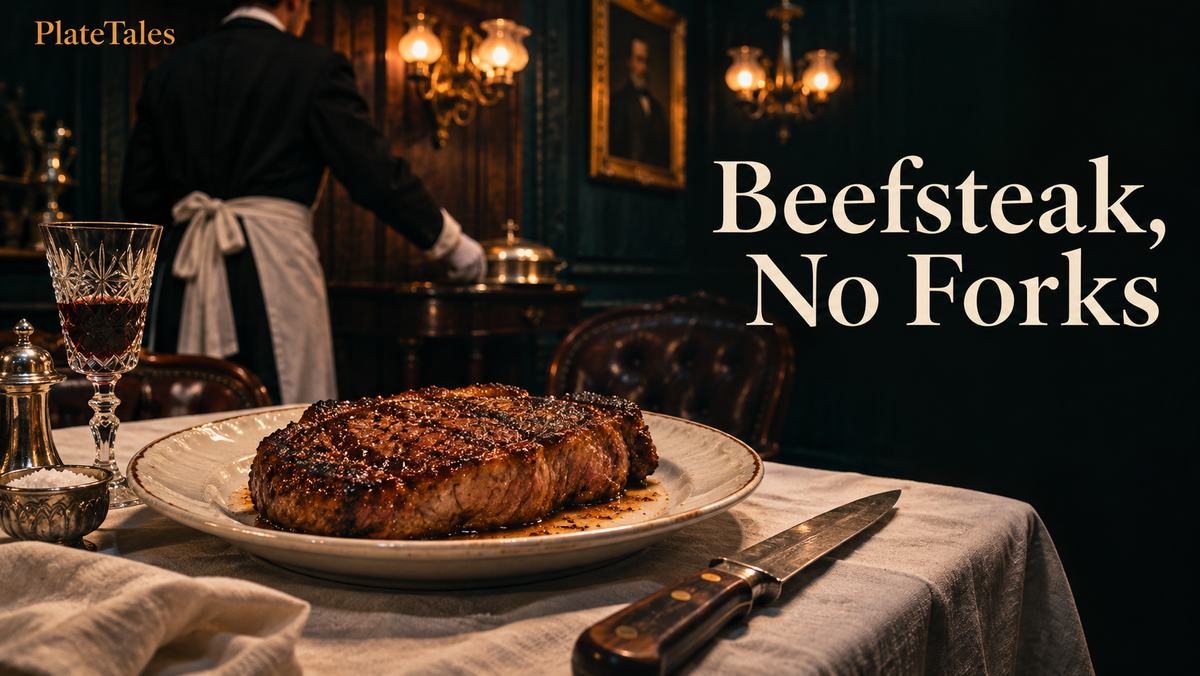
The American steakhouse starts in New York, with Delmonico's on Beaver Street in 1837, with chophouses that sold mutton and beef by the chop, and with a working-class party called the beefsteak. Peter Luger's began in 1887 as a Brooklyn billiards hall. Chicago's Union Stock Yards, which opened on December 25, 1865, supplied the cattle behind all of it.
Delmonico's: the steak, the date problem and a room upstairs
The Delmonico brothers started with a small shop. By the restaurant's own account it sold pastries, coffee, chocolate, wines and Havana cigars, and its success let the brothers buy a triangular plot where Beaver, William and South William Streets meet. The restaurant opened there in 1837, at 56 Beaver Street. Delmonico's calls it the first fine dining restaurant in the country.
The dates do not line up neatly. Britannica gives 1827 for Delmonico's and calls it the first restaurant in the United States where patrons ordered from a menu, instead of eating whatever had been cooked that day. The 1837 date is the Beaver Street building, and the 1827 date is the family's start in business.
The Beaver Street house sold privacy. Its private dining rooms were on the third floor, and the basement held what the restaurant describes as the largest private wine cellar in the city, about 1,000 bottles. Early in those years, the restaurant says, Chef Alessandro Fellippini began to build its reputation around a house special, the Delmonico steak. In 1862 Charles Ranhofer became chef de cuisine, and the restaurant credits him with eggs Benedict, baked Alaska and lobster Newburg. Britannica notes that the Benedict story is only one of several, and that some sources place it in the 1860s and others in the 1890s.
Ask what a Delmonico steak actually is and the answer slips. Britannica says it is most commonly associated with the rib eye, that it was traditionally broiled with salt, pepper and butter and topped with herbed butter, and that the exact cut used originally is debated. Britannica adds that the term is also used as another name for a club steak. So a menu line that says Delmonico steak names a tradition more than a single piece of beef.
Delmonico's was a restaurant of private dining rooms and a long menu, not yet a steakhouse. The steak was one house special among its dishes.
Chophouses and the first steakhouses
Before anyone said "steakhouse," New Yorkers ate meat in chophouses patterned on London's, serving chops of beef and mutton, kidneys and bacon. A hobbyist food-history page, the Kitchen Project, describes them as often dusty and dank, nothing like Delmonico's, and aimed at merchants and vendors who wanted a plain meal.
That page lists three New York houses from the period that are still in business: Old Homestead, opened in 1868, Keens, opened in 1885, and Peter Luger, opened in 1887. Keens is known for its mutton chop, not beef. The list says something. The American steakhouse was not born with a steak. Mutton was the early star in New York, and beef took over as the supply behind it changed.
Peter Luger: a billiards hall in Williamsburg
The Peter Luger that people queue for began as something else. By the restaurant's own history, it opened in 1887 as "Carl Luger's Cafe, Billiards and Bowling Alley" in Williamsburg, Brooklyn, a neighborhood that was largely German then. Peter Luger owned the place, and his nephew Carl worked the kitchen.
The Williamsburg Bridge opened in December 1903, and the restaurant says a new crowd of Manhattan businessmen began crossing the East River. In 1920 a seventeen-year-old named Sol Forman, who had left high school to light street lamps, set up a metalwork firm with his siblings at 185 Broadway, across from Luger's. The firm made silverware, trays and stamped-metal giftware, and Forman took clients across the street to eat. He was known, the restaurant says, to eat two steaks a day, three when trade shows came through.
After Peter Luger died the place fell into disrepair. Sol Forman went to the auction as the only bidder and bought it for the price of the real estate. The restaurant dates the purchase to 1950. That story is the restaurant's own telling, and no second account was checked for this article.
What Forman bought, he rebuilt around the meat. His wife, Marsha Forman, was given the job of buying it. She spent two years learning the skill from a retired USDA grader, who took her through the wholesale meat houses along Manhattan's West Side Highway. The restaurant says it still buys only USDA Prime beef, which it says is often less than 2 percent of graded cattle, and ages the short loins on site. The place that sold billiards and bowling in 1887 sold steaks by the 1950s because a regular customer bought it.
The beefsteak banquet: no forks, no women
The steak did not only reach the public through restaurants. A parallel tradition, the beefsteak, belonged to clubs, unions and political machines.
The Museum of the City of New York traces the earliest beefsteak dinners to the Birth Day Union, a group of thirteen men honoring George Washington who met every Washington's Birthday at Shannon's Corner, at Market and Monroe Streets in lower Manhattan. The museum holds the group's constitution, dated 1844. The tavern keeper there, Anton W. "Uncle Billy" Miller, is considered by some accounts the father of the New York beefsteak.
The rules were simple. The steak was broiled, often on a hickory-fired stove, and served with gravy-soaked bread and ale. No knives or forks were allowed. Diners ate with their hands and wiped them on big napkins or aprons. Early rooms were cellars and taverns, nicknamed "dungeons," where men sat on crates and kegs.
One 1894 invitation from William Miller, Anton's son, promised "the enjoyment of Beefsteak and Ale, to be prepared and devoured in old original style." Anton retired in 1888 and moved his stove to the cellar of William's carpentry shop on East 40th Street, which became a known venue in the 1890s.
Women were shut out at first. The museum notes that later dinners became coed, and that women attended and arranged the Millers' dinners. After 1920, when women gained the vote, politicians began inviting them, and the dinners grew more formal, with salads, orchestras and eventually utensils.
The fad ran from the mid-1800s through the First World War. In the New Jersey counties of Bergen and Passaic, it never really stopped.
Why is steak American? The stockyards behind the American steakhouse
Steak became an American restaurant staple partly because of where the cattle went. Chicago's Union Stock Yards opened on Christmas Day, 1865, gathering the city's scattered stockyards into one place beside the railroads.
The Chicagology history of the yards gives the site as 320 or 345 acres, depending on the 1865 or 1971 newspaper. Octave Chanute, chief engineer of the Chicago & Alton Railroad, won the design contest over about twenty others and became the yards' chief engineer. The Chicago Tribune of December 29, 1865, called them "the finest stock yards in the world."
The volume grew fast. In 1873 the yards received about 761,428 cattle and more than 4.3 million hogs, and the 1924 peak was over 18.6 million head of livestock in a single year. At its height the yards and affiliated industries employed about 40,000 people.
Those numbers are why a big-city restaurant could make beef the main event and not an occasional treat.
Where the steak stands among other American beef
Beef shows up elsewhere in American food as a cheaper, quicker thing. Chicken-fried steak treats an inexpensive cut with a breading, and the thin-sliced steak in a Philadelphia cheesesteak is a sandwich story. The steakhouse is the version where the cut is the whole point. Its side dishes have their own history too, such as the salad in the history of the salad bar. For the wider pattern of food as identity, see Cultural Identity.
Joseph Mitchell's 1939 New Yorker essay on the beefsteak, titled "All You Can Hold for Five Bucks," describes the tradition, the Museum of the City of New York notes. By then the dinners had moved from taverns to hotels, clubhouses and rooftops.
Questions people ask
What was the first steakhouse in America?
No one can name a single first. Delmonico's opened its Beaver Street restaurant in New York in 1837 and sold fine dining, a steak menu. Old Homestead (1868), Keens (1885) and Peter Luger (1887) are three early New York houses still in business. Chophouses selling chops and steaks existed in the city before any of them.
What is a Delmonico steak?
A Delmonico steak is a cut named for Delmonico's restaurant in New York. Britannica says it is most commonly associated with the rib eye, traditionally broiled with salt, pepper and butter, and that the original cut is debated. The name is also used for a club steak, so the label does not guarantee one piece of beef.
How did Peter Luger become a steakhouse?
Peter Luger opened in Williamsburg, Brooklyn, in 1887 as Carl Luger's Cafe, Billiards and Bowling Alley. By the restaurant's own history, Sol Forman, a metalwork manufacturer across the street who ate steak daily, bought it at auction in 1950 and rebuilt it around USDA Prime beef.
What was a beefsteak banquet in New York?
A beefsteak banquet was an all-you-can-eat dinner of broiled beef served with bread soaked in gravy and ale, eaten without knives or forks. Clubs, unions and political groups held them in New York from the mid-1800s. Early ones were men only, in cellars and taverns, and later ones included women.
Why did the Union Stock Yards matter for steak?
The Union Stock Yards in Chicago opened on December 25, 1865, and by 1873 received about 761,428 cattle in a year. By 1924 the yards handled over 18.6 million head of livestock annually. That volume of cattle in one place beside the railroads is the supply behind the American habit of beef as a restaurant centerpiece.
Filed under Cultural Identity
Want more stories like this?
One food history story, every week. No spam, just the stories behind what the world eats.