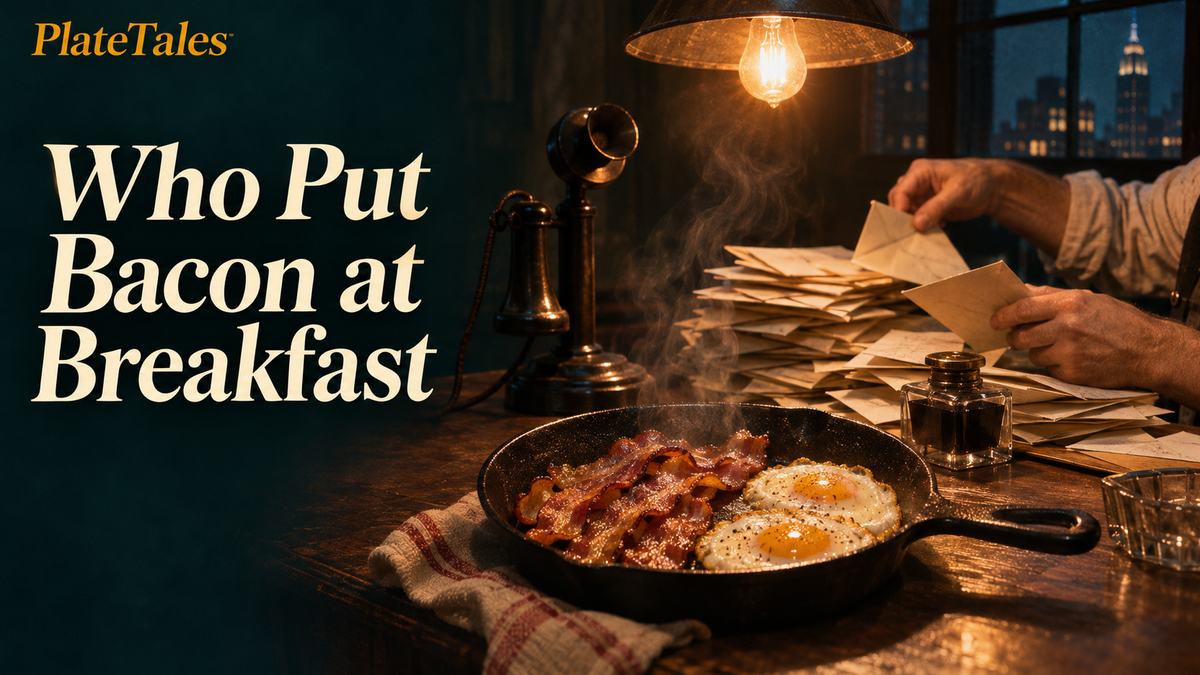
Bacon and eggs are breakfast food because English households were already eating them in the morning by the 1600s, and Victorian cookbooks made them standard. Then, in the 20th century, a New York publicist named Edward Bernays got thousands of doctors to endorse a heavy breakfast for a bacon packer. The word itself is plain: breakfast is the meal that breaks the night's fast.
The word turned up in written English around the 15th century. Putting fried pork and eggs into the meal took longer. The version that circulates online, where one clever PR man invented the American breakfast from nothing, gets the order wrong. Bernays sold more bacon. He did not put it on the plate.
Did Edward Bernays make bacon and eggs breakfast food?
He did not invent the pairing, and he never said he had. What he claimed was narrower: that he raised bacon sales for a client.
Bernays was born in Vienna in 1891 and was Sigmund Freud's nephew twice over. His mother, Anna, was Freud's sister, and his father was the brother of Freud's wife, Martha Bernays. His working method was to skip the public and persuade the people the public already trusted.
NPR's Alix Spiegel put the popular version in two lines in 2005. "Years ago, Americans grabbed toast and coffee for breakfast," she wrote, and Bernays used his uncle's ideas to convince the public "that bacon and eggs was the true all-American breakfast."
The client was the Beech-Nut Packing Company of Canajoharie, a town in New York's Mohawk Valley. It started in 1891 as the Imperial Packing Co., and ham and bacon were its main products for its first seven years. It took the Beech-Nut name in 1899. The chewing gum that later made the brand famous did not arrive until 1910.
Where does the "5,000 doctors" story come from?
Every retelling repeats the same figure, and almost none say where it comes from. It comes from Bernays himself. A clip of him telling the story on camera was uploaded to YouTube in 2014 under the title "Edward L. Bernays Beech-Nut Packing Co". It runs two minutes and 25 seconds, and nobody has dated the filming.
In it, he says his firm found that Americans ate a very light breakfast: coffee, maybe a roll and orange juice. The firm then went to a physician, who agreed that a heavy breakfast was better for health, on the theory that the body loses energy during the night. Bernays asked the doctor to write, "at no cost," to 5,000 other physicians and ask whether they agreed.
About 4,500 answered, and by his account they all concurred. The result went to newspapers around the country, under headlines saying that 4,500 physicians urged a bigger breakfast. Other stories said bacon and eggs should be part of it. "The sale of bacon went up," he says.
What is missing from his account?
The doctor is never named. No year is given. No copy of the original newspaper story turned up in the research for this article, and the headline wording shifts from one retelling to the next.
The 5,000 is a publicist's number describing a publicist's success. Treat it as his memory, not as a survey.
When did the bacon campaign happen?
The usual answer is the 1920s, and the best evidence is a book. In 1928 Bernays published Propaganda, his manual for the new trade, and the bacon method is in it almost step by step.
"Suppose the old type of salesmanship, acting for a meat packer, was seeking to increase the sale of bacon," he writes. The old salesman would run full-page ads: "Eat more bacon. Eat bacon because it is cheap, because it is good, because it gives you reserve energy." The new one would first ask who influences the eating habits of the public. "The answer, obviously, is: 'The physicians.'"
He presents it as a made-up example. It does show the technique was in print by 1928, which fits the usual dating, but no source read for this article fixes the year of the Beech-Nut campaign.
When did bacon and eggs become breakfast?
About 260 years before Beech-Nut hired its publicist, the same plate was being recommended in England for the same reason: health.
Sir Kenelm Digby was born on July 11, 1603. His father, Sir Everard Digby, was one of the Gunpowder Plotters and was executed when Kenelm was not yet three. The son grew up to be a courtier, a privateer, a natural philosopher and a keen amateur cook. He died in Covent Garden on June 11, 1665.
In 1669 his recipes came out in London as The Closet of the Eminently Learned Sir Kenelme Digbie Kt. Opened, with more than a hundred ways to make mead and metheglin (spiced mead). Someone else prepared it for the press from his notes after he died.
Just after a recipe for pan cotto, a bread soup made "as the Cardinals use in Rome," comes "a wholesom course of diet." For breakfast it suggests one of those broths, or panada (another bread soup), cream of oatmeal, barley, or two new-laid eggs, with dinner at four or five o'clock. Then comes the line the internet half-remembers:
Two Poched Eggs with a few fine dry-fryed collops of pure Bacon, are not bad for break-fast, or to begin a meal.
Collops are slices. "Not bad" is as warm as the endorsement gets. Because the book was put together after Digby's death, nobody can be sure every line is his. Still, it is the passage behind the claim that bacon and eggs were a breakfast by the 17th century, and like Bernays's campaign, it is framed as advice for staying well.
How did bacon and eggs end up on the Victorian breakfast table?
For much of the Middle Ages, the English upper classes did not make much of a morning meal. Breakfast was for laborers, children, the old and the sick. Tudor doctors argued about it, and in 1589 Thomas Cogan wrote that it was unhealthy for adults to skip it. When tea reached Britain in the 1600s, the morning meal gained a drink worth sitting down for.
The cooked spread arrived in print in 1861 with Isabella Beeton's Book of Household Management. Her chapter on breakfasts offers "the following list of hot dishes" for "the comfortable meal called breakfast." It runs from broiled mackerel, whiting and herrings to mutton chops, rump steaks, sheep's kidneys and sausages. Then come "plain rashers of bacon, bacon and poached eggs, ham and poached eggs," omelets and boiled eggs.
Elsewhere she labels broiled rashers "a Breakfast Dish," at 10d. to 1s. a pound for the best cuts. Cold bacon left from the day before, she adds, "answers very well for breakfast."
Most of that list has since dropped away. The kidneys and the mackerel went. The bacon and eggs stayed, and became the core of the British full breakfast, which was at its most popular in Edwardian homes in the early 1900s.
What did Americans eat for breakfast before Bernays?
Here the sources disagree. Bernays said his research found Americans eating coffee, a roll and orange juice. NPR says toast and coffee. American cookbooks from before his campaign describe something much heavier.
Fannie Farmer's Boston Cooking-School Cook Book first came out in 1896. Its 1910 printing has a chapter of sample breakfast menus, and one reads, in full: strawberries, hominy with sugar and cream, "Bacon and Fried Eggs," baked potatoes, rye muffins and coffee. Others offer boiled ham, beefsteak with Lyonnaise potatoes, warmed-over lamb or corned beef hash. Her fried ham is served "with fried eggs cooked in the dried-out ham fat."
Both accounts can be partly right. Farmer wrote for Boston households with a cook and a kitchen range, so her menus show an ideal, not what most families ate. Bernays may have been pushing against a real drift toward lighter breakfasts. But his research was never published in any source read here, and Farmer's menus are in print. The claim that he converted a nation of toast-eaters is the weaker one. On his own telling, he pushed up sales of something people already ate.
Why do we eat cereal for breakfast too?
The same Farmer menus are full of cereal, much of it branded: Quaker Rolled Oats, H-O, Wheatlet, Old Grist Mill Toasted Wheat, Pettijohn's, each served "with Sugar and Cream." The back pages carry an advertisement for Malt Breakfast Food at 15 cents a package. Cereal had its own health argument, pushed by John Harvey Kellogg and his rivals, a story told in how cornflakes were invented to curb desire.
Bernays saw the contest clearly. Propaganda quotes a speech about "the great war on the dining-room table," where three meals a day were a fight between industries. "Shall we have prunes for breakfast? No, cry the embattled orange-growers and the massed legions of pineapple canners."
In that fight, bacon was one army among several. Bernays's bet was that a doctor's letter would beat a full-page ad.
Who decided what breakfast food is?
No single person. Digby's book called bacon and eggs "not bad" for the morning in 1669. Mrs. Beeton put them on her list of hot dishes in 1861. Fannie Farmer printed "Bacon and Fried Eggs" on a Boston breakfast menu. Bernays, working for a Canajoharie ham packer, found a doctor and, by his count, 4,500 colleagues willing to say a heavy breakfast beat a light one, and let the newspapers do the rest.
He told the bacon story on camera years after the campaign. Edward Bernays died in Cambridge, Massachusetts, on March 9, 1995, at the age of 103.
Questions people ask
Were people eating bacon and eggs for breakfast before the 1900s?
Yes. A 1669 English cookbook of Sir Kenelm Digby's recipes called two poached eggs with fried slices of bacon "not bad for break-fast." Isabella Beeton listed bacon and poached eggs among her hot breakfast dishes in 1861, and Fannie Farmer's Boston cookbook printed "Bacon and Fried Eggs" on a sample breakfast menu.
Who was Edward Bernays?
Edward Bernays was a New York publicist born in Vienna in 1891, a nephew of Sigmund Freud. He wrote Propaganda in 1928 and worked by persuading trusted figures, such as physicians, instead of the public directly. He died in Cambridge, Massachusetts, on March 9, 1995, aged 103.
Did 4,500 doctors really endorse a heavy breakfast for Beech-Nut bacon?
The figure comes from Bernays himself, in a filmed account of unknown date. He said about 4,500 of 5,000 physicians agreed that a heavy breakfast was healthier, and bacon sales rose. The doctor who sent the letter is never named, and no copy of the original newspaper story was found, so treat it as his memory.
What did Victorian Britons eat for breakfast?
Isabella Beeton's 1861 Book of Household Management lists hot dishes such as broiled mackerel, whiting and herrings, mutton chops, rump steaks, sheep's kidneys and sausages. It also lists rashers of bacon, bacon and poached eggs, ham and eggs, and omelets. The kidneys and fish later dropped away, while bacon and eggs became the core of the British full breakfast.
Filed under Origin Stories, Cultural Identity
Want more stories like this?
One food history story, every week. No spam, just the stories behind what the world eats.