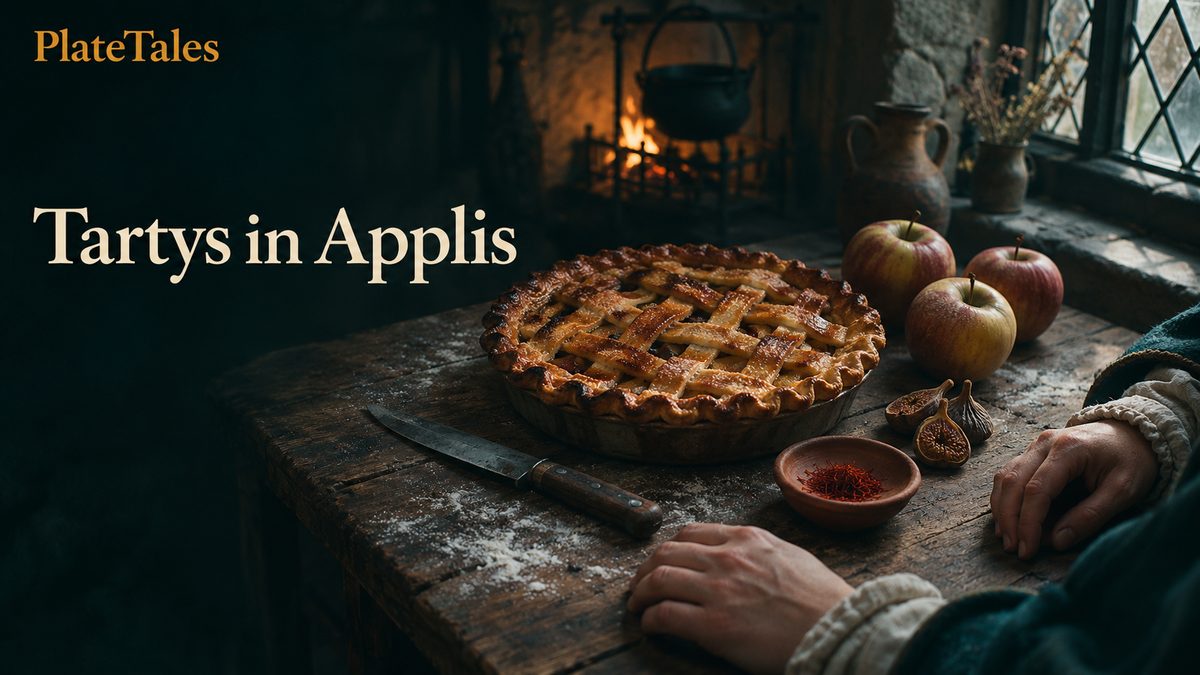
Apple pie starts in England, not America. The oldest recipe in the English record is "Tartys in Applis" in the Forme of Cury, a cookbook of the master-cooks of King Richard II, compiled about 1390. By the time Amelia Simmons printed two apple pie recipes in Hartford, Connecticut, in 1796, the pie had crossed the Atlantic and picked up a new name for its owner.
What the Forme of Cury actually says
The recipe is number XXIII in the Project Gutenberg text of the Forme of Cury, and it is short enough to read in one breath. In the spelling of the roll: "Tak gode Applys and gode Spycis and Figys and reysons and Perys." Beat them well together, colour them with saffron, put the mixture in a "cofyn" and bake it well.
That is the whole instruction. No sugar is named. No quantities, no oven temperature, no time.
The fruit mix is the surprise. Apples share the coffin with figs, raisins and pears, and the saffron colours the filling. Nobody reading it today would guess the dish from the ingredients alone.
The editor of the printed edition glossed "coffyns" in another recipe as "Pies without lids." So the first apple pie on record was not the domed pie of a children's book. It was a pastry box, and an open one.
Is the date really 1381?
You will see 1381 attached to this recipe in many places. The edition on Project Gutenberg gives a different, vaguer date. Its title page reads "Compiled, about A.D. 1390, by the Master-Cooks of King RICHARD II." We found no reason in that text to prefer 1381, so "about 1390" is the safe figure.
The roll did not stay in the kitchen. The title page says it was "presented afterwards to Queen ELIZABETH, by EDWARD Lord STAFFORD." Another owner is named too, one Gustavus Brander, who lent it to the editor for printing.
Was there an apple pie before 1390?
Almost certainly someone baked apples in pastry earlier, but we have no recipe to point at. The Forme of Cury is where the dish is first written down in the sources we could read. That is a statement about paper, not about ovens.
The roll is full of other coffyns, and they show how ordinary the apple tart was. One recipe grinds figs and raisins with apples and pears, adds salmon, codling or haddock, then bakes it in a coffyn an inch deep, topped with prunes and dates. Another, "Tartes of Flesh," packs ground pork, hard eggs and cheese with sugar and saffron into the same kind of case. A third, "Daryols," sets cream, eggs, sugar and saffron in a coffyn two inches deep. The apple tart was one pie among many, and it sits in the book as a sweet one while sugar turns up in the meat.
Sweet things in the English record are often not what we expect. Another English dish that crossed to America and changed on the way is baked macaroni, told in who invented mac and cheese.
Apples arrive in America, and so does the pie
Simmons's book is the other fixed point. Its title page reads "American Cookery," "adapted to this country, and all grades of life," by "an American orphan," printed in Hartford by Hudson and Goodwin in 1796. It is often called the first cookbook by an American author.
It has two apple pies. The first is a plain one: stew and strain the apples, grate in the peel of a fresh lemon, add cinnamon, mace, rose-water and sugar, and bake in paste number 3. The second is a "buttered apple pie," with quartered tart apples under a lid of paste, and sugar, butter, cinnamon, mace, wine or rose-water added after baking, once you gently raise the top crust.
Read those two lists beside the 1390 roll. Spices still dominate, and rose-water and wine still sit in the pastry. The fruit has narrowed to apples alone, and sugar is now named outright. This is the English pie, adapted.
Simmons also wrote about the tree itself. Apples, she says, "are still more various" than pears, and "highly useful in families," and "ought to be more universally cultivated." She suggests that every household set a tree "in some otherwise useless spot," serving "the two fold use of shade and fruit," and graft twelve or fourteen kinds onto it.
Where "as American as apple pie" comes in
The phrase is much younger than the pie. The etymologist Pascal Tregue, on his Word Histories site, found the earliest use he could trace in The Sun and the New York Herald of 4 April 1920. Edwin C. Hill, writing about the Barnum & Bailey circus, said the German army had borrowed "ideas as American as apple pie." It is a joke about efficiency, not about dessert.
Food52's Rossi Anastopoulo, drawing on newspaper searches, gives a few more early dates. A 1924 Gettysburg Times advertisement promised "New Lestz Suits that are as American as apple pie." In 1928 the New York Times used "as American as apple pie or corn pone" to describe the homemaking of First Lady Lou Henry Hoover. The corn pone dropped out, and the apple pie stayed.
The ground had been laid earlier. A New York Times editorial of 1902, as Anastopoulo reports it, called pie "the American synonym for prosperity" and said "No pie-eating people can be permanently vanquished." By the Second World War, she writes, American soldiers were telling reporters they were fighting for "mom and apple pie." Tregue also traces the adjective "apple pie American" to a Rochester newspaper in September 1952, and the tone had turned affectionate by then.
The phrase works because the pie came from somewhere else. John Lehndorff of the American Pie Council is quoted as saying it means the item "came to this country from elsewhere and was transformed into a distinctly American experience." Libby O'Connell, in The American Plate, puts it more bluntly: except for American Indians, "we are all transplants on this continent, just like apple trees."
If anything makes the pie American, it is the cook. Simmons printed it for American kitchens and said so on the title page.
Other origin stories
For more food histories that turn out to start somewhere else, browse the origin stories shelf.
Timeline
| Date | What the source shows |
|---|---|
| About 1390 | Forme of Cury: "Tartys in Applis" with apples, spices, figs, raisins and pears in a coffin, coloured with saffron |
| 1796 | Amelia Simmons, American Cookery, Hartford: an apple pie and a buttered apple pie, plus apple tarts and apple puddings |
| 4 April 1920 | The Sun and the New York Herald prints "ideas as American as apple pie", the earliest use of the phrase its tracer found |
| 1928 | New York Times applies "as American as apple pie or corn pone" to Lou Henry Hoover, as reported by Food52 |
Questions people ask
Is apple pie American?
Apple pie is not American in origin. The earliest recipe we found is "Tartys in Applis" in the Forme of Cury, compiled in England about 1390 by the master-cooks of King Richard II. Amelia Simmons printed two apple pie recipes in Hartford, Connecticut, in her 1796 cookbook American Cookery.
What is the first apple pie recipe?
The first recipe we could read is number XXIII in the Forme of Cury, compiled in England about 1390. It calls for good apples, spices, figs, raisins and pears, coloured with saffron and baked in a pastry case the roll calls a cofyn. It names no sugar and gives no quantities.
Was medieval apple pie sweet like today's?
The medieval recipe in the Forme of Cury names spices, figs, raisins and pears but no sugar, and it is coloured with saffron. It was a fruit tart in a pastry case, an open one according to the editor's note on the word "coffyn." By 1796 Amelia Simmons named sugar outright in her apple pie.
Where does "as American as apple pie" come from?
The earliest use of the phrase that etymologist Pascal Tregue found is in The Sun and the New York Herald of 4 April 1920, where Edwin C. Hill wrote of German army ideas "as American as apple pie." A 1924 Gettysburg Times suit advertisement and a 1928 New York Times piece on Lou Henry Hoover used it too.
Who wrote the first American cookbook with apple pie in it?
Amelia Simmons, who called herself "an American orphan," printed American Cookery in Hartford, Connecticut, in 1796. It contains two apple pies, a plain one with lemon peel, cinnamon, mace, rose-water and sugar, and a buttered one with the sugar and butter added under a lifted top crust.
Filed under Origin Stories
Want more stories like this?
One food history story, every week. No spam, just the stories behind what the world eats.