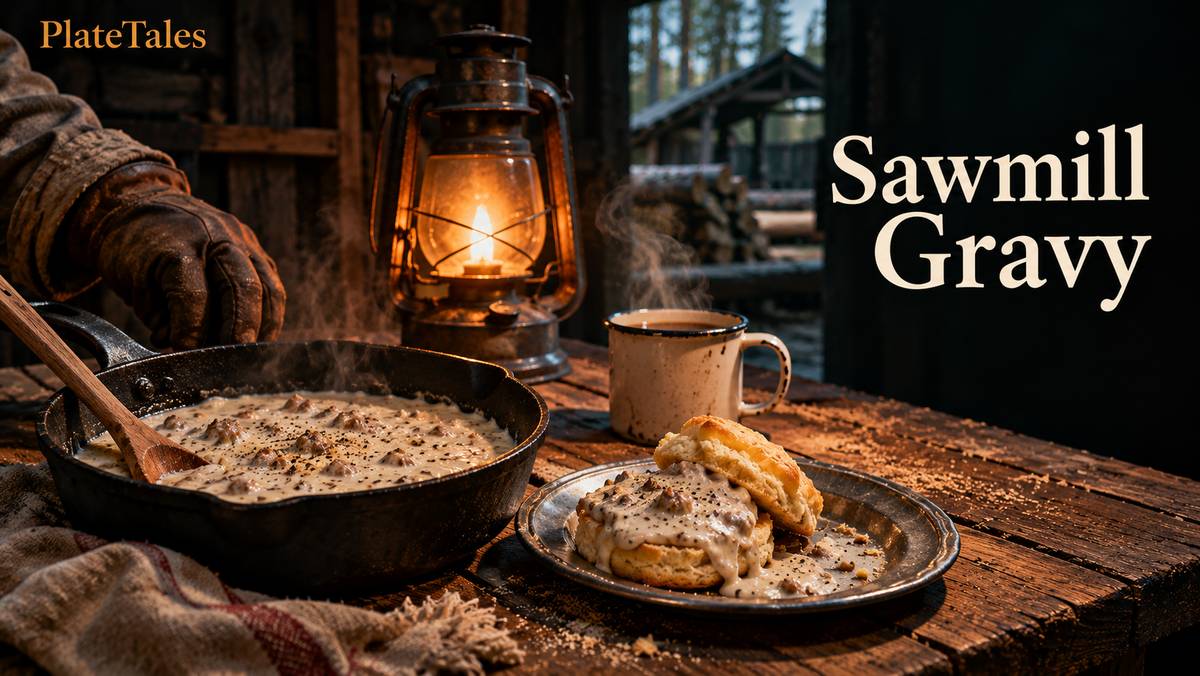
Biscuits and gravy history comes down to a cheap Southern breakfast of pork fat, flour and milk spooned over split biscuits. The most repeated origin puts it in the Appalachian lumber camps of the late 1800s, where the white sausage gravy picked up the name "sawmill gravy." No inventor, first recipe or dated first use of the name has been found, so that origin is lore, not record.
The sawmill story and what holds it up
The tale goes like this. Sawmill and logging crews in Appalachia worked long days on little more than coffee, biscuits and cream gravy, and the gravy took its name from the camps. A 2011 feature in the Jackson Free Press repeats it and says plainly that it rests on "food lore." It names no cook, no camp and no year, and places the dish's rise after the Civil War, when food was scarce.
A 2019 feature by Aaron Hutcherson, run in the Washington Post and reprinted by other papers, is more careful. It says many food writers and culinary historians put the birthplace in southern Appalachia in the late 1800s, and that lumber was one of the region's main industries, which "supports" the sawmill origin of the name. Supports is the right word. It makes the story plausible. It does not date it.
A second folk explanation for the name is about texture. Gregory Hartley, writing in Edible Alaska in 2025, says the gravy was thickened with cornmeal and that loggers grumbled it tasted like sawdust. That is another story told about the name, with no document behind it in the pages consulted for this article. The same goes for the idea that the dish goes back to the Revolutionary War, which the Hutcherson feature mentions as a rival claim and does not back up.
Why pork, flour and milk
The ingredients are easier to document than the name. Heather Arndt Anderson, author of Breakfast: A History, told Hutcherson that the gravy was affordable and made from foods in short supply, and added, "Pork was always the protein of the poor." Sara Roahen and John T. Edge, in The Southern Foodways Alliance Community Cookbook, write that "The Southern way with gravies was born of privation."
Gravy of this kind starts with whatever fat came out of the pan. Sausage, bacon or ham left drippings, flour browned in them, and milk went in if the household had it. Water went in if it did not. The Arkansas Democrat-Gazette's 2019 piece on the subject quotes a writer's grandmother, born in 1928 in Rondo, Arkansas, who remembered "thick gravy" in lean years made from water and an oil-and-flour roux, with no sausage and no cream.
That is a useful reminder. The white gravy sold in diners is one version of a household method, not a single recipe handed down from one camp.
The biscuit underneath
The other half of the plate has its own record. John Egerton, in Southern Food: At Home, On the Road, In History (1987), describes the early beaten biscuit, a dense bread that took vigorous beating and folding and, as quoted by Hutcherson, was often the work of enslaved cooks or domestic servants and could take over an hour. After the 13th Amendment, Egerton wrote, the process "had come to be viewed as too burdensome." An 1877 machine, in his words, "not only saved beaten biscuits from extinction but actually made them smoother, prettier, and more popular than before."
The soft, risen biscuit that sits under modern gravy came with commercial baking powder and soda and cheaper flour, the same feature says. The full story of that bread is in the history of Southern biscuits.
An 1865 plate of biscuits in reindeer gravy
One of the more specific scenes comes from Alaska, not Appalachia. Hartley writes that William Healey Dall, a young naturalist with the Western Union Telegraph Expedition in 1865, described in his journals soaking biscuits in reindeer gravy at Unalakleet and called the dish "telegraph stew." Hartley calls Dall almost certainly the first recorded eater of biscuits and gravy in Alaska.
This is a secondhand report of a journal, and the biscuits in question were most likely hard ship's biscuit, softened in a sauce. It says little about the Southern dish. It does show that bread soaked in meat gravy was an ordinary expedient well before anyone wrote "sawmill gravy" in a cookbook.
The missing paper trail
The sawmill gravy origin has a gap where the paper should be. Egerton noted in 1987 that country gravy was rarely found in cookbooks, according to the Hutcherson feature, and The Joy of Cooking did not add a recipe until its 2006 edition. A dish cooked from memory in kitchens and camps leaves few printed traces.
The dictionary record is thin too. The Dictionary of American Regional English ran a gravy question in its 2013-2014 survey and tallied "gravy" 23 times, "sauce" 5, "drippings" 3, and "fake gravy" and "real gravy" once each. The results say nothing about sawmills. No dated printed use of "sawmill gravy" turned up in the sources read for this article, so its earliest appearance in print is still open.
Arndt Anderson found that the dish moved onto menus late. Quoted in the same feature, she wrote in Portland Monthly that biscuits and gravy "would never have appeared on fancy restaurant or hotel menus in Portland's past," and that by the early 1980s restaurants in that city were advertising it. Out west, it took until then to become something a restaurant would print on a card.
Breakfast neighbors
Biscuits rarely sit alone on the plate. Another cheap Southern grain breakfast, grits, often shares it, and a skillet of hash browns sits beside it at plenty of diners. More lost and half-remembered dishes of this kind are collected in forgotten recipes. The gravy has relatives at the same table. Ronni Lundy's Victuals covers chipped beef gravy and tomato gravy, and the Hutcherson feature mentions red-eye gravy, ham drippings with coffee, remembered by the writer Nicole Taylor from Athens, Georgia.
Questions people ask
Where did biscuits and gravy originate?
Biscuits and gravy came out of the American South. Many food writers and culinary historians place its start in southern Appalachia in the late 1800s, though some accounts reach back to the Revolutionary War. No inventor, first recipe or exact date has been documented for the dish.
Why is it called sawmill gravy?
The usual explanation is that sawmill and logging crews in Appalachia lived on coffee, biscuits and cream gravy, so the gravy took their name. Another story says cornmeal made it gritty like sawdust. Both are lore, and no dated printed use of the name has been found.
Was biscuits and gravy a poor people's food?
Yes. Heather Arndt Anderson, author of Breakfast: A History, says the gravy was cheap and made from foods in short supply, and that "Pork was always the protein of the poor." Sara Roahen and John T. Edge write that Southern gravies were "born of privation."
Was biscuits and gravy on early restaurant menus?
Not widely. John Egerton noted in 1987 that country gravy rarely appeared in cookbooks, and The Joy of Cooking only added a recipe in 2006. Heather Arndt Anderson found that restaurants in Portland, Oregon, were advertising biscuits and gravy by the early 1980s.
Filed under Forgotten Recipes
Want more stories like this?
One food history story, every week. No spam, just the stories behind what the world eats.