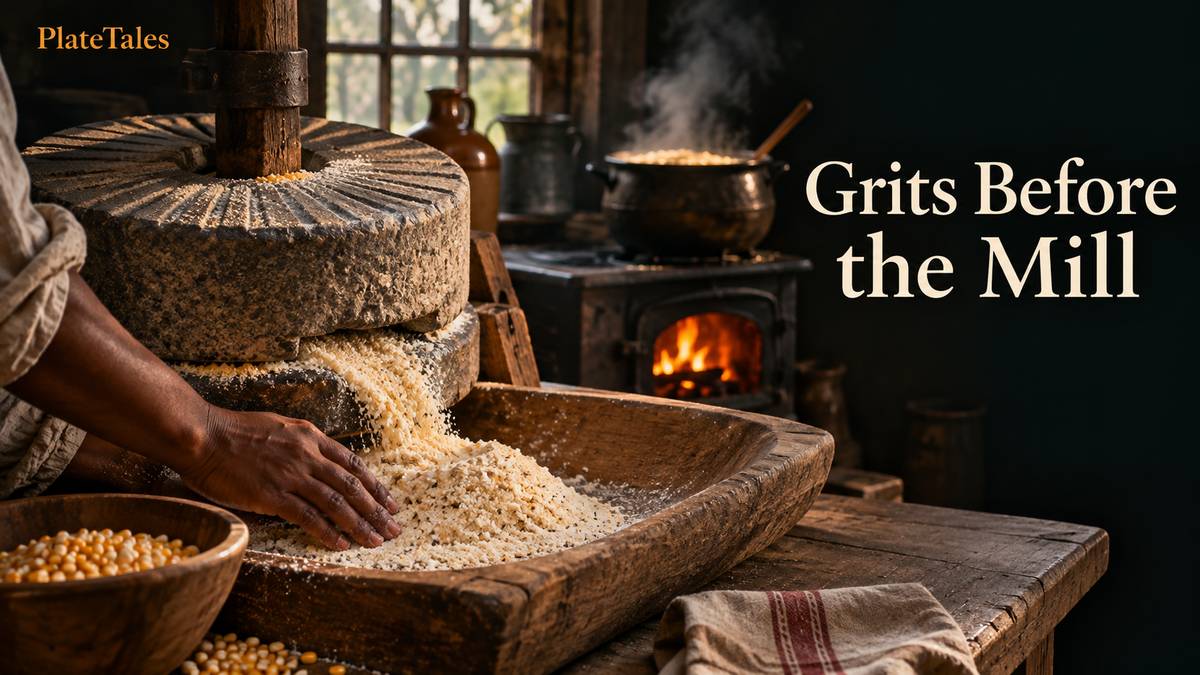
Grits start with Native American corn cooking in the Virginia Tidewater and the word "hominy", which Encyclopedia Virginia traces to a Powhatan suffix meaning "crushed with an instrument". English settlers ate the pounded corn, then ground it on mill stones, and by the 1800s grits had become a Southern staple. Shrimp and grits is far younger as a restaurant dish, and it owes its fame to a Chapel Hill kitchen in the 1980s.
Grits in the Tidewater before the mills
Before there were grits there was a pot. Encyclopedia Virginia, describing cooking in early Virginia Indian society, says Powhatan cooks made hominy by soaking corn kernels overnight, beating them, and then simmering them for ten to twelve hours until soft. The same entry notes that the word itself is Powhatan, a suffix meaning "crushed with an instrument."
The hominy pot was a fixture of daily life. The entry quotes a late seventeenth-century observer who wrote that men were "almost always either eating or sleeping," and went "to the Hominy-pot" at any hour.
Not everything was boiled. The same source describes rockahominy, which was dried, parched corn beaten into a powder. Travelers carried it in a bag, and a few handfuls stirred into stream water made a whole meal. It is the nearest thing in the record to a trail ration, and a long way from a breakfast bowl.
Nobody can say which Native nation first ground corn coarse enough to count as grits, and the sources do not try. What they do show is that pounded and boiled corn, with a Native name, was already in the pot when English colonists arrived at Jamestown in 1607.
Grits vs hominy: two words for different things
People use the words as if they were the same, and in parts of the South they have been. The South Carolina Encyclopedia, in an entry by Stan Woodward, calls hominy "the Native American word for dried corn" and "the name for what we came to call grits." It describes the settlers pounding what English recipe books called "Indian corn" in a wooden mortar.
Food writers who have looked closely draw a line. Erin Byers Murray, in The Local Palate, notes that some people in the Lowcountry call cooked grits hominy, but that true hominy is made from corn that has been nixtamalized, soaked in a lye-based solution to loosen the hull of the kernel. Think of posole.
So the older Powhatan method of soaking and beating was a close cousin of what later cooks call hominy, while stone-ground grits are dried corn milled into pieces. The names drifted together because the pot on the fire looked the same.
How the mill turned hominy into grits
The change from mortar to mill is the part of the story with a paper trail. The South Carolina Encyclopedia reports that research has shown the first flour mills erected by European settlers in Virginia were converted from grinding grain into flour to grinding corn into hominy "grits," corn meal and animal feed.
Corn then pushed wheat aside in much of the South. Grist mills spread until each town had one, and the entry says they became as much a mainstay of a community as the general store.
A stone mill sorted its own work. Grooved stones ground the dried corn, the miller set the stone with wooden pegs to make it coarser or finer, and the vibration shook the product through screens into meal, fine, medium and coarse grits, and bran for animal feed. The miller took ten percent of what he milled as payment.
Two South Carolina mills give a sense of how long this lasted. The Hagood Mill above Pickens ran from 1828 to 1960 and was later restored, and the Ellerbe Mill near Rembert in Sumter County ran from 1835 to 1985.
Steel roller mills changed the product. The encyclopedia says modern grits are one grind, with the germ removed, and made to keep on a shelf. Old-timers it quotes blame the heat of fast-turning rollers for a taste they say stone-ground grits do not share.
What the table looked like
Grits took on whatever sat beside them. The South Carolina Encyclopedia lists red eye gravy, tomato gravy, sausage with sawmill gravy, country ham, country fried steak with onion gravy, fried fish and quail, and shrimp in the Lowcountry. Its line for the purist in the Palmetto State is short: salt and butter.
That plainness is why grits turned up wherever rations were thin. The Local Palate piece describes a few cups of ground corn as part of a weekly ration for laborers, and grits or rice as cheap, filling staples that Lowcountry fishermen dropped into a single pot on long days at sea. For more on how that kind of Southern pantry food was built, see the stories on Southern biscuits and red beans and rice.
Shrimp and grits: older than the menu, younger than the legend
Murray found that the dish was once called shrimps and hominy or breakfast shrimp, and that it was cooked at home, not in restaurants. She gives three early traces. A recipe for breakfast shrimp ran in a syndicated column in the Louisiana Review in 1891. A "breakfast tomorrow" listing in the New Orleans Times-Democrat on May 8, 1895 included "Fried Lake Shrimp. Grillade. Hominy." And the 1930 Charleston cookbook Two Hundred Years of Charleston Cooking, compiled by Blanche S. Rhett, printed a recipe for "shrimps and hominy" credited to her African American butler, William Deas.
Deas is described there as 78 years old and as having eaten the dish every morning in shrimp season for as long as he could remember. Murray points out that crediting a Black cook by name was not common in a cookbook of that time.
An older origin is claimed as well. Murray reports that the food historian Michael Twitty told an audience at the Southern Foodways Alliance symposium in 2016, "I don't care what anyone says; shrimp and grits came from Mozambique," and that he pointed to dishes there that combine corn and shellfish. That is an argument about a shared habit carried across the Atlantic by enslaved people, not a document. Murray herself says the threads connecting the modern dish to its African roots have nearly disappeared.
The chef who put it on a menu
The move from fishermen's breakfast to restaurant plate is easy to date. According to Murray, Bill Neal, a chef raised in Grover, North Carolina, had cooked French food in Chapel Hill before opening a restaurant called Crook's Corner. In 1984 the New York Times food editor Craig Claiborne, a Mississippian, came to North Carolina to tour barbecue and asked Neal to guide him. The visit pushed Neal toward Southern cooking.
Claiborne later wrote Neal up in the Times, with a recipe for shrimp with cheese grits. Murray says the dish "shot into the culinary mainstream" and showed up on menus across the South almost at once.
Robert Stehling, who trained under Neal and later opened a Charleston restaurant, had eaten breakfast shrimp in its original form in Charleston but had never seen shrimp and grits on a restaurant menu. Then it was at every important restaurant in town. He recalls that nearly 40 percent of the orders at Neal's restaurant included it.
The Lowcountry kitchens had cooked shrimp and grits for generations. A New York newspaper column in the 1980s, not a Charleston cookbook, is what set it on menus.
A few dates in order
| Date | What the sources record |
|---|---|
| 1607 | English settlement at Jamestown, where Powhatan hominy was already in use |
| 1828 to 1960 | Hagood Mill near Pickens, South Carolina, grinds corn |
| 1891 | Breakfast shrimp recipe in a syndicated column |
| 1895 | New Orleans listing of "Hominy" with fried shrimp |
| 1930 | "Shrimps and hominy" recipe credited to William Deas |
| 1984 | Craig Claiborne tours barbecue with Bill Neal |
Questions people ask
What is the difference between grits and hominy?
Grits are dried corn ground into coarse or fine pieces. Hominy, strictly, is corn soaked in an alkali such as lye to remove the hull, as in posole. In the Lowcountry, cooked grits were also called hominy, and the word hominy comes from a Powhatan suffix meaning "crushed with an instrument."
Did Native Americans invent grits?
Native Americans cooked hominy, soaked and pounded corn simmered for hours, and Powhatan people gave English the word. Encyclopedia Virginia describes that method for early Virginia. No source consulted names who first milled corn into the coarse meal called grits, and Virginia's early English mills later converted to grinding it.
Where did shrimp and grits come from?
Shrimp and grits began in the Lowcountry of South Carolina and Georgia as shrimps and hominy, a home breakfast and fishermen's one-pot meal. Written traces appear in 1891 and 1895, and a 1930 Charleston cookbook credits William Deas. Bill Neal's version at Crook's Corner in Chapel Hill reached menus after a 1984 visit from Craig Claiborne.
Who made shrimp and grits famous?
Bill Neal, the chef at Crook's Corner in Chapel Hill, North Carolina, is credited with taking shrimp and grits to restaurant menus. After Craig Claiborne of the New York Times wrote him up and printed a recipe for shrimp with cheese grits in the 1980s, the dish spread across the South almost at once.
Filed under Cultural Identity
Want more stories like this?
One food history story, every week. No spam, just the stories behind what the world eats.