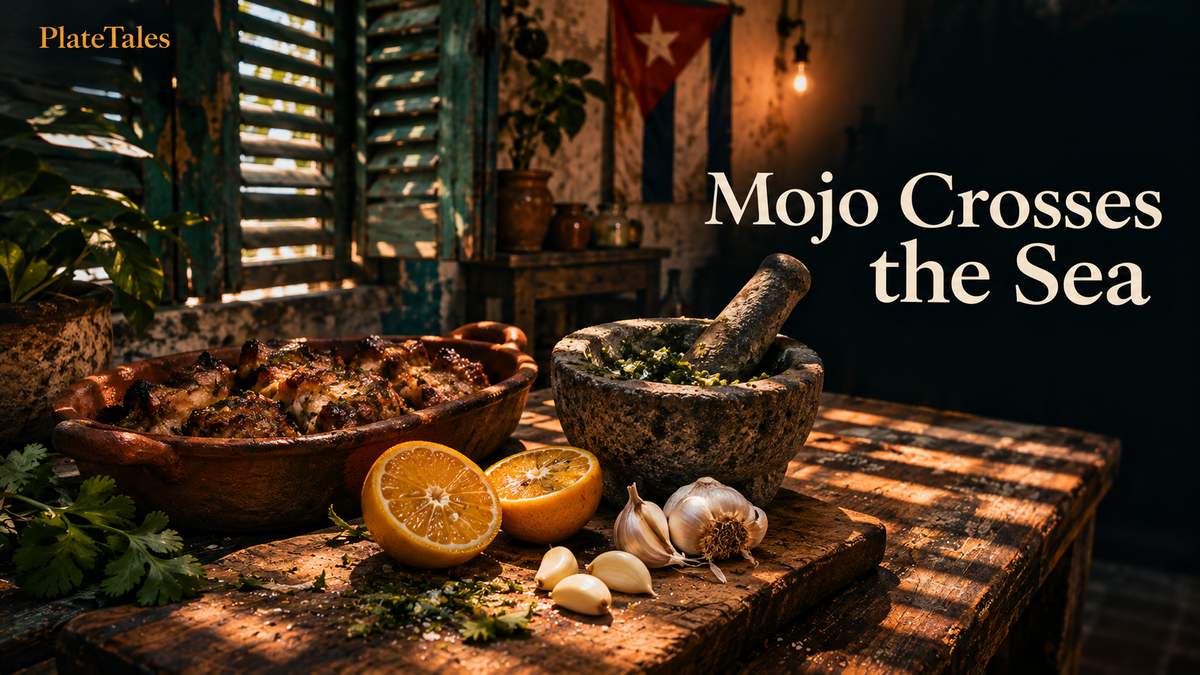
Cuban mojo starts in the Canary Islands, where mojo meant a pounded sauce of oil, vinegar, garlic and peppers. Canarian emigrants carried the idea to Cuba over several centuries. There the vinegar gave way to the juice of the sour orange and the pork fat of the island's kitchens, and the result became the garlic-and-citrus sauce Cubans call mojo criollo. After 1959 the sauce crossed the Florida Straits again, in the memory of exiles.
That is the outline most writers give. The details are thinner than the confident versions suggest, and they are worth taking one at a time.
Two sauces with one name
In a 2021 Saveur piece on Seville oranges, Carlos Olaechea describes a Miami chef, Miguel Massens, who grew up eating Cuban food and later cooked in Andalusia. On a visit to the Canary Islands he tasted mojo and found it different from the one he knew. The Cuban version he knew combined Seville orange juice, lard, garlic and oregano. The Canarian one used wine vinegar, olive oil, chiles, garlic, cumin and smoked paprika.
"Nevertheless, the connection was clear," Olaechea writes of the chef's visit. The pairing of the two sauces is a cook's recognition, not a document, but it is the kind of evidence this history rests on.
| Canarian mojo (as described by Olaechea) | Cuban mojo (as described by Olaechea) | |
|---|---|---|
| Acid | Wine vinegar | Seville orange juice |
| Fat | Olive oil | Lard |
| Heat and spice | Chiles, cumin, smoked paprika | Oregano |
| Base | Garlic | Garlic |
No page read for this article gives a date for the first Canarian mojo. Claims that it goes back to the islands' pre-Spanish people are not backed by anything opened here, so they stay out.
How Canarians got to Cuba
Olaechea writes that many Canarians reached Cuba as early as the 17th century, when officials in mainland Spain believed the islands were overpopulated. He describes a decree he calls the "Tribute of Blood," under which five Canarian families were sent to the American colonies for every ton of goods those colonies shipped to Spain.
Those families were not carrying a recipe book. They carried habits: a mortar, a head of garlic, a taste for something sharp on the side of the plate. Olaechea's account does not say which of these emigrants first cooked mojo in Cuba, and no record he cites names one.
Why sour orange took the place of vinegar
Olaechea says those emigrants, no longer able to grow olives and grapes, "likely adapted" their mojo to local citrus juice and pork fat. The word "likely" matters: no cookbook or letter quoted in these sources catches a Canarian family making the switch. It is an inference, a sensible one.
The orange itself has a documented trail. Olaechea cites Maricel E. Presilla, in her book Gran Cocina Latina, for the view that the fruit probably began in Southeast Asia and reached Spain with Moorish invaders around the turn of the 8th century. For roughly 500 years it was Europe's standard citrus, and the Andalusian city of Seville gave it a name. Seville orange trees were probably the first citrus planted in the Americas, Olaechea writes, after Columbus brought them to Hispaniola on his second voyage in 1493. From there they spread across the Caribbean.
So by the time Canarian farmers arrived with garlic and a mortar, sour oranges were already growing in Cuba. Ana Sofia Pelaez, in The Cuban Table, says that where Seville oranges are missing, equal parts fresh orange and lime juice can stand in for them.
The same loose method shows up elsewhere in the Caribbean. Olaechea quotes Luz Bryson, a Haitian American home cook in Atlanta, who says her mother uses the juice, called zoranj su in Haitian Creole, to clean meat before marinating it. A sauce built on a bitter orange was not a Cuban secret. It was a regional habit that the Canarians arrived into.
Cuban mojo in Miami after 1959
The sauce's second migration began on January 1, 1959. Francis J. Sicius of St. Thomas University, in a paper prepared for the Florida Historical Society's 1988 annual meeting, writes that the first refugees from Castro's Cuba reached Miami that day. The early arrivals were often wealthy and had made arrangements in advance. Soon thousands of penniless people followed.
Housing broke first. Sicius quotes Monsignor Bryan Walsh describing "19 families living in a single family residence." Many later arrivals were middle class: Sicius reports a former appellate judge delivering groceries part-time for $18 a week.
Kitchens came back one at a time. In December 1960, according to Sicius, a man identified as Mr. Abraham, the former owner of a Havana dulceria (a sweets shop), opened a restaurant at the Old Raleigh Hotel on Miami Beach. Sicius says it may have been the area's first Cuban restaurant. Its announcement was short: "We have Cuban food."
The food of that exile has a later biographer. In The Cuban Sandwich: A History in Layers, Andrew T. Huse, Bárbara C. Cruz and Jeff Houck describe a sandwich that became "a symbol for a displaced people," built with roast pork, Cuban bread, sweet ham, Swiss cheese and pickles. Cruz was born in Cuba and is a professor at the University of South Florida, and the book's research covers the Cuban exile experience.
What these sources do not say is as plain as what they do. None of them states what marinade the first Miami Beach kitchen used, and none dates mojo chicken as a South Florida staple. The one firm link is smaller, and it comes from Saveur: Massens, a Miami chef raised on Cuban food, still knew the Cuban sauce as sour orange, lard, garlic and oregano.
For a Cuban plate the sauce pairs naturally with beans and rice, the subject of our history of red beans and rice, and with slow roast pork like the kind described in the history of pulled pork. The wider story of how islanders and their cooking crossed oceans sits in our migration stories.
What the record does not show
Several popular claims could not be confirmed in anything read here: a date for the first mojo in Cuba, the name of the family that first swapped vinegar for juice, and the exact route of mojo-marinated chicken into South Florida.
Sour oranges were already in Cuba. The Cuban and Canarian sauces share a name and garlic, and differ in the acid. Between 1493 and the exile years, someone swapped vinegar for juice, and nobody wrote down who.
Questions people ask
What is mojo sauce?
Mojo is a garlic-based sauce that began in the Canary Islands, where Saveur's Carlos Olaechea describes it as made with wine vinegar, olive oil, chiles, garlic, cumin and smoked paprika. In Cuba the sauce took on Seville orange juice and lard, with oregano, and it is used as a marinade and a sauce for meat.
Where does mojo criollo come from?
Mojo criollo is the Cuban form of the Canarian sauce. Canarians emigrated to Cuba in large numbers, some as early as the 17th century according to Olaechea. They likely replaced vinegar with local citrus juice and pork fat, but no document confirms the exact moment.
Why does Cuban mojo use sour orange instead of vinegar?
Sour orange was already growing in the Caribbean. Saveur reports that Columbus brought Seville orange trees to Hispaniola in 1493 and that they spread across the islands. Canarians who could no longer grow olives and grapes likely used the local juice instead of wine vinegar. That adaptation is an inference, not a documented event.
How did Cuban mojo reach Miami?
It traveled with the exiles who began arriving in Miami on January 1, 1959, according to historian Francis J. Sicius, who also dates what may have been the area's first Cuban restaurant to December 1960. The sources read here do not record which marinade that kitchen used or when mojo chicken became common in South Florida.
Filed under Migration Stories
Want more stories like this?
One food history story, every week. No spam, just the stories behind what the world eats.