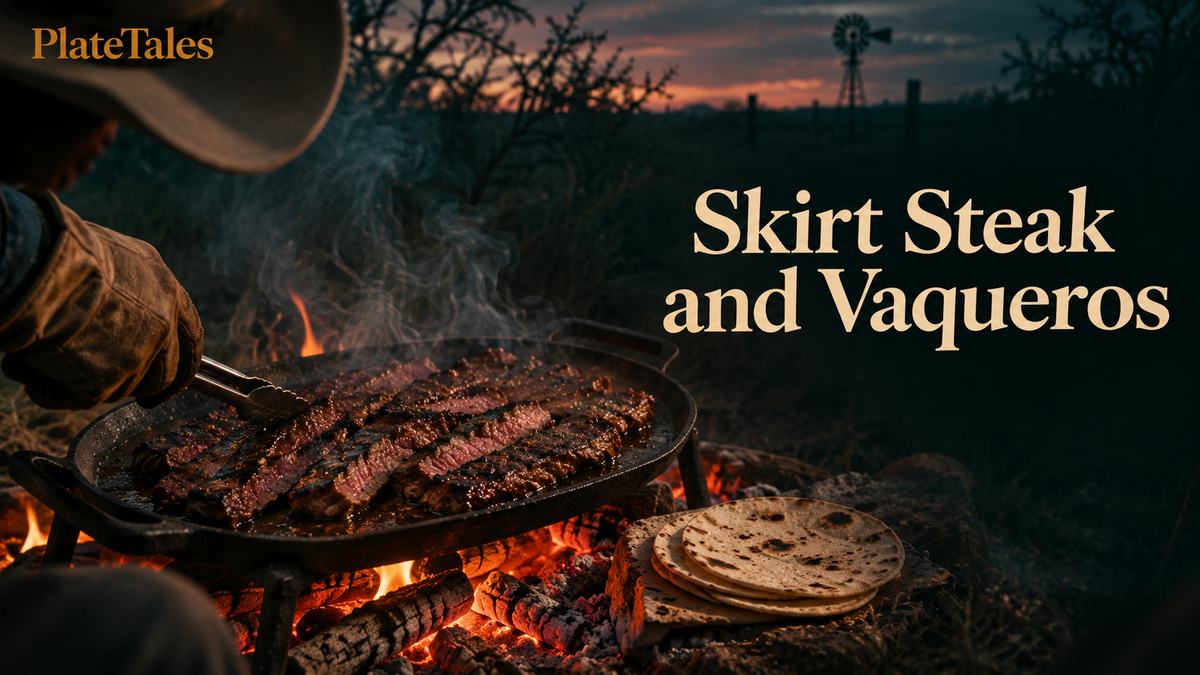
Fajitas began as ranch food in South and West Texas, where Mexican vaqueros were handed the cheap cuts of a steer, skirt steak among them, and grilled them over open fires. The first documented sale came in September 1969, when Sonny Falcon, an Austin meat market manager, ran a fajita taco stand at a Diez y Seis celebration in Kyle, Texas. A Houston restaurant made the dish famous four years later.
Ranch fajitas, before anyone sold them
Nobody wrote the first fajita down. What exists is oral history, gathered late. In 1984 Homero Recio, an animal scientist at Texas A&M, went looking for the dish's origins after the price of skirt steak jumped, and he found stories of the cut, the cooking style and a Spanish nickname going back to the 1930s on ranches in South and West Texas, according to Virginia B. Wood's account in The Austin Chronicle (March 4, 2005).
The arrangement was simple. At roundups, the vaqueros were given the parts the ranch did not value, as part of their pay. That meant heads, tripe and the thin, tough muscle that hangs inside a steer's belly. The same pay-in-offal economy gave Texas barbacoa de cabeza and menudo.
Robb Walsh, writing in the Houston Press in 2000, reports Recio's version of the method: the ranch hands pounded the meat, marinated it and grilled it. Walsh adds that Recio also found the word in use among butchers in the lower Rio Grande Valley in the early 1940s.
What does the word fajita mean?
Faja is Spanish for belt or girdle. Fajita is its diminutive, a little belt. Walsh explains that it names the steer's diaphragm muscle, which looks something like a short belt, and the ranch-hand cooks used it for the cut they were given.
Mexico has its own name for the same meat, arrachera, and Wood notes that cookbook authors Cheryl and Bill Jamison, in The Border Cookbook, point out that arracheras have long been served in the Mexican ranching states bordering Texas. The dish did not cross the river so much as it grew on both banks.
The printed word is much younger than the cut. Walsh states that "fajita" did not appear in print until 1975.
The Kyle stand and the Pharr kitchen, 1969
Two claims share the year 1969, and neither is a legend. They are documented.
Wood reports that Falcon ran what she calls the first commercial fajita taco concession stand at a rural Diez y Seis de Septiembre celebration in Kyle in September 1969. John Morthland, in Texas Monthly (March 1993), adds that Falcon had come to Austin from Mercedes in 1959, had heard that folks back home ate beef skirt, and began experimenting while working at an east side meat market. At Kyle he cooked on a gas grill, with no marinade, and served the meat in flour tortillas because they hold heat better. The idea did not catch on in the small town, Morthland writes, but it spread elsewhere.
The same year, in Pharr, near the Rio Grande, Otilia Garza took over the Round-Up Restaurant, then still a drive-in. Morthland says she began giving fajitas away to favored customers and put them on the menu within a year. Garza never claimed to have invented anything, Wood writes. She grilled skirt steak the way her grandmother, a restaurateur in Reynosa, had.
| Year | Place | Who | What the sources say |
|---|---|---|---|
| 1930s-1940s | South and West Texas ranches | Vaqueros | Skirt steak given as part of pay; butchers in the lower Rio Grande Valley use the word by the early 1940s |
| 1969 | Kyle, Texas | Sonny Falcon | First commercial fajita taco stand, at a Diez y Seis celebration |
| 1969-1970 | Pharr, Texas | Otilia Garza | Fajitas given away, then put on the menu, at the Round-Up Restaurant |
| 1973 | Houston | Ninfa Rodriguez Laurenzo | Sold as tacos al carbon from her restaurant on Navigation Boulevard |
| 1975 | - | Earliest printed use of the word, per Walsh | |
| 1982 | Austin | George Weidmann | Sizzling fajitas on a hotel restaurant menu |
Garza's platter, Falcon's crew
Morthland's article is the best account of what the early fajita looked like, and it was not strips. Garza butterflied outside skirts, tossed them on a griddle, sprinkled on a secret spice mixture with no marinade, and cooked the thin meat in six or seven minutes. She served it as a steak, dripping with its own juices. Before then, Morthland says, slaughterhouses customarily ground the skirt for hamburger or packaged it as stewing beef.
She says she got the idea of a sizzling platter after being served queso flameado, melted Mexican cheese, on a cast-iron plate in Acapulco. Her botana plate, introduced at her McAllen restaurant Tila's in 1977, put the steak on a fourteen-inch platter over bean-and-cheese nachos, with five scoops of guacamole and mounds of diced vegetables. Flour tortillas came alongside so diners could make their own tacos.
Falcon went on the road. He and a fifteen-person crew worked the West Texas State Fair in Abilene, the Pecan Street fair in Austin and the Rio Grande Valley Livestock Show in Mercedes, among others, and Morthland quotes him: "The way we did things, we became a show in ourselves." He opened a restaurant, Taco Tyme, in 1970, and at festivals he cooked six hundred pounds of meat a day. The title Fajita King came from an Austin reporter, Morthland writes.
Houston, 1973: tacos al carbon
Ninfa Rodriguez Laurenzo, a native of the Rio Grande Valley, opened her restaurant on Navigation Boulevard in Houston in 1973. Wood says she sold the meat as tacos al carbon and tacos a la Ninfa; the word fajita came later to her menu.
A press release in the 1990s said she had "originated the first fajita in the United States in 1973." Walsh does not accept that, and neither does the record above. Laurenzo told him she served the family recipe she had grown up eating in the lower Rio Grande Valley. What her restaurant did was reach a city audience, and Walsh credits it with making fajitas a national craze rather than inventing them.
The format was a taco, built around meat a ranch crew would have recognized. If you want the longer story of the tortilla-wrapped format, see the history of tacos, and for the Mexican side of the same flour tortilla, the history of the burrito. Guacamole, which came with Garza's plates, has its own history.
Why the price of skirt steak jumped
Once restaurants wanted the cut, it stopped being cheap. Walsh reports that fajita meat rose from 49 cents a pound in 1976 to $2.79 a pound in 1985. Morthland, writing in 1993, put skirt steak at about $2.49 in the Valley and close to $4 elsewhere in Texas, and noted that one cow yields only about eight pounds of it. Demand outran supply almost at once.
In 1982 George Weidmann, the German-born opening chef of the Hyatt Regency Austin, put sizzling fajitas on the menu of the hotel's La Vista restaurant. Wood reports that the dish became the most profitable on the chain's restaurant menus. By 1993, Morthland says, that one dining room sold more than ten thousand pounds of fajitas a month. Weidmann used sirloin, which he said was more tender, and shared his method with chefs at other Hyatt hotels.
That change is worth noticing. By the mid-1980s, Wood writes, fajitas were common in Mexican restaurants, and as demand grew, cooks substituted other cuts. Chicken, shrimp and vegetable versions followed, and the word came loose from the diaphragm muscle it had named.
Questions people ask
Who invented fajitas?
No one person did. Mexican vaqueros on South and West Texas ranches were grilling skirt steak by the 1930s, according to Homero Recio's research. The first documented commercial sale was by Sonny Falcon in Kyle, Texas, in September 1969, and Otilia Garza began serving them at her Pharr restaurant the same year.
What does the word fajita mean?
Fajita is the diminutive of the Spanish word faja, meaning belt or girdle. It names the steer's diaphragm muscle, which looks something like a short belt. Houston Press writer Robb Walsh reports that the word did not appear in print until 1975, though butchers in the lower Rio Grande Valley used it in the early 1940s.
Why were fajitas a vaquero food?
South Texas ranches paid their vaqueros partly in cuts the owners did not value, including skirt steak. The cooks pounded the meat, marinated it and grilled it, according to Recio's account in the Houston Press. Cheap and tough, it suited a trade that had to make use of everything.
When did fajitas reach restaurants?
Otilia Garza began giving them away at the Round-Up Restaurant in Pharr, Texas, in 1969 and put them on the menu within a year, and Ninfa Rodriguez Laurenzo began selling them as tacos al carbon in Houston in 1973. In 1982 the Hyatt Regency Austin put sizzling fajitas on its menu, and by the mid-1980s they were common in Mexican restaurants.
Filed under Street Food
Want more stories like this?
One food history story, every week. No spam, just the stories behind what the world eats.