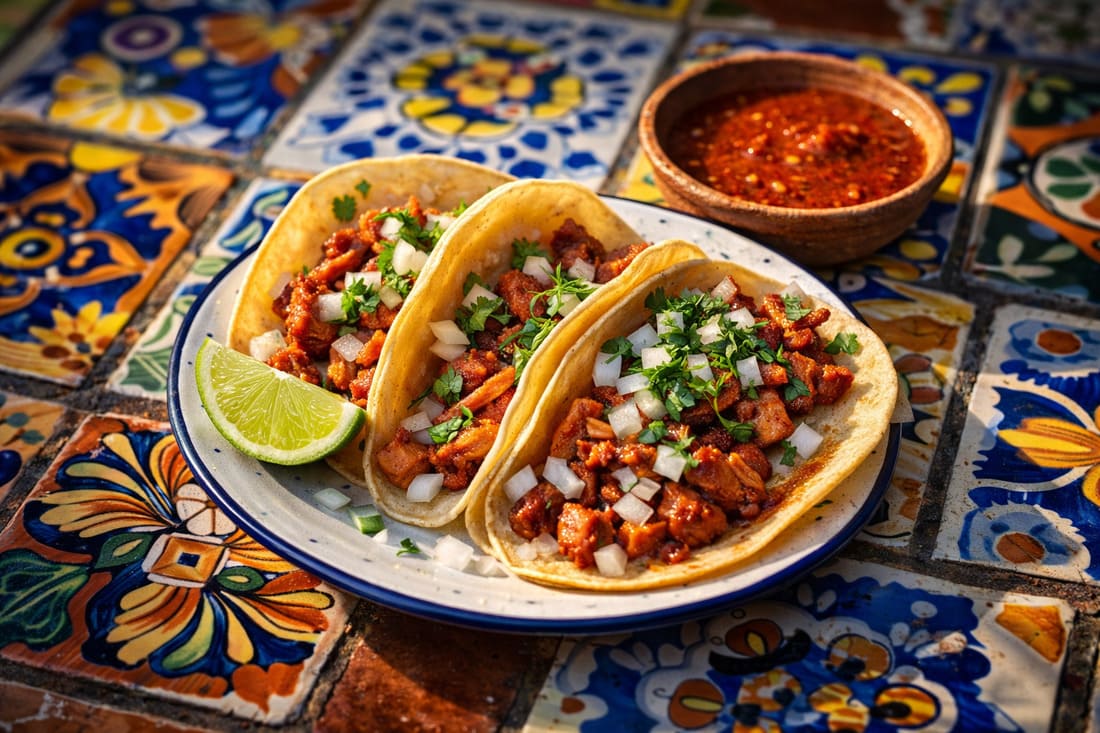
The history of tacos is two stories braided together. One is very old: people in Mexico were grinding maize into flatbreads and eating things wrapped in them long before the Spanish arrived. The other is much younger, because the word "taco" for a food shows up in writing only in the nineteenth century, and the hard-shell version belongs to twentieth-century California. The popular claim of a "10,000-year-old taco" blurs the two.
What the 10,000 years claim gets wrong
Maize is old, but not quite that old. Britannica puts its domestication in Mexico at "at least 9,000 years" ago, and says one of the first uses of ground maize was very likely the tortilla. That is a reasonable guess, not a find. Nobody has dug up a nine-thousand-year-old tortilla, because a flatbread of ground corn does not survive in the ground.
The hard evidence comes later. Archaeologists link tortillas to the comal, the clay griddle, though a comal could have cooked other things. At Chalcatzingo, in the Mexican state of Morelos, remains of a comal and of processed lime dated to about 700 BC are taken as likely evidence of tortilla making. The lime matters: soaking maize in an alkaline solution, first wood ash and later lime, is the step that turns corn into dough. By one account, farmers in the Oaxaca Valley between roughly 500 and 100 BC packed tortillas for lunch, which would be the taco's ancestor in the plainest sense.
So the tortilla is ancient. A tortilla wrapped around something is not yet a taco, and nobody can say who first folded one.
What the Aztec markets actually sold
When the Spanish reached the Valley of Mexico, tortillas were everywhere. Hernan Cortes is reported to have eaten them in 1519, when Moctezuma sent them as a gift, and to have thought them poorer than European bread. The Spanish word "tortilla," meaning a little cake, replaced the Nahuatl tlaxcalli. The friar Bernardino de Sahagun recorded how many kinds of Aztec tortilla there were.
What went inside is harder to pin down than the old article claimed. Britannica says the meats eaten in tacos before the Spanish were likely reptiles such as snakes and iguanas, native mammals and birds such as armadillos and turkeys, and insects such as grasshoppers. Eurasian livestock, cheese, lettuce and cabbage came with the Spanish, and the chiles and tomatoes of the filling had their own New World routes. A modern taco, in other words, is a hybrid of two food worlds that only met in the sixteenth century. The same meeting reshaped another Mexican gift to the world, the story of which is in the history of chocolate.
Where the word taco comes from
Nobody knows for certain. The Spanish Royal Academy's dictionary lists the food sense among several meanings of "taco," and the etymology is, in the words of one summary, largely theoretical. The candidates are these:
| Theory | Basis |
|---|---|
| Silver mining | Miners called paper-wrapped gunpowder charges "tacos" |
| Spanish "taco" | A plug or dowel, as in a plug to fill a hungry stomach |
| Nahuatl tlahco | "half" or "in the middle" |
| Nahuatl tlacoyo or tlaxcalli | Names of related maize foods |
The historian Jeffrey Pilcher, author of Planet Taco: A Global History of Mexican Food (2012), favors the mines. He dates the word to the eighteenth century, when "taco" meant the small charges miners packed into holes in the rock face to excavate ore. He notes that the earliest archival and dictionary references to the food come from the late nineteenth century, and that one of the first kinds described was the taco de minero, the miner's taco. His own caution is worth keeping: the taco, he argues, is not necessarily an age-old cultural expression.
Britannica, for its part, leans toward the Nahuatl tlacoyo as the likelier source. The honest answer is that scholars disagree, and the Nahuatl theories are attractive mostly because they sound ancient.
The first taco in print
Printed evidence is thin and then suddenly specific. In 1836, Antonia Carrillo's cookbook Nuevo y sencillo arte de cocina, reposteria y refrescos compared a rolled pork loin to a "taco de tortilla." That is a comparison, so the word was already in use for a rolled tortilla. In 1861, the novelist Manuel Payno described in El hombre de la situacion a tortilla taco filled with a spread of red chile. This earlier date corrects the claim that Payno's 1891 novel Los bandidos de Rio Frio held the first mention.
The word was also local. "Taco" was Mexico City's term, while in Guanajuato, Guerrero, Michoacan and San Luis Potosi the same thing could be called a burrito, and in Yucatan and Quintana Roo a codzito. The national dish was, for a long time, a regional habit.
Lebanese cooks and the pastor
Not every Mexican taco is a pre-Columbian one. Tacos al pastor, pork seasoned with adobo and stacked on a vertical spit that is flame-broiled as it turns, are usually traced to Mexico's Lebanese immigrant community, which brought the shawarma spit. The cookbook author David Sterling and a 2015 BBC report are cited for this. The pastor is a twentieth-century taco, built from an Old World technique and New World seasonings, and it is as Mexican as any.
How the taco crossed the border and got a shell
Various taco types were selling in the United States in the early twentieth century, especially in Texas and California. By the late 1930s, firms such as Ashley Mexican Food and Absolute Mexican Foods were selling the appliances and ingredients for hard-shell tacos, and the first patents for such appliances came in the 1940s. In 1949, Fabiola Cabeza de Baca Gilbert published The Good Life: New Mexican Food in Santa Fe, the first US cookbook with a hard-shell taco recipe. Every credited inventor of the hard shell, it seems, was copying a dish that already existed.
That includes Glen Bell. In 1948 he opened a hot dog stand, Bell's Drive-In, in San Bernardino, California. Across the street the Mitla Cafe had lines for its fried, hard-shelled tacos, and Bell set out to work out how they were made. Accounts differ on who finally showed him. He opened a taco stand in 1951 under a name that moved from Taco-Tia to El Taco and then to Taco Bell. The first Taco Bell opened in Downey in 1962, a 400-square-foot building with mission-style arches and a walk-up window, selling tacos, burritos, tostadas and frijoles at 19 cents each. Hot dog stands taught America to eat from a window, a habit traced in the history of hot dogs, and Bell applied the lesson to a tortilla.
Franchising began two years later, and by 1967 there were 100 locations. Pilcher describes Bell as the man who mass-marketed the taco "to Anglo palates via the crunchy Taco Bell shell." Whether that was theft or translation depends on who is telling it, and Pilcher's account of Mexican Americans in the Southwest reinventing the taco first is the part usually left out. If you want another flatbread that took a similar trip into the American fast-food order, the story of pizza's origins is a close cousin.
Britannica estimates there are some 50,000 Mexican restaurants in the United States, nearly all offering tacos. The first one Bell built in Downey in 1962 sold its tacos for 19 cents.
Questions people ask
Who invented the taco?
No one person did. Maize tortillas have been made in Mexico for thousands of years, and people wrapped food in them long before the word "taco" meant a food. The word is documented as a food by 1836 in a Mexican cookbook, and the hard-shell version took shape in the United States in the 1930s to 1950s.
Where does the word taco come from?
Its origin is uncertain. Historian Jeffrey Pilcher favors the silver mines of eighteenth-century Mexico, where "taco" meant a paper-wrapped gunpowder charge. Others point to Spanish "taco," meaning a plug, or to Nahuatl words such as tlahco ("half") and tlacoyo, a maize food. Scholars have not settled the question.
Are tacos really 10,000 years old?
No. Britannica dates maize domestication in Mexico to at least 9,000 years ago, and the earliest likely evidence of tortilla making is a comal and processed lime from about 700 BC at Chalcatzingo. The word and the dish called a taco are far more recent, with the first printed uses in the 1800s.
Who invented the hard-shell taco?
No single inventor is documented. Firms in the US sold hard-shell taco supplies by the late 1930s, patents for the appliances followed in the 1940s, and a New Mexican cookbook printed a recipe in 1949. Glen Bell popularized the crunchy shell, opening his first Taco Bell in Downey, California, in 1962, but he copied a dish he had seen at the Mitla Cafe.
Filed under Origin Stories, Street Food
Want more stories like this?
One food history story, every week. No spam, just the stories behind what the world eats.