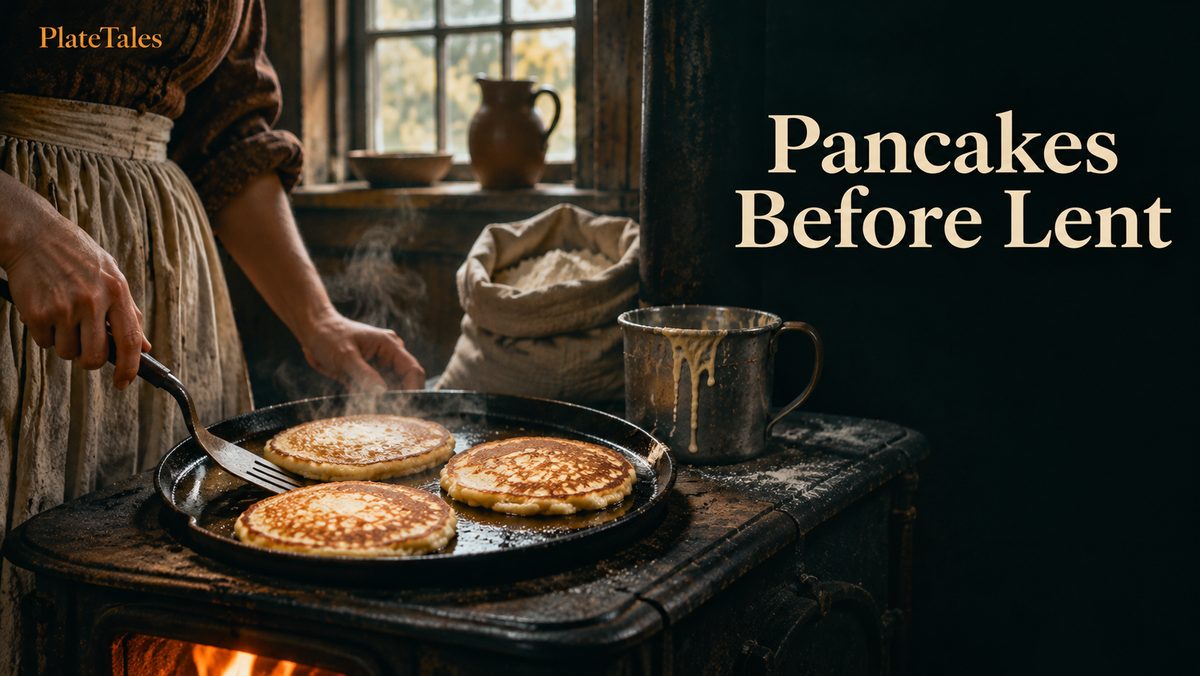
Pancakes are older than the word for them. The Greek poets Cratinus and Magnes were writing about fried batter cakes called tagenias in the 5th century BC, which makes those the earliest pancakes anyone can point to in writing. The English word "pancake" turns up in the 15th century, and the boxed mix came in 1889 in St. Joseph, Missouri.
Fried batter cakes in Greek verse, 5th century BC
Griddle cakes are what you get when anyone with flour, liquid and a hot pan gets bored of porridge, so no single inventor exists. What exists is a paper trail, and it starts in Athens.
The Greek word was tagenias (also spelled tagenites), from tagenon, a frying pan. Cratinus and Magnes, comic poets of the 5th century BC, are the earliest writers who use it. The cakes were made from wheat flour, olive oil, honey and curdled milk, and they were eaten at breakfast. Much later, Athenaeus, in his Deipnosophistae, mentions a related cake called staititas, served with honey, sesame and cheese.
Rome had fried sweets too. The Latin name was alia dulcia, "other sweets," but they were quite different from what a modern diner would recognize as a pancake. Calling them Roman pancakes is a stretch.
When the word pancake first shows up in English
The compound "pancake" is Middle English, recorded in the 15th century. That is the date reference works give, and nothing earlier is on offer for the word itself.
The thing was already everywhere by then. Britannica notes that pancakes were a popular food before the 40-day fast of Lent, and that is the reason the word is tied so tightly to one date on the calendar.
Why do we eat pancakes on Shrove Tuesday?
Because the pantry had to be cleared. Lent meant no meat, and pancakes were historically a way to use up fat or lard before it began. A day of batter and a hot pan cleared the larder.
The custom left its names behind. In Britain, Ireland, Canada, Australia and New Zealand the day is Pancake Day, and in Ireland and Scotland Pancake Tuesday. In the United States and France the same day is Mardi Gras, Fat Tuesday. Same day, same logic, different breakfast: for a sibling story built on the same pre-Lent clearing-out, see the history of French toast.
The Olney race and the story nobody can date
Olney, in Buckinghamshire, runs a race every Shrove Tuesday that is said to go back to 1445. The story goes like this: a housewife was still frying pancakes when the shriving bell rang for church, and she ran there with the pan in her hand, tossing the pancake as she went, apron and headscarf still on.
Look for the 1445 document and you will not find one. The account of the race is a tradition, and the sources behind it cite no record from that year. What is documented is more recent: the race was revived in 1948 and has run every year since 1950. Women who live in Olney run from the market place to the Church of St Peter and St Paul, a little over 400 yards, and the traditional prize was a kiss from the verger.
That revival gave the race its American rival. Liberal, Kansas, now competes with Olney for the faster time, and the pair call it the International Pancake Race.
Flapjacks, hoecakes and johnnycakes in the colonies
American pancakes came from more than one parent. English settlers brought the batter cake and its names, flapjack and slapjack among them. Corn gave them something else to work with.
The johnnycake is a cornmeal flatbread whose roots lie with Indigenous peoples who ground corn, and the Narragansett are credited with making it as early as the 1600s. The modern johnnycake is believed to have come from Rhode Island. The word "johnny cake" is first recorded in 1739. "Hoecake" appears in 1745, probably naming the iron pan called a hoe, though the tale that cooks baked them on garden-hoe blades is disputed. The word may descend from "jonakin," recorded in New England in 1765, which in turn may come from "jannock," a word recorded in northern England in the 1500s.
Corn griddle cakes of this kind are cousins of what the South later did with the oven; see the history of Southern biscuits for that branch of the breakfast table. For the other great batter-on-iron breakfast, there is the history of the waffle.
The first pancake mix, St. Joseph, Missouri
In 1888, Chris L. Rutt, an editor at the St. Joseph Gazette, and Charles G. Underwood bought a small flour mill at 214 North 2nd Street in St. Joseph, Missouri, and founded the Pearl Milling Company. Britannica puts the first pancake mix in 1889. The mill was dealing with a glutted flour market, and the partners began selling what they had in bags labeled "Self-Rising Pancake Flour." It is usually called the first ready-mix.
The mix needed a face. In late 1889 Rutt took the name Aunt Jemima from a minstrel song, "Old Aunt Jemima," which Billy Kersands wrote in 1875. The story that he heard it at a minstrel show in St. Joseph is the version told most often, and the historian Doris Witt could not confirm it.
The name sold flour for 130 years, and it did so on a stereotype. In 1893 Nancy Green, born into slavery in Montgomery County, Kentucky, played the character at the World's Columbian Exposition in Chicago, cooking pancakes at the fair. The R. T. Davis Milling Company is the firm named as hiring her.
On June 17, 2020, the owner announced that the brand would be discontinued and replaced, saying it wanted to make progress toward racial equality. The image left the packaging in the fall of 2020. On February 9, 2021, the company announced that the replacement would carry the name of the original mill, Pearl Milling Company, and the new packaging launched that June.
Questions people ask
What is the oldest pancake recipe?
No recipe survives from the earliest pancakes, but the oldest written mention of a pancake is the Greek tagenias, named by the poets Cratinus and Magnes in the 5th century BC. Such cakes were fried in a pan from wheat flour, olive oil, honey and curdled milk and eaten for breakfast.
Who made the first pancake mix?
The Pearl Milling Company of St. Joseph, Missouri, founded in 1888 by Chris L. Rutt and Charles G. Underwood, began selling "Self-Rising Pancake Flour" in 1889. It is commonly described as the first ready-mix, and the mill later branded it Aunt Jemima.
Did the Olney pancake race really start in 1445?
The date 1445 belongs to local tradition, and no contemporary record of that year is cited for it. The documented history is shorter: the race was revived in 1948 and has been run every year since 1950. The women run about 400 yards from the market place to the parish church.
What is the difference between a pancake, a flapjack and a johnnycake?
In North America flapjack, hotcake, griddle cake and slapjack are all names for the pancake, a flat round cake of thin batter cooked on both sides. A johnnycake is different: a cornmeal flatbread with Indigenous roots, first recorded as a word in 1739.
Filed under Origin Stories
Want more stories like this?
One food history story, every week. No spam, just the stories behind what the world eats.