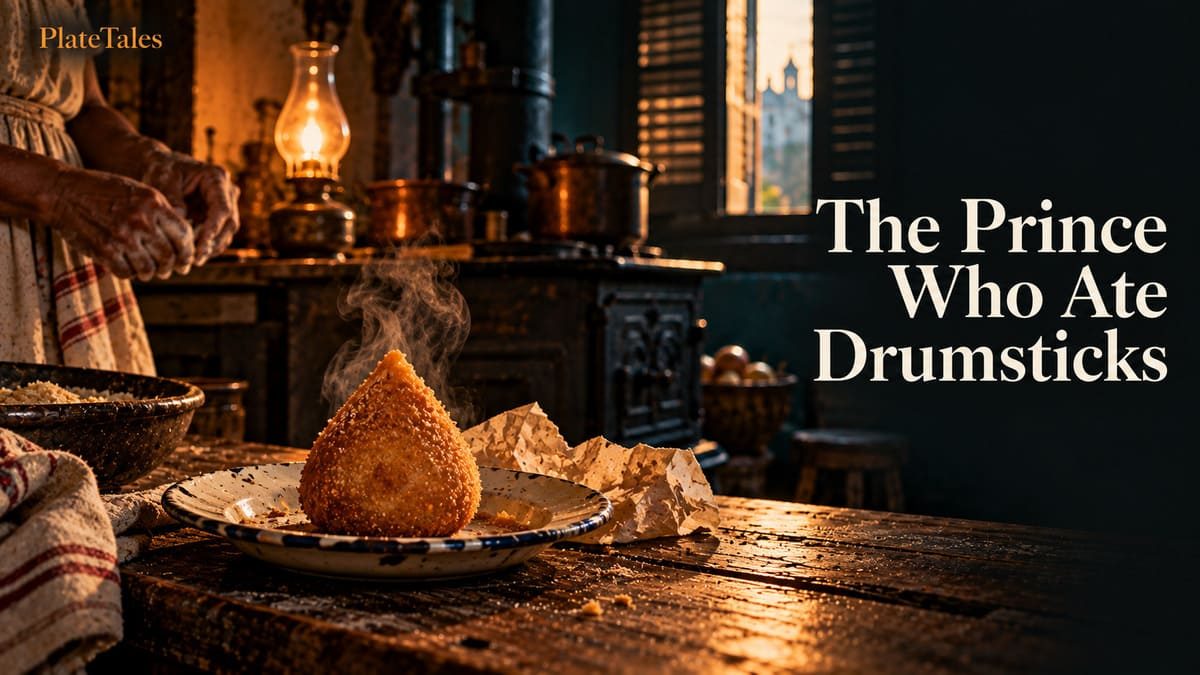
The coxinha origin most Brazilians hear is a royal one: a cook on a farm in Limeira, in the state of Sao Paulo, shaped dough and chicken into a fake drumstick for a child of Princess Isabel who would eat nothing else. The written evidence for that scene is thin. What historians describe instead is a cheap, long-lasting street snack that took its modern form in 19th-century Sao Paulo.
The coxinha origin story about a picky prince
The tale goes like this. Isabel, Princess Imperial of Brazil, and her husband Gaston d'Orleans, the Count of Eu, had a son who lived in seclusion because of mental problems. He liked chicken, but only the drumstick. One day the kitchen ran out of drumsticks. A cook, rather than disappoint the boy, wrapped dough around a filling and shaped it like the missing leg. The child ate it. Then the Empress, Teresa Cristina, visited, tasted the snack, and liked it so much that she asked the master of the imperial kitchen to learn how to make it.
This version comes from Nadir Cavazin's book of stories and recipes, which gives no date beyond the princess's own lifespan (1846 to 1921). Accounts place the scene at Fazenda Morro Azul in Limeira, and the town's yearly Festa da Coxinha is built around it. The story is one of several versions, not settled history.
Versions differ on the details. A 2023 piece in the history magazine Aventuras na Historia, which says the story is told especially in Limeira, has the princess's cook improvising a dish of shredded chicken and mashed potato for Prince Pedro de Alcantara, who loved chicken legs. In that telling the boy liked it so much that his grandmother, Empress Teresa Cristina, supposedly came to Limeira to try it. The magazine calls it a legend, and it notes that the tale makes the snack look exclusively Brazilian.
The name fits the tale neatly. Coxinha means roughly 'little thigh', and the teardrop shape is meant to look like a drumstick. That is the part nobody disputes.
Where the farm and the family actually meet
Morro Azul is real. It is a coffee-era estate founded in 1806, and its main house was finished in 1877. It was part of Limeira until 1953, when the district of Iracemapolis was split off, and it now lies there. It was listed as protected heritage in 1974. Locals called it the Emperor's Farm, because Pedro II stayed there twice, in 1878 and in 1886.
So an imperial visit to the property is documented. Accounts of the farm, though, say nothing about a coxinha, a cook or a child with a drumstick habit. The link between the place and the snack comes from the legend itself.
Does the prince match the record?
Isabel married Gaston in October 1864 and had three sons who lived to adulthood: Pedro de Alcantara, born 15 October 1875 with a disabled left arm, possibly from a hard delivery; Luis, born in Petropolis in early 1878, who died in early 1920 after a long illness; and Antonio, born about August 1881, who died in 1918 after a plane accident. They also had a daughter, Luiza Victoria, listed in the biography's family box.
One long biography of Isabel, only partly readable for this article, mentions the disabled arm of the eldest son and says nothing about a mental disability in any of the three. That is an absence in one secondary source, not proof. But the legend's central figure, a secluded child with mental problems, is not one that this source supports, and the tellings do not agree on the details: the version from Cavazin's book leaves the boy unnamed, while Aventuras na Historia names the eldest, Pedro de Alcantara.
There is also a calendar problem. The imperial family left Brazil on 17 November 1889, two days after the republican coup. A farm visit with an empress at the table has to fall before that, when the three boys were between roughly eight and fourteen at the latest. Nothing in the story says which year.
What historians say instead
Aventuras na Historia reports that the TasteAtlas food encyclopedia, which in 2023 ranked the coxinha 30th among the world's best street foods and the only Brazilian dish on its list, says it probably arose during Sao Paulo's industrialization as a cheaper, longer-lasting substitute for the chicken pieces sold at factory gates. That is a guess about likelihood, not a dated record. Other accounts give a similar story. The coxinha took its present form in the 19th century in Greater Sao Paulo, during the city's industrialization. It was a cheaper, more durable substitute for the fried chicken thighs sold outside factory gates. From there it spread across the state and the country, and by the 1950s it was popular in Rio de Janeiro and Parana, where the first variations appeared.
These accounts agree on the place and the period. The modern processed form may have started in Limeira in the 19th century, according to Luiz Farias's Brazilian Bakery (2013), and early coxinhas were made with any part of the chicken. A reader will notice that this is the same town the legend names. The two accounts may have grown from one local tradition, one with a prince in it and one without.
None of the sources read for this article offers a dated recipe, a menu or a newspaper advertisement that fixes the first coxinha. That gap is the honest finding. The earliest written record of the royal story is a modern book, and the earliest firm account of the food itself is a general statement about the 1800s.
The croquette behind the shape
The snack also has a European ancestor. The croquette traces to the French verb croquer, to crunch. Early recipes include a 17th-century one by Francois Massialot for breaded, fried croquets, and a 1691 one from the chef of Louis XIV for a version with a ragout filling. The thick-binder croquette, closer to the modern kind, shows up in Louis Eustache Ude's 1822 English cookbook, and in France the dish became a way to use leftover stewed meat.
Croquetes, mostly made with beef, are common across Brazil, and the coxinha is a popular chicken-based croquette. Aventuras na Historia adds a sharper detail: it says the chef Antonin Careme, in a French cookery book it dates to 1831, already advised shaping a chicken croquette like a pear. Read this way, the Sao Paulo cook did not invent a fried, breaded, filled morsel. Someone gave an old European format a chicken filling and a leg-shaped silhouette, which is a smaller but more believable invention. Brazilian food often carries this kind of mixed parentage; the story of feijoada is another place to see how a national dish gathers its legends.
Why a royal story sticks to a street snack
Street food rarely has a paper trail. Nobody writes down the vendor outside the factory gate, so the first written mention is often a legend recorded long after the fact. A prince and an empress give a fried fritter a date, a place and a face. If you like that pattern, the street food stories on this site have more of it, and the tale of the hot dog follows a similar path from the cart to the myth.
Limeira has kept the legend alive. A city hall press release covers the town's Festa da Coxinha, and the festival is built on the Morro Azul story.
Meanwhile another town has made its own reputation. Bueno de Andrada, a district of about 1,700 people in the municipality of Araraquara, became known for its coxinha after the writer Ignacio de Loyola Brandao praised it in a newspaper chronicle, calling it, in a state legislature report, 'uma obra-prima de dourada crocancia', a masterpiece of golden crispness. The railway reached the locality in 1898, and the district took its present name in 1937. Its former grocery store now sells 25 flavors of coxinha to thousands of visitors a week.
Questions people ask
Who invented the coxinha?
No one is documented as the inventor. A story from Limeira credits a cook at Fazenda Morro Azul who made a drumstick-shaped fritter for a son of Princess Isabel, but it rests on one book. Historians describe a cheap chicken snack that took its modern form in 19th-century Sao Paulo.
Why is the coxinha shaped like a chicken leg?
The name coxinha means roughly 'little thigh', and the teardrop shape is meant to resemble a drumstick. In the Limeira legend the cook shaped the dough that way to please a child who would eat only drumsticks. Early coxinhas in Sao Paulo were made with any part of the chicken.
Did Princess Isabel's son really inspire the coxinha?
There is no confirmation. Accounts differ on which son, and a biography of Isabel mentions a disabled arm in her eldest son, Pedro de Alcantara, but no mental disability in any of her sons. The only source given for the story is Nadir Cavazin's book.
Is the coxinha related to the French croquette?
Probably in format. Aventuras na Historia points to a pear-shaped chicken croquette in a French cookbook it dates to 1831, though it does not claim a direct line to Brazil. The croquette is a French dish documented in the 1600s, and the coxinha is a chicken-based croquette popular in Brazil. Croquetes made mostly with beef are common across the country.
Where is the best-known coxinha town?
Two towns compete for attention. Limeira, in Sao Paulo state, holds a yearly Festa da Coxinha built around the Princess Isabel legend. Bueno de Andrada, in Araraquara, became famous after a writer praised its coxinha, and its shop now offers 25 flavors.
Filed under Origin Stories, Street Food
Want more stories like this?
One food history story, every week. No spam, just the stories behind what the world eats.