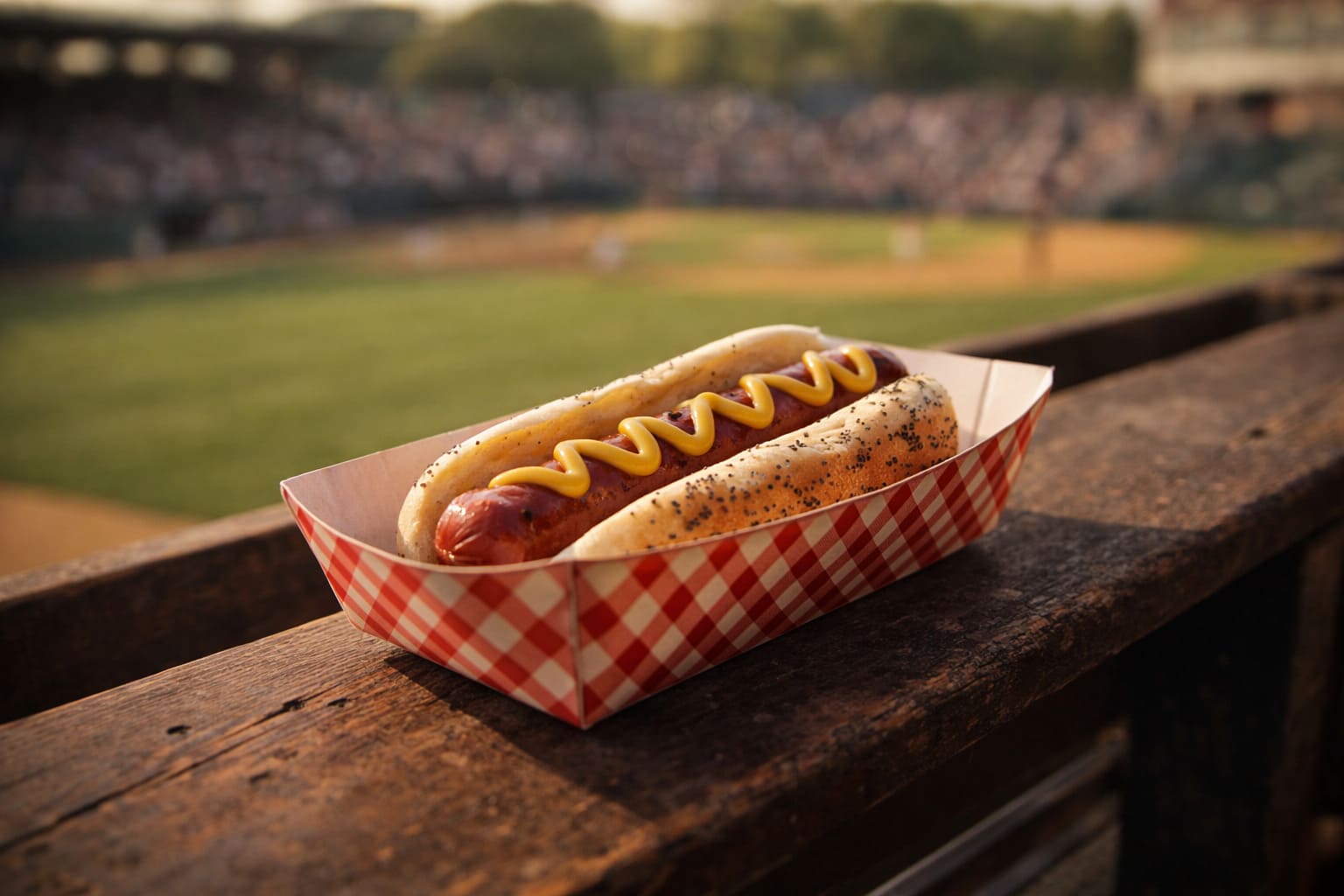
The history of hot dogs starts with a German-style sausage that immigrants carried to New York in the 1860s and sold from street carts. Frankfurt and Vienna both claim the sausage itself, and no one can prove who first tucked it in a roll. The name "hot dog" appears in print by 1884. Coney Island, Nathan Handwerker and the ballpark did the rest.
Frankfurt or Vienna: who made the sausage first?
Both cities put their name on it. Frankfurt gave the word "frankfurter" and says it has been making the sausage for more than 500 years; Vienna gave "wiener." Britannica calls the origin "disputed but probable German." Frankfurt held a 500th birthday party for the hot dog in 1987, counting from a claimed date of 1487, and the National Hot Dog and Sausage Council, the industry's trade group, calls that claim disputed.
The same council doubts that either city can claim the American hot dog outright. Its account says the North American version most likely descends from a common European sausage that butchers of several nationalities brought over. One story names a late-1600s butcher from Coburg, Johann Georghehner, as the creator of a "dachshund" sausage that he later promoted in Frankfurt. The council presents this as one account among others, not settled fact.
The 1860s: dachshund sausages on the Bowery
Britannica says German immigrants brought the food to New York in the 1860s, where street vendors sold the sausages as "dachshund sausages," presumably because of their shape. The National Hot Dog and Sausage Council adds that German immigrants were selling sausages from push carts on the Bowery in that decade.
That is the soft, murky stage of the story. Nobody recorded the first man who split a roll and laid a sausage in it. What survives are competing claims, each one tied to a person and a place, and most of them first written down long after the fact.
Charles Feltman and the Coney Island stand
The best-known claim belongs to Charles Feltman, a German immigrant at Coney Island. Britannica dates his popular stand to 1871. The council says he sold 3,684 sausages in milk rolls in his first year, and it calls him a baker in one place and a butcher in another, so even the basics of his trade are blurry. A common retelling puts his first cart in 1867, but the sources read for this article give 1871 as the firm date.
Whatever the exact year, Feltman's name stuck to the place. Coney Island was a beach and amusement district in Brooklyn, and a cheap sausage you could eat standing up suited a crowd out for a day. Britannica says the stand tied the sausage to fun and leisure for good. If you are curious how the same logic shaped other portable food, the story of who invented the sandwich runs on a similar idea.
The glove story from St. Louis
A second tale puts the bun in the American Midwest. Anton Feuchtwanger, a Bavarian concessionaire, supposedly lent customers white gloves to hold his hot sausages. They failed to return the gloves, and a relative suggested a roll instead. The council dates this to the 1904 Louisiana Purchase Exposition in St. Louis and says the baker was his brother-in-law.
Food historian Bruce Kraig, quoted by the council, rejects it outright with the words "Not a chance." He argues the bun came from German immigrant practice, not one inventor's fix. Other versions of the glove tale place it in 1880 or at the 1893 Chicago fair, and in some it is his wife who has the idea. A story that moves around that much is usually a story told afterward.
Where the name "hot dog" comes from
The cartoonist Tad Dorgan is often credited with coining the term. The legend says he heard a vendor named Harry M. Stevens shouting about "red-hot dachshund sausages" at the New York Polo Grounds on a cold April day in 1901, then drew the sausages in buns with the caption "hot dog!" The council notes that nobody has found that cartoon, and Kraig suggests it may have been a joke between the two men or may never have existed. The tale may trace to Stevens' 1934 obituary, which does not confirm it.
The dates do not help the legend. Britannica places the first use of the phrase in the sausage sense in 1884 and says it was in wide use around the country by 1892. The council points to Yale: "dog wagons" selling sausages in the fall of 1894 and a Yale Record mention on October 19, 1895. All of that predates 1901. The implied joke was that the sausage might contain dog meat.
From the 1893 fair to the ballpark
By the time of the Chicago World's Columbian Exposition in 1893, Britannica says, hot dogs were served by the thousands. They also became standard at baseball parks, where vendors still carry them through the stands. Stevens, the Polo Grounds concessionaire, remains a leading name in the ballpark story, though the claim that he started the practice in 1901 rests on that murky obituary account.
Regional styles followed the sausage across the country. Britannica lists the Chicago dog, an all-beef sausage in a poppy seed bun with yellow mustard, bright green relish, onion, tomato, a pickle, sport peppers and celery salt. It also lists the New York dog, with sauerkraut, brown mustard and onions, and the Sonoran dog, which came from Mexico by way of Arizona and arrives with beans, salsa, mayonnaise and bacon. The way each city dressed the same sausage says a lot about who lived there, a theme in how immigration changed American food.
Nathan Handwerker and the nickel dog
Nathan Handwerker was a Polish immigrant who worked for Feltman before opening his own Coney Island stand in 1916, according to Britannica. By the usual account he sold his hot dogs for five cents, half Feltman's price. Britannica credits him as a gifted marketer who promoted the stand with a Fourth of July eating contest that continues today; the winner in 2020 ate 76 in 10 minutes.
The company's own history, as cited in a reference summary, has his wife Ida creating the recipe and their savings of $300 funding the start. Tales that the singers Eddie Cantor and Jimmy Durante pushed him to open are repeated in a 1974 wire story, but the company history leaves them out, so treat that part as a story and not a record.
Britannica adds one last scene. In 1939 President Franklin Roosevelt served hot dogs to King George VI of Britain, drawing criticism for the menu. The king asked for a second one.
Questions people ask
Who invented the hot dog bun?
Nobody has proved it. Charles Feltman is credited with selling sausages in milk rolls at Coney Island in 1871, and Anton Feuchtwanger with a glove-and-roll story at the 1904 St. Louis fair. Historian Bruce Kraig rejects the Feuchtwanger tale, saying the bun came from German immigrant practice, not a single inventor.
Is a hot dog German or Austrian?
Both Frankfurt and Vienna claim the sausage, and Britannica calls its origin disputed but probably German. The name "frankfurter" points to Frankfurt and "wiener" to Vienna. The National Hot Dog and Sausage Council thinks the American hot dog descends from a common European sausage that many butchers brought over.
Did Tad Dorgan really name the hot dog?
Probably not. The story says the cartoonist Tad Dorgan coined "hot dog" in 1901 at the Polo Grounds, but no such cartoon has been found. Britannica dates the first use of the phrase to 1884, and Yale student publications used it in the 1890s, well before 1901.
Why is it called a hot dog?
Britannica says New York vendors sold the sausages as dachshund sausages in the 1860s, presumably for their shape, and the name "hot dog" came from that, with a joking hint that the sausage held dog meat. The earliest use of the phrase it cites in that sense is from 1884.
Filed under Origin Stories, Street Food, Migration Stories
Want more stories like this?
One food history story, every week. No spam, just the stories behind what the world eats.