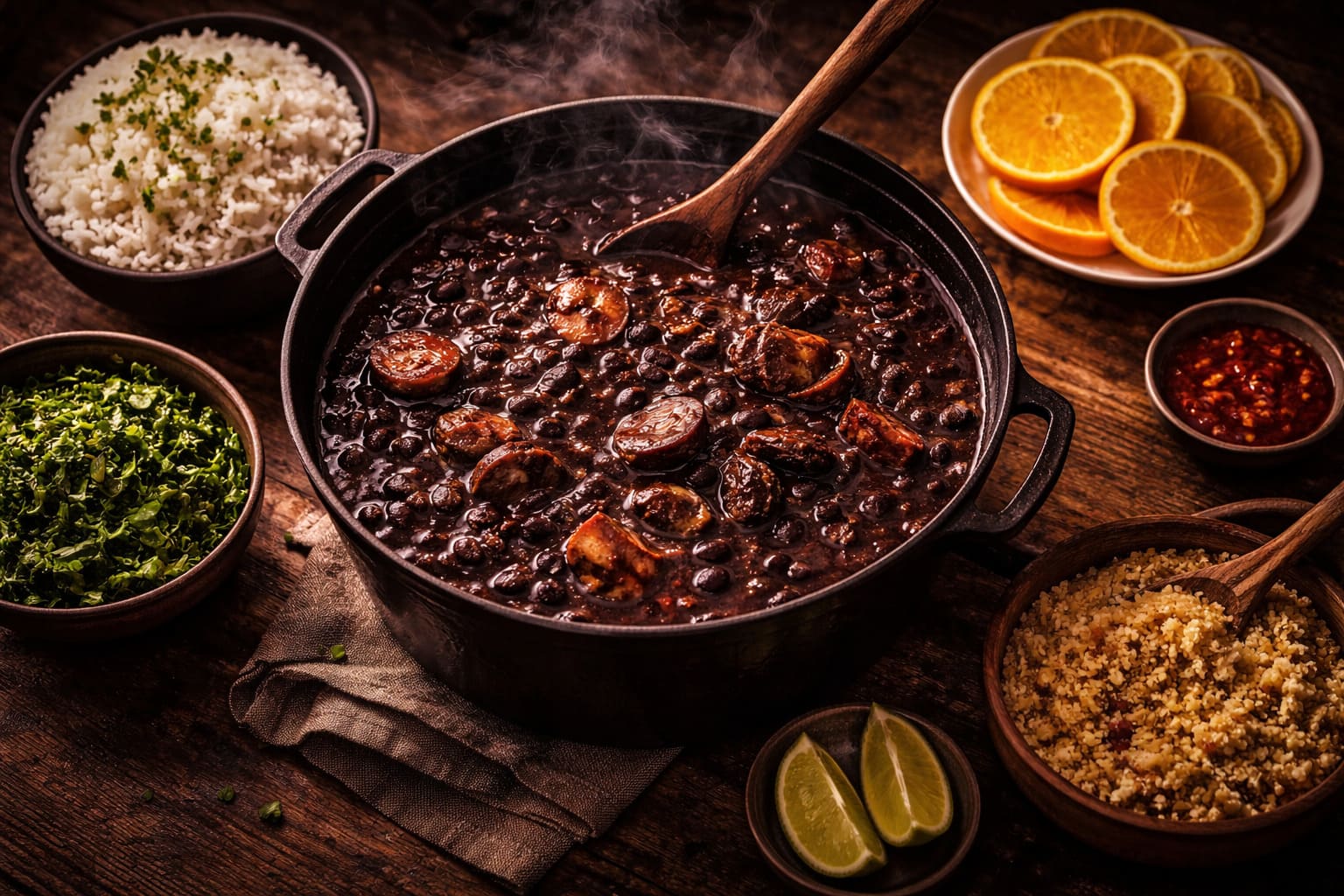
The origin of feijoada is less simple than the story Brazilians usually tell. The popular version says enslaved Africans invented it from pig scraps their masters threw away. The written record points elsewhere: a Portuguese bean-and-pork stew, first advertised in Recife in 1827, that Brazil reworked over the next century into the feijoada completa now treated as the national dish.
The feijoada origin story everyone tells
Ask in Brazil where feijoada comes from and most people give the same answer. On the sugar plantations, the tale goes, the enslaved were handed the parts of the pig the big house did not want, the ears, feet and tails, and they stewed them with black beans. Olivia Ware Terenzio, writing in Southern Cultures, notes that most Brazilians still claim this, and that some scholars have questioned it.
The tale is attractive because it is partly true. Pig parts and beans did feed the enslaved. Gilberto Freyre, in his study of colonial Brazilian society, noted corn, salt pork and beans in their diets. Nearly four million Africans were brought to Brazil between the sixteenth and nineteenth centuries, and African cooks did shape the colonial kitchen, introducing ingredients such as palm oil. The question is narrower: did they invent this stew, from those scraps?
What the first written records say
The earliest known mention of "feijoada à brasileira" is an advertisement in the Diário de Pernambuco on 2 March 1827. It promoted the Locanda da Águia d'Ouro in Recife, which served the dish on Thursdays. Another Recife house, the Hôtel Théatre, advertised it in 1833, again on Thursdays. (Terenzio gives 1833 as the first reference, so the date depends on which source you trust; some histories date it to the 1827 advertisement.)
These are paid ads for restaurants and inns, not accounts of plantation quarters. Other early traces are scattered. In 1840 a Recife priest, Father Carapuceiro, wrote that leftover meats were often turned into feijoada, calling it "the burial of the bones." In 1860 the French writer Oscar Comettant described it as the everyday main dish at modest Brazilian dinners and compared it to the French pot-au-feu. The American Elizabeth Cary Agassiz is quoted as saying no house was so poor that it lacked feijoada, nor so rich as to keep it off the table.
Why the scraps story fits the evidence badly
Historian Carlos Augusto Ditadi, writing in Gula magazine in May 1998, argued that the senzala myth comes from modern folklore and a romanticized view of slavery. The article that summarizes his case adds two details. Black beans with manioc flour were the ordinary food of enslaved and poor Brazilians, not a pork stew. And pork trimmings were already respectable food for people with money.
That second point shows up in odd places. Camilo Castelo Branco's 1882 novel A Brasileira de Prazins mentions pig's foot in Portuguese tripe. A household receipt from the imperial residence in Petrópolis in 1889 lists many meats and offal. Terenzio makes the same point from the other direction: Iberian cooking prizes offal and viscera, so pig parts in a stew would have been an option for the elite.
A Portuguese pot with a Brazilian name
Portuguese cooks were already stewing beans with pork, cured meats and cabbage before anyone advertised a feijoada in Recife. Regional versions survive. The northwest of Portugal favors white beans and Trás-os-Montes red ones, while black beans are of American origin, so the black-bean version is the Brazilian twist. Similar clay-pot stews turn up across Europe, among them the Portuguese cozido, the Italian bollito and the French cassoulet. The Brazilian dish is probably an adaptation of a stew from northern Portugal. Terenzio sets it beside American Hoppin' John, and the wider story of soul food has the same tangle.
The writer Pedro Nava thought the dish evolved from Latin dishes such as the cassoulet rather than arising spontaneously. He praised the feijoada at G. Lobo, a Rio restaurant that closed in 1905, and the Bahian cook Tia Ciata was famous for hers in Rio.
What enslaved cooks did add
None of this erases African hands. Terenzio notes that Africans planted the fruits and grains they preferred in Brazilian soil, and the Americas' rice economies depended on their skills (see the story of rice). Culinary scholar Carlos Alberto Dória draws a line between plain beans, a simple feijoada, and feijoada completa. In his account the enslaved evolved beans and flour into the simple feijoada, still a food of scarcity, while the full version with rice, greens and orange was for restaurants serving the highest classes.
Terenzio also argues that the food scholar Raul Lody's phrase "slave food" reflects an idealized picture of plantation kitchens, with singing cooks and bountiful pots, that hides cruelty. Planters, she notes, were recorded in the 1850s as preferring to use up a slave in five to seven years and buy another.
When the stew became a national dish
The feijoada on a Brazilian table today is a later arrival. Luís da Câmara Cascudo put the introduction of feijoada completa into Brazilian kitchens at around 1930. The timing matters. After abolition in 1888, elites debated what Brazil's mixed population meant for the nation, and Freyre's celebration of mixture became the idea of a "racial democracy." Terenzio argues that a dish of black beans, white rice and pork told that story well, and she cites the anthropologist Jane Fajans, who called it a symbolic microcosm of the nation.
The dish also carries real religious meaning. Feijoada is served in connection with candomblé ceremonies, and one legend tells of the deity Ogum instructing a priest to cook a feijoada for his whole community. Some quilombos, settlements founded by people who escaped slavery, still hold feijoada feasts.
Which day is feijoada day?
It depends on the city. Terenzio reports that restaurants serve it on Wednesdays, Thursdays, Saturdays or Sundays depending on region. In São Paulo it appears on working-class menus on Wednesdays and Saturdays, while Rio restaurants traditionally served it on Fridays. The earliest ads named Thursday. It is also a traditional dish of Carnaval.
When the scholar Scott Alves Barton did fieldwork in Bahia in 2011, he heard the same words every time he was served feijoada: "Now you're eating slave food!"
Questions people ask
Is feijoada Portuguese or Brazilian?
Both, in a sense. Feijoada is the name of bean-and-meat stews across the Portuguese-speaking world, and the Brazilian black-bean version is probably an adaptation of a stew from northern Portugal. The first known mention of "feijoada à brasileira" is a Recife advertisement from 1827, and feijoada completa with rice and greens came later, around 1930 according to Cascudo.
Did enslaved Africans really invent feijoada?
There is no documentary evidence for it. Historian Carlos Augusto Ditadi argued in 1998 that the story comes from modern folklore. Enslaved Africans and their descendants did cook in Brazilian kitchens and shaped Brazilian food, but the earliest records of feijoada are restaurant advertisements, and pork offal was already valued in Portuguese cooking.
When was feijoada first written about?
The earliest known mention of feijoada in Brazil is an advertisement in the Diario de Pernambuco on 2 March 1827 for the Locanda da Águia d'Ouro in Recife, which served "feijoada à brasileira" on Thursdays. Another Recife house advertised it in 1833. Some writers give 1833 as the first reference.
What is feijoada completa?
Feijoada completa is the full meal Brazilians now call feijoada: beans cooked with dried and smoked meats, sausage and pig parts, served with rice, greens, orange and toasted manioc flour. Cascudo dated its arrival in Brazilian kitchens to around 1930. Earlier feijoadas were simpler versions of beans boiled with meat.
Filed under Origin Stories
Want more stories like this?
One food history story, every week. No spam, just the stories behind what the world eats.