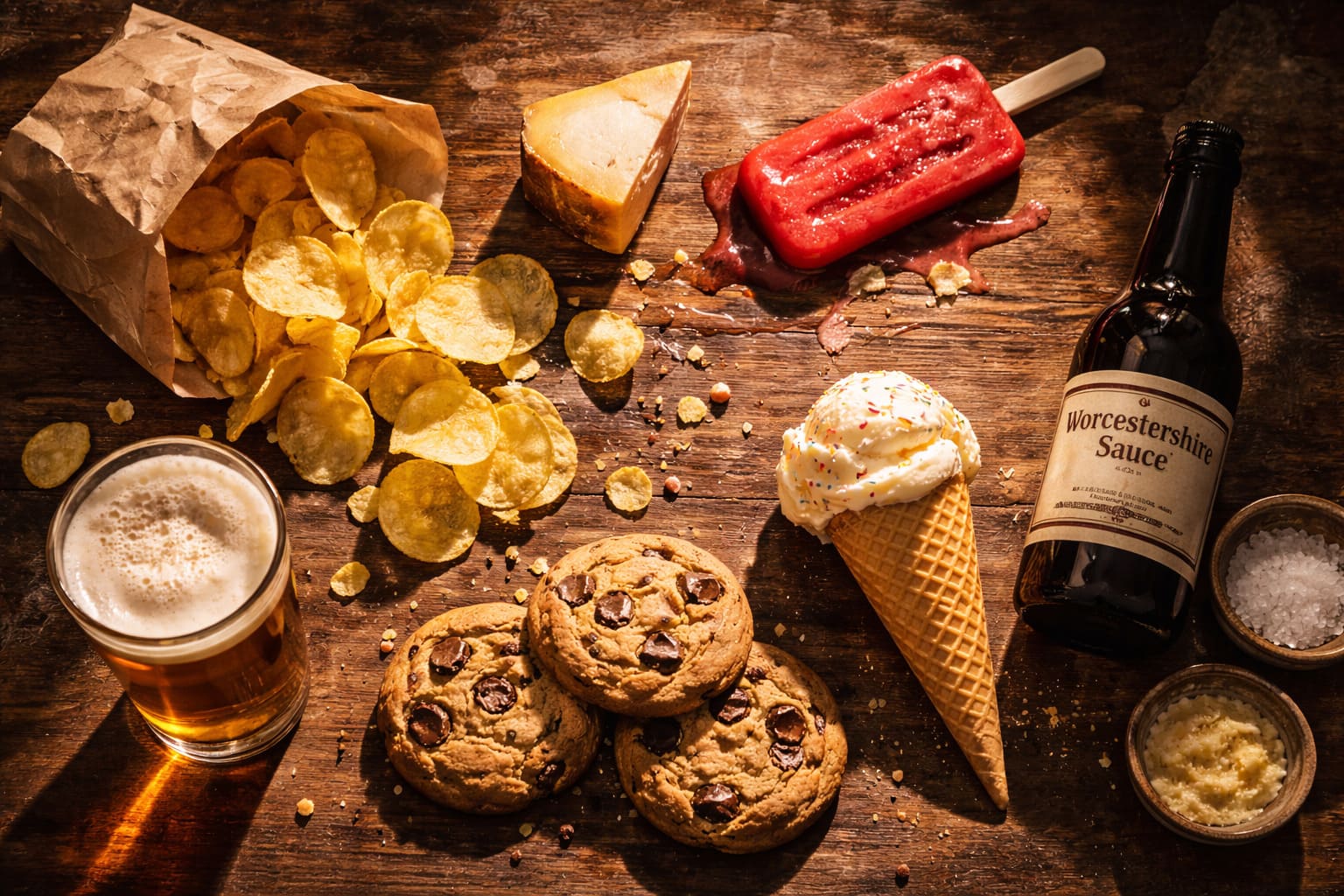
Foods invented by accident are rarer than the legends say. Saccharin and corn flakes have the strongest claims, because each came from a real slip in a lab or a kitchen, while the potato chip, the chocolate chip cookie and the barrel of Worcestershire sauce owe more to good storytelling than to documents. Here is what the sources show for each.
Foods invented by accident that hold up: saccharin first
The least romantic accident is the best documented. In 1879 Constantin Fahlberg was working on coal tar derivatives in Ira Remsen's laboratory at Johns Hopkins University. One evening he noticed a sweet taste on his hand and traced it to the compound he had been handling that day, benzoic sulfimide.
Fahlberg and Remsen published on the compound in 1879 and 1880, with Fahlberg's name first on the earlier paper. In 1884, working on his own in New York, Fahlberg applied for patents in several countries and named the substance saccharin. By 1886 he was making it at a factory near Magdeburg, Germany. He grew rich. Remsen thought the credit belonged in his laboratory, and said so in blunt terms: "Fahlberg is a scoundrel." Historians still argue over who contributed what.
Corn flakes: wheat dough left out overnight
The usual account of the Kellogg brothers goes like this. In 1894, at the Battle Creek Sanitarium in Michigan, John Harvey Kellogg was called away and left a batch of cooked wheat dough sitting. Next morning, instead of throwing it out, he ran it through rollers and got thin flakes that could be baked. His younger brother Will Keith Kellogg, the sanitarium's business manager, was left to work out how to repeat the result reliably.
Even this one is told with caution. Accounts differ on who did what, and John's wife, Ella Eaton Kellogg, is sometimes named too. The patent, filed on May 31, 1895 and issued on April 14, 1896, carried only John's name, and Will argued for years that he deserved more credit. The fuller story of the cereal is in our piece on the history of cornflakes.
Potato chips: the legend dated August 24, 1853
By the late nineteenth century a tidy tale credited a cook named George Crum at Moon's Lake House in Saratoga Springs, New York. A customer kept sending back his fried potatoes as too thick, too soggy or not salted enough. Crum, irritated, sliced the next batch paper-thin, fried them crisp and salted them heavily. The customer loved them. The date attached to the story is August 24, 1853.
The record is less kind. The earliest known recipe for potato chips is in William Kitchiner's The Cook's Oracle, published in London in 1817. The 1822 edition tells the cook to cut potatoes "in shavings round and round, as you would peel a lemon" and fry them. Mary Randolph's The Virginia House-Wife (1824) and a London cookbook of 1825 give similar recipes. The Moon family did not buy the Lake House until 1854, and crisp fried potatoes were already known in Saratoga.
The version in which the customer is Cornelius Vanderbilt was spread by a 1973 advertising campaign from a company that made chip packaging. Vanderbilt was in Europe at the time. The story is today known to be a myth. Saratoga chips were real, and the name lasted into the mid-twentieth century. The accident was not.
Chocolate chip cookies: the dietitian who said she meant it
The popular story says Ruth Wakefield, who ran the Toll House Inn in Whitman, Massachusetts, chopped up a bar of Nestle semi-sweet chocolate in 1938, expecting it to melt into the dough. It held its shape, and a cookie was born by mistake.
Wakefield was not a novice. She trained at Framingham State Normal School of Household Arts, graduated in 1924, taught home economics and worked as a hospital dietitian. Modern food writers find the accident story unlikely for that reason. Wakefield herself said in the 1970s that she "came up with" the cookie on purpose, reportedly to give guests something different from the butterscotch nut cookie served with ice cream. Other versions of the legend say she ran out of nuts or out of baker's chocolate, and one former employee credited the vibration of a mixer.
The business side is better documented. The recipe first appeared in print in the 1938 edition of Toll House Tried and True Recipes as "Toll House Chocolate Crunch Cookies." In 1939 she agreed to let a Nestle licensee print it on wrappers, and the deal later widened to Nestle itself. She reportedly received a dollar and, in some tellings, a lifetime supply of chocolate. Bags of chocolate chips followed by 1940. Nestle ended the agreement in 1979.
Popsicles: an eleven-year-old's porch, by one man's account
This one rests almost entirely on Frank Epperson's own telling. He said that in 1905, at age 11, he left a glass of powdered lemonade soda mix and water, with a mixing stick in it, on the porch on a cold night. By morning it had frozen around the stick. The story is still printed on Popsicle boxes.
What the paper trail shows starts much later. Epperson, then working as a realtor in Oakland, California, brought the treat to a fireman's ball in 1922, where it was an instant hit. He received a patent in 1923 for what he called the "Epsicle," and in 1924 patented handled frozen confections more broadly. He launched it in seven fruit flavors at Neptune Beach amusement park, and a couple of years later sold the invention and the Popsicle name to the Joe Lowe Company of New York. Frozen fruit on a stick was not entirely new even then: a partnership called Ross and Robins sold something similar as early as 1872.
Worcestershire sauce: a barrel nobody can document
Lea & Perrins tells a two-part story. A nobleman, Lord Sandys, brought a taste for a sauce home from India in the 1830s and asked two Worcester chemists to copy it. Their first batch was so harsh that they shoved the barrel into a cellar. Eighteen months later they tasted it again and found it mellowed.
The first half does not hold up. Neither Marcus Lord Sandys nor any other Baron Sandys was ever Governor of Bengal, and records show no visit by him to India. The original packaging only claimed the sauce came "from the recipe of a nobleman in the county." The barrel is company tradition with no independent evidence behind it. What is firm is the commercial record: John Wheeley Lea and William Henry Perrins branded the sauce in 1837, and the first bottles reached the public in 1838.
Nashville hot chicken: a revenge breakfast
André Prince Jeffries, who has run Prince's Hot Chicken Shack in Nashville since 1980, says the dish began as an accident. Her granduncle Thornton Prince III, she says, was a womanizer, and after a late Saturday night his girlfriend served him fried chicken for breakfast with extra pepper as payback. He liked it. By the mid-1930s, in this telling, he and his brothers had a recipe and opened a cafe.
It is a family account, and it rests on memory rather than documents. Spicy fried chicken had been served in Nashville's African American communities for generations, and the paste-style hot chicken known today may date only to the mid-1970s. Treat the revenge breakfast as a good family story rather than a documented event.
The ice cream cone: improvised in 1904, not invented there
The 1904 St. Louis World's Fair is the usual setting. Ernest Hamwi, a Syrian concessionaire, is said to have curled a waffle into a cone when a neighboring vendor ran out of paper cups. The Doumar family of Norfolk, Virginia, make a rival claim for the same fair, and the dispute has never been settled.
Both stories have a problem: the cone is older. Agnes B. Marshall's cookery book of 1888 gives a recipe for "Cornet with Cream," baked in an oven, and is the earliest certain evidence of ice cream cones. A French cookbook of 1825 and Charles Elme Francatelli's The Modern Cook of 1846 hint at earlier versions. Italo Marchiony's 1903 New York patent was for a mold making edible cups, not cones. St. Louis may be where the cone caught on in America, but not where it began. For the frozen dessert itself, see the history of ice cream.
Questions people ask
What food was really discovered by accident?
Saccharin is the best documented case. In 1879 chemist Constantin Fahlberg, working in Ira Remsen's laboratory at Johns Hopkins University, noticed a sweet taste on his hand and traced it to benzoic sulfimide, the compound he had been handling. Corn flakes, from a forgotten batch of wheat dough at Battle Creek in 1894, is the other strong candidate.
Were potato chips really invented by accident?
Probably not. The story credits George Crum at Moon's Lake House in Saratoga Springs, New York, in 1853, but William Kitchiner's The Cook's Oracle printed a recipe for thin fried potato slices in London in 1817. The Moon family did not buy the Lake House until 1854, so the tale is now considered a myth.
Was the chocolate chip cookie an accident?
Most likely not. Ruth Wakefield, who ran the Toll House Inn in Whitman, Massachusetts, was a trained home economics teacher and hospital dietitian. In the 1970s she said she came up with the cookie on purpose, to offer guests something different. The accident version, with chocolate expected to melt, is popular legend.
Who invented the Popsicle?
Frank Epperson patented the "Epsicle" in 1923, after introducing it at a fireman's ball in Oakland, California, in 1922. He said he first made it by accident at age 11 in 1905, leaving powdered lemonade soda mix and water outside overnight. That account is his own and is still printed on Popsicle boxes. He later sold the rights to the Joe Lowe Company.
Filed under Accidental Inventions
Want more stories like this?
One food history story, every week. No spam, just the stories behind what the world eats.