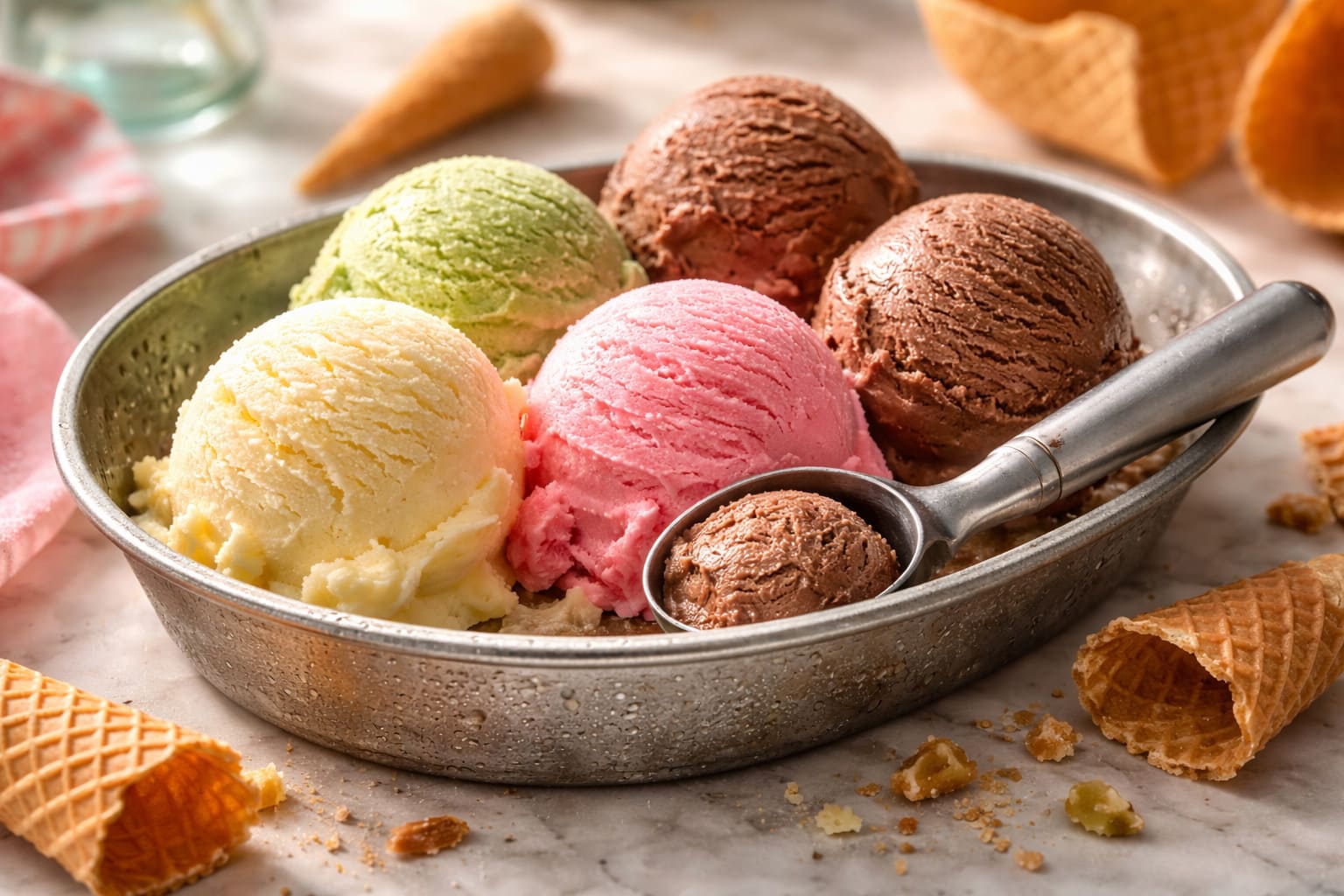
The history of ice cream has no single inventor and no single birthplace. Chilled and iced sweets were known in Persia, China and Rome, cooks in 17th-century France, Italy and England wrote down the first recipes for frozen cream, and in the United States a dairy dealer named Jacob Fussell turned it into a business in 1851-52. The famous origin stories mostly fall apart when you look for the documents.
Snow before freezers
Cold sweets are older than any way of making them. Britannica notes that ancient peoples, the Greeks and Romans among them, cooled food with ice carried down from the mountains, and that wealthy households kept snow in cellars: pits dug into the ground and insulated with wood and straw. Packed snow and ice could last for months that way, and stored ice stayed the main means of keeping things cold until the early 1900s.
Some of the earliest hints of dessert are thin. A Roman cookbook of the first century includes sweet dishes sprinkled with snow. In China, the Tang-era miscellany Youyang Zazu describes a butter-like frozen sweet called sushan. A Song poem by Yang Wanli was once read as an "Ode to Ice Cheese" and cited as proof of early Chinese ice cream, but scholars later concluded its title was "Ode to Butter." The neat line from a Chinese snow dessert to a modern cone is a modern construction, not a documented chain.
What Marco Polo and Catherine de Medici did not do
Two stories turn up in nearly every popular history. Marco Polo supposedly carried frozen desserts from China to Italy. The problem is that he does not mention them in his writings. Catherine de Medici supposedly brought Italian ices to France when she married in 1533. No evidence supports that either, and no Italian chefs are recorded at the French court in her time.
What the record does show begins in the 1600s, and it is a crowd of cooks more than a single hero. Jean Fargeon's 1665 catalogue in Montpellier lists a frozen sorbet. Nicolas Lemery's Recueil de curiositez (1674) has a French recipe for flavored ices. An account of a 1671 banquet for Charles II, written by Elias Ashmole, is the first recorded mention of ice cream in English. Antonio Latini's Italian cookbook Lo Scalco alla Moderna printed sorbetti in its 1694 edition.
Salt, ice and a tin pot
The trick that makes a frozen cream possible is old kitchen physics. Salt added to ice lowers its melting point, so the mixture draws heat out of whatever sits in the middle. By the late 1600s cooks were using it to freeze sorbets and creams.
The first English recipe for ice cream appeared in Mrs Mary Eales's Receipts in London in 1718. It calls for tin pots packed in ice and bay salt. This is the method that stayed in use for the next century and a half: a pot of sweetened cream, a tub of crushed ice, a lot of salt, and a cook who kept scraping the frozen edge into the middle.
Procope's Paris
Francesco Procopio dei Coltelli, born in Palermo, opened a cafe in Paris in 1686 that served ice cream. By one account about 250 more Paris cafes selling it followed over the next fifty years. That is the real Italian contribution to the story: not a court secret handed to a queen, but a trade, practiced by people who knew how to cut ice and sell cold sweets across a counter. It sits beside the long French story of sugar and sweets, told in the history of sugar and in the history of French cuisine.
Across the Channel the business followed. Domenico Negri opened a shop in Berkeley Square, London, in 1769, and Frederick Nutt's The Complete Confectioner (1789) gave 31 ice cream recipes.
Washington's ice pots and Jefferson's recipe
Ice cream reached the American elite before it reached anyone else. Mount Vernon's records show that the first reference to ice cream there dates to May 1784, when a "Cream Machine for Ice" was bought for one pound, thirteen shillings and threepence. As president, George Washington bought tin ice cream molds, and Martha Washington served ice cream at her Friday levees. Abigail Adams wrote that guests were "entertained with Ice creems & Lemonade." A merchant's records, according to one summary, show Washington spending about $200 on ice cream in the summer of 1790.
Thomas Jefferson left an 18-step recipe in his own hand. He did not, as the common story says, introduce ice cream to America, but he did help popularize vanilla ice cream. The vanilla itself has its own path, covered in the history of vanilla.
Mount Vernon also records a detail that explains why ice cream was a table-top spectacle in 1790: the eighteenth-century version was more liquid than ours, so it was served in small footed cups called ice pots, filled from a piece of china called an icery. The Washingtons' French dinner service included 36 of the pots.
Ice cream becomes a business: Fussell and a surplus of cream
Making ice cream at home needed a household with ice, salt, a pot and spare hands. The 1840s brought a hand-cranked freezer credited to Nancy Johnson, which sped up the scraping. The step that changed who could buy it came from a milk dealer.
C. Jacob Fussell sold dairy products and cream, and the demand for cream was unpredictable. In the winter of 1851-52, he used surplus cream to make ice cream at Seven Valleys, Pennsylvania, and shipped it by train to Baltimore. After about two years he moved the work to a factory in Baltimore at Hillen and Exeter streets. Washington, D.C. followed in 1856, Boston in 1862 and New York in 1864. By 1870 his New York company charged hotels $1.00 a gallon and smaller buyers $1.25. A 2012 historical marker calls him the first person to commercially distribute ice cream in the United States.
The timing helped him. Mechanical refrigeration was only just arriving: Britannica gives 1856 for the first commercial refrigeration, by Alexander Twining, and says stored natural ice remained the principal means of cooling until the early twentieth century. Fussell's business ran on ice and trains. In 1851, the same year as his first batches, Carlo Gatti set up an ice cream stand outside Charing Cross station in London.
Cones and sundaes: more claimants than facts
The cone is usually told as a 1904 St. Louis World's Fair accident, in which a vendor named Ernest Hamwi rolled a waffle after a neighbor ran out of dishes. Abe Doumar of Norfolk, Virginia, also claimed the credit, and the story is disputed. The earliest firm evidence is older: Agnes B. Marshall's 1888 cookbook has a recipe for a "Cornet with Cream," made with baked almond cases. Antonio Valvona patented a cup-shaped waffle iron in 1902, and Italo Marchiony patented a cone mold in December 1903.
The sundae has four towns claiming it: Buffalo, Two Rivers, Ithaca and Evanston. The popular tale that it was created to dodge laws against Sunday soda sales is one explanation among several.
Questions people ask
Did Marco Polo bring ice cream to Italy?
No record supports it. Marco Polo does not mention frozen desserts in his writings, so the popular story that he carried them from China to Italy rests on nothing he wrote. The documented history of ice cream begins instead with French and English recipes of the 1600s, such as Nicolas Lemery's in 1674.
Who sold ice cream commercially first in the United States?
C. Jacob Fussell, a dairy dealer, is credited with it. In the winter of 1851-52 he made ice cream from surplus cream in Seven Valleys, Pennsylvania, and shipped it by train to Baltimore, later opening a factory there. A 2012 historical marker names him the first person to commercially distribute ice cream in the United States.
When was the first English ice cream recipe published?
Mrs Mary Eales's Receipts, published in London in 1718, contains the first English recipe for ice cream. It calls for tin pots packed in ice and bay salt. Elias Ashmole's account of a 1671 banquet for Charles II is the earliest recorded mention of ice cream in English, but it gives no recipe.
Who invented the ice cream cone?
Nobody can be named with certainty. The St. Louis World's Fair of 1904 popularized cones, and both Ernest Hamwi and Abe Doumar claimed credit. The earliest firm evidence is Agnes B. Marshall's 1888 cookbook recipe for a "Cornet with Cream," and Italo Marchiony patented a cone mold in December 1903.
Filed under Origin Stories
Want more stories like this?
One food history story, every week. No spam, just the stories behind what the world eats.