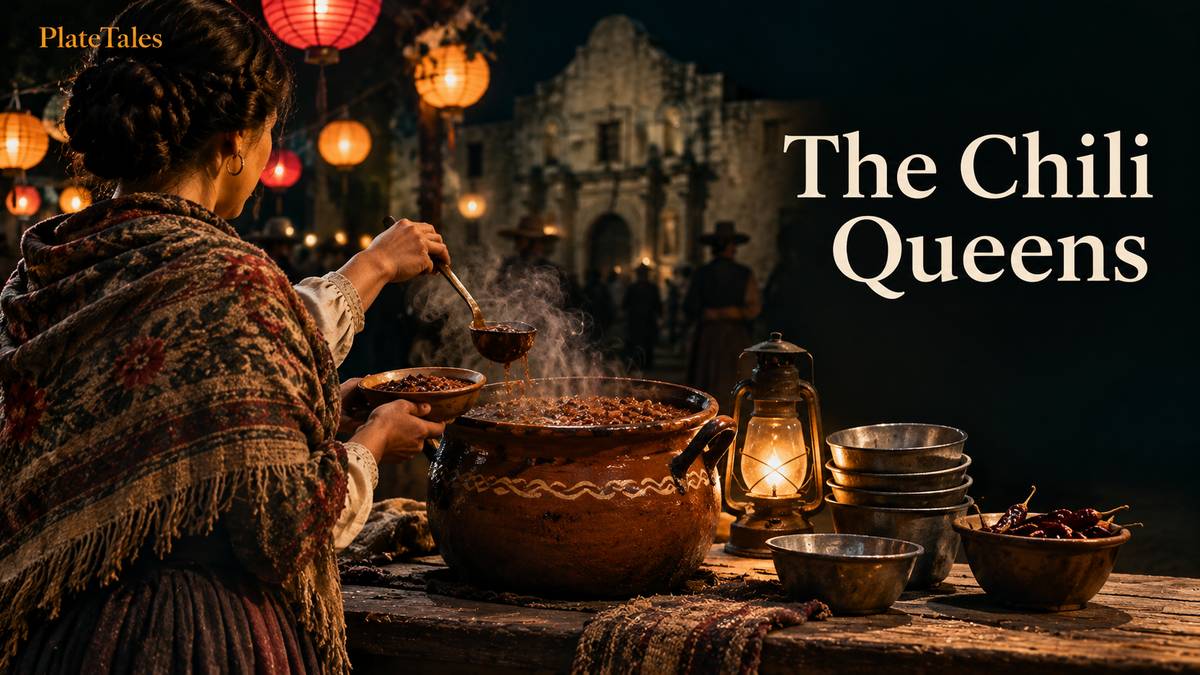
Chili con carne as Americans know it took shape in San Antonio, Texas, where Mexican American women sold bowls of it from open-air stands on the city's plazas in the decades after about 1870. Nobody can name an inventor. What the record does show is a street trade, run mostly by women, that fed visitors and townspeople at night until city health rules ended it around 1940.
The chili origin stories nobody can prove
Origin stories for chili are many and thin. One that gets repeated in Texas holds that women from the Canary Islands, brought to San Antonio as settlers under Spanish rule, were the first to sell meat stewed with peppers and cumin to the soldiers of the garrison. The San Antonio Current, in a piece on the African and Berber threads in the chili queens' cooking, passes this along as something "some people claim" and credits the retelling to Robb Walsh, the author of The Tex-Mex Cookbook. Walsh relays the claim; he does not offer a document for it.
That is the honest state of the early record in the sources we could read. A dish of meat, chiles and spice is the kind of thing a household cooks for generations without writing down. What was written down came later, and it came from travelers who stood in a plaza with a bowl in their hands.
The women who ran the plazas
The railroad reached San Antonio in 1877, and Lewis Fisher, a local historian, told Texas Public Radio that travel writers then began featuring the chili queens in magazines. Texas Public Radio dates their heyday from about 1870 to 1930. A history in the Journal of San Antonio, published by the University of the Incarnate Word, puts it a little earlier, with the stands running from the 1860s into the late 1930s.
The stands set up at night on Military Plaza, Alamo Plaza and Plaza de Zacate. Many of the women lived nearby in Laredito, "Little Laredo," according to Graciela Sanchez of the Esperanza Peace and Justice Center. Lilliana Saldana, a professor of Mexican American studies at the University of Texas at San Antonio, says the work probably began around 4 in the morning, with the cooking done long before the first customer. Fisher lists what was on offer: chili, enchiladas, tamales and menudo.
The Journal of San Antonio names two of the earliest queens, Sadie and Martha. It describes Sadie as Anglo-Celtic and Martha as Hispanic, which is a reminder that the trade was never one tidy community. Musicians worked the stalls too. Texas Public Radio reports that they tried to earn three or five cents a song, per stall.
What visitors wrote
Stephen Crane, the author of The Red Badge of Courage, recalled the plazas in 1895. The Journal of San Antonio quotes him describing the food as tasting like "pounded fire-brick from Hades." He did not say it as an insult, or not only as one. He also wrote of lamps glowing with "a tender radiance" and a hum of talk.
O. Henry, who knew the town in the 1880s and 1890s, wrote of the Alamo Plaza encampments as "a carnival," with hundreds of caterers and thousands of patrons, in the Journal's account. Maury Maverick, later a congressman and the mayor of San Antonio, remembered the stands from boyhood, around 1900, and the way people walked in circles around the square the way they would in Mexico.
Chili con carne history on a map: where the stands moved
The queens did not stay put. In 1889 the city built its City Hall on Military Plaza, which ended the tables there. After the Municipal Market House opened in Market Square in 1900, the stands moved to Haymarket Plaza and Milam Park, according to the Journal of San Antonio. A 1930s city booklet it quotes describes Haymarket Square on lantern-lit nights, with musicians paid in food.
A photograph from 1933 shows chili stands at Haymarket Plaza, including a tent whose origin is unclear. Walsh guessed that fans of chili from the nearby Army posts supplied it, a guess the Current repeats and marks as such.
By then the trade was already shrinking. The Journal says the number of queens "gradually dwindled." It also says that during a cholera epidemic the women left their tables to nurse the sick and dying, and that some of them caught the disease and died.
Why the chili queens were shut down
Accounts differ on the date, and they differ in a way worth stating plainly. Texas Public Radio says the queens had been driven from the downtown plazas by the 1930s. The San Antonio Current says they were gone before 1940. The Journal of San Antonio says the City Council had closed the stands at various times for sanitary reasons, only to reopen them after public protest, and that in the early 1940s the City Health Department closed them for good, citing unsanitary dishwashing.
The reasons are layered. Fisher says sanitation became an issue as people grew more aware of germs around the turn of the century. Sanchez says indoor restaurant owners, who paid rent and carried costs that the queens did not, complained to the health department. Saldana says new inspection and health certificate rules made things harder, and that the queens tried to resist before they "eventually were banned." None of the pieces we read give the text of a rule or the day it took effect.
Chili powder and a German in New Braunfels
Chili left the plaza in a tin. William Gebhardt was born in Germany in 1875 and came to the United States with his family in 1883, according to the University of Texas at San Antonio library's collection on his company. The family settled in New Braunfels, Texas. In 1892 he opened a cafe in the back of a saloon there. He had become interested in Mexican food through visits to San Antonio, about thirty miles south.
In 1896 Gebhardt registered the Eagle Brand Chili Powder trademark and opened a business in San Antonio to make and sell the powder. The library's account says he imported ancho peppers from Mexico, ground them several times and stored the powder in airtight containers. Around 1908 he published Mexican Cooking, which the library calls one of the first Tex-Mex cookbooks. In 1911 he took out a butcher's license and began canning chili con carne and tamales.
Whether he made the first chili powder is argued; the sources differ, and we have not settled it here. What the library's records support is narrower and still large: by the early 1900s a cook in a town with no chili queen could buy the flavor of San Antonio in a can.
A parlor on Vine Street: Cincinnati chili
The dish travelled and changed. In Cincinnati, the first Empress Chili parlor opened on October 24, 1922, at 9th and Vine streets, where the public library's south plaza now sits, according to WVXU. Brothers Tom and John Kiradjieff, Macedonian immigrants, are credited with introducing what came to be called Cincinnati-style chili. They named the parlor for the Empress Theatre next door, and had begun with a hot dog stand before moving into the storefront.
That is a different bowl from the one the queens sold in Texas, and a different set of cooks. It came from a different set of immigrants too, which is one reason a single "authentic" chili is hard to defend. The street food that began beside the Alamo was already being rewritten two states away within a generation.
The tables on Military Plaza went in 1889, when the City Hall rose there. For more of the street trade, see the street food stories. For another American street food with a disputed origin, there is the history of hot dogs, and for a Tex-Mex cousin, who invented nachos and the history of queso dip.
The state dish
In 1977 the Texas Legislature named chili the official state dish. The Texas State Library's list of state symbols gives the measure as House Concurrent Resolution No. 18 of the 65th Legislature, and lists the dish as chili con carne. The women who built the trade had by then been off the plazas for decades.
Questions people ask
Who were the chili queens of San Antonio?
The chili queens were women, mostly Mexican American, who sold chili, enchiladas, tamales and menudo at night from stands on San Antonio's Military Plaza, Alamo Plaza, Plaza de Zacate and later Haymarket Plaza. Sources date the trade from the 1860s or 1870s until the 1930s or early 1940s.
Is chili Mexican or Texan?
The best-documented early trade in chili con carne is the San Antonio plaza stands of the 1870s onward, and the Texas Legislature named it the state dish in 1977. Earlier origins are claimed, including a story about Canary Islander settlers, but the sources we read offer no document proving them.
Who made the first chili powder?
William Gebhardt of New Braunfels, Texas, registered the Eagle Brand Chili Powder trademark in 1896 and opened a San Antonio business to make it, according to the University of Texas at San Antonio library. Whether his was the very first chili powder is disputed.
When did Cincinnati chili begin?
Cincinnati chili is traced to the Empress Chili parlor, opened on October 24, 1922, at 9th and Vine streets by the Macedonian immigrant brothers Tom and John Kiradjieff. They named it after the Empress Theatre next door, and WVXU credits them with introducing the style.
When did the chili queens end?
Accounts differ. Texas Public Radio says they were driven from the downtown plazas by the 1930s, and the San Antonio Current says they were gone before 1940. The Journal of San Antonio says the City Health Department permanently closed the stands in the early 1940s over dishwashing conditions.
Filed under Street Food
Want more stories like this?
One food history story, every week. No spam, just the stories behind what the world eats.