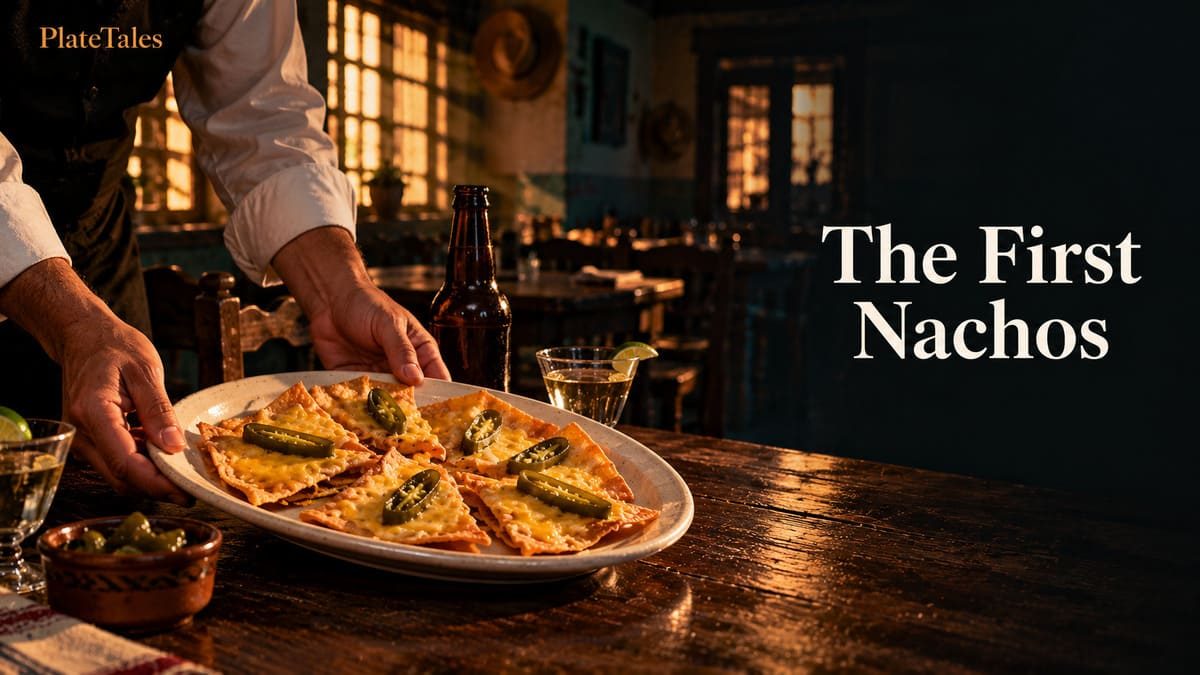
Nachos were invented by Ignacio "Nacho" Anaya, a waiter and later head cook in Piedras Negras, Mexico, who melted cheese over fried tortilla pieces for four women visiting from Eagle Pass, Texas. Anaya himself dated that afternoon to 1940, three years before the date most pages give. By 1948 the snack was already on menus in San Antonio.
Few famous dishes have a paper trail like this. Most origin stories fall apart when you ask for documents, as the tale of the Earl of Sandwich and his card table tends to. Anaya was interviewed by newspapers while he was alive, more than once, and the reporters wrote down what he said. They just could not agree on how to spell his name.
The oldest paper trail: a 35-cent hors d'oeuvre in 1948
The earliest printed nachos anyone has found are advertisements. The person who found them is Barry Popik, an etymologist (someone who traces where words come from) who combs digitized newspapers for first uses of food words.
On January 28, 1948, the Latin Quarter Mexican Restaurant at 305 W. Josephine advertised "Nachos" in the San Antonio Light as a Mexican hors d'oeuvre for 35 cents. The ad called them "a real dainty" and described them: "Golden fried tortilla strips, deliciously spiced, topped with mellow, melted cheese and garnished with chili jalapeno bits."
On May 15 of the same year, Roxy's at 2200 Broadway listed "Nachos" among its short orders with no description at all. Customers were apparently expected to know.
A year later the word reached a book. In Jane Trahey's A Taste of Texas (Random House, 1949), a character named Pedro promises that "nachos make one romantic." The Oxford English Dictionary uses that page as its earliest citation. It calls the origin "uncertain" and says Anaya "is often credited with creating the first nachos."
None of these early mentions names an inventor. For that we have to wait until 1954.
Ignacio Anaya's own story of the first plate
On May 23, 1954, the San Antonio Express and News ran a feature by Clarence J. La Roche under the headline "Nacho's? Natch!" Piedras Negras sits on the Rio Grande, directly across from Eagle Pass, and La Roche had talked with the cook people along the border pointed to.
In his telling, four Eagle Pass ladies walked into the Victory Club dining room one afternoon in 1940. "Nacho, we're tired of the usual type snacks with our drinks," one said, and asked if he could make something new.
He went into the kitchen. "I saw a bowl of freshly fried pieces of tortilla; then I figured some grated cheese on them might be all right," he said. Jalapeno strips went on top of the cheese, and the plate went into the oven until the cheese melted. "Honestly," he admitted over a bottle of cold Bohemia beer, "I didn't have the least idea what I was going to try."
When one of the women asked what the snacks were called, he answered: "I guess we can just call them 'Nacho's Special.'" He figured he would never hear of them again. Instead the women demanded a second batch, and as soon as he passed the method on to the staff, a club waiter named Gaspar Salazar got an order for "Nacho's."
By 1954, La Roche wrote, the snack had been moving up and down the border for 14 years, and other towns claimed it as their own. The reporter had watched Frank G. Huntress Jr., president of the company that published his newspaper, show the waiters at a drive-in in Matamoros how to make them. The two men had also stopped at a restaurant in Xochimilco, near Mexico City, to explain the recipe to the cook.
By then the inventor was the Victory Club's jefe de cocina, its head chef. He was a native of Chihuahua and had been with the club 16 years.
La Roche spelled his name Amaya. So did the San Antonio Light in 1961. So did the Corpus Christi Times on March 25, 1974, which printed a correction two days later: "The original 'Nacho' is named Ignacio Anaya. We called him Amaya."
Why are they called nachos?
Nacho is the ordinary Spanish nickname for Ignacio, the way Bill is for William. The dish was "Nacho's Special," with an apostrophe, because it was the special that Nacho made.
The apostrophe did not last. In January 1954 the San Antonio Express gave its weekly $10 recipe prize to a reader for her "Nachos Specials." In December its food editor, Susan Hart, wrote that "Mexican Nachos, which were originated in Piedras Negras by Chef Ignacio, are fast becoming accepted popular appetizers."
The 1948 ads had already dropped the word "special." A man's nickname had become a plural noun, and few of the people ordering it knew there was a man behind it.
Where were nachos invented, and was it 1940 or 1943?
Everyone agrees on the town, Piedras Negras, in the Mexican state of Coahuila. The year and the building are where the accounts split.
| Printed | Source | Year given | Place given |
|---|---|---|---|
| May 1954 | San Antonio Express and News | 1940 | Victory Club |
| June 1969 | San Antonio Express and News | mid-1940 | Moderno Restaurant |
| March 1974 | Corpus Christi Times | June 1940 | Cafe Moderno |
| Recent retellings | Popular web histories, Google's 2019 Doodle | 1943 | Victory Club |
The standard modern version says 1943 and calls the customers wives of American officers or soldiers stationed at Fort Duncan or the Eagle Pass air base. The three interviews from Anaya's lifetime that give a year all say 1940, and none of them mentions the military. The 1974 column even names two of the women: a Mrs. Paul Steele and a Mrs. White.
The base is the problem for 1940. According to the Texas State Historical Association, Eagle Pass Army Air Field was activated in 1942. Fort Duncan had been a city park since 1935, and the mayor offered it to the military only in 1942, after which its country club served as an officers' club for the airfield.
So military wives fit a 1943 story and cannot fit a 1940 one. Either the year drifted later and picked up the officers along the way, or the wives were real and Anaya got his own year wrong in three separate interviews. The first seems likelier, which makes 1940 the better supported date.
The building is harder. In 1954 the scene is the Victory Club. In 1969 reporter Bill Salter put Anaya at "the old Moderno Restaurant" as a waiter in mid-1940, while also saying he worked at the Victory Club until 1961. A 1961 Light article mentions both places too. An Eagle Pass church cookbook from 1970, cited by the OED, says the snack "originated some years ago in Old Victory Club." Nothing we have read settles it.
What Anaya got out of it
Salter's 1969 article ran under the headline "'Nacho' Inventor hasn't profited." It also gives the best clue to where the idea came from. Anaya was born in 1895 in Chihuahua and was raised by a foster mother after his parents died.
"This woman who raised me used to feed me quesidias," he said, meaning quesadillas, tortillas folded around melted cheese. Salter described a true nacho as "a tortilla quarter, Wisconsin cheese and a sliver of jalapeno pepper." That is close to the quesadilla opened flat, and a cousin of the fillings in the long history of the taco.
Since November 18, 1961, Salter reported, Anaya had run Nacho's Restaurant on Highway 57, two miles from the international bridge. (Google's 2019 Doodle calls it El Nacho and says it was open by 1960.) By 1974 he was 78, had nine children, and ran a dining room that could seat 100.
After the war, the Corpus Christi paper said, a group of investors had wanted to back a chain of "Nacho" food stands in the United States. He stayed in Piedras Negras and said he had no regrets. Asked for his secret, he said: "I use Wisconsin cheese."
Are nachos Mexican or American?
Both, and the record shows exactly how. A Mexican cook made them in a Mexican restaurant for women from Texas, later with cheese from Wisconsin, and the first people to print the word were Texas newspapers. It is a small, well-documented case of how migration and trade built American food.
The San Antonio Light reported his death on November 12, 1975: "Ignacio Anaya, originator of the famous 'nachos,' a Mexican food operator, died in Piedras Negras last Sunday." Piedras Negras later put up a plaque in his honor and holds an International Nacho Festival every October.
Who invented stadium nacho cheese?
The year after Anaya died, his snack was rebuilt for a ballpark. Frank G. Liberto, born in 1933, ran a San Antonio concession supply company, Ricos, whose family business went back to a grocery and butcher market the Libertos were running by 1909. According to the company's own history, it introduced "Concession Nachos" at Arlington Stadium, then home of the Texas Rangers, in 1976: fried tortilla chips with a cheddar cheese sauce and jalapeno peppers.
Nobody at the stand had to grate cheese or wait for an oven. The sauce came out of a pump, and Ricos says Liberto later helped design its first cheese dispensing equipment. Grated cheese needs a kitchen. A sauce only needs a counter, which is what a ballpark line has.
Movie theaters followed. Ricos says John Rowley, president of United Artist Theatres, ordered 75 setups, which turned into a 60-day trial at three cinemas. In 1977 the company paid $25,000 for an animated film starring three characters named Rico, Pepe and Nacho. Ricos claims it sold 100,000 orders a day for the next 18 months.
By the company's account, in 1980 the National Association of Concessionaires recognized Liberto as the "Father of Nachos" and nachos as the fourth greatest concession item, quick work for a snack that had shared the stands with the hot dog for only four years. Television helped. Liberto credited a Monday Night Football broadcast of a Dallas Cowboys game, which he remembered as 1977, when announcer Howard Cosell mentioned nachos several times. Other accounts date it to September 4, 1978.
Arlington Stadium, where the pumped version began, was torn down in 1994. Liberto died in San Antonio on November 5, 2017, at 84.
Questions people ask
Why are nachos called nachos?
Nachos are named for Ignacio "Nacho" Anaya, the cook in Piedras Negras, Mexico, who made them. Nacho is the ordinary Spanish nickname for Ignacio. The plate was first "Nacho's Special," meaning the special Nacho made, and the apostrophe and the word "special" were dropped as the snack spread through Texas menus.
Were nachos invented in Mexico or Texas?
Nachos were invented in Piedras Negras, in the Mexican state of Coahuila, across the Rio Grande from Eagle Pass, Texas. Ignacio Anaya made the first plate for women visiting from Texas. The earliest printed ads and the first recipe prize came from San Antonio newspapers, so the dish has roots on both sides of the border.
Was the first plate of nachos made in 1940 or 1943?
Anaya's three newspaper interviews that give a year, printed in 1954, 1969 and 1974, all say 1940. The common 1943 date comes from later retellings that add military wives. Eagle Pass Army Air Field was only activated in 1942, so 1940 is the better supported date for the first plate of nachos.
What was in the original nachos?
The original nachos from Piedras Negras were fried tortilla pieces topped with grated cheese and strips of jalapeno, then heated in the oven until the cheese melted. A 1969 interview described a true nacho as a tortilla quarter, Wisconsin cheese and a sliver of jalapeno, close to an opened-flat quesadilla.
Who invented the nacho cheese used at stadiums?
Frank G. Liberto of the San Antonio supply company Ricos introduced "Concession Nachos" at Arlington Stadium, then home of the Texas Rangers, in 1976. According to the company, they were tortilla chips with a pumped cheddar cheese sauce and jalapeno peppers, which a ballpark stand could serve without grating cheese or using an oven.
Filed under Origin Stories, Accidental Inventions
Want more stories like this?
One food history story, every week. No spam, just the stories behind what the world eats.