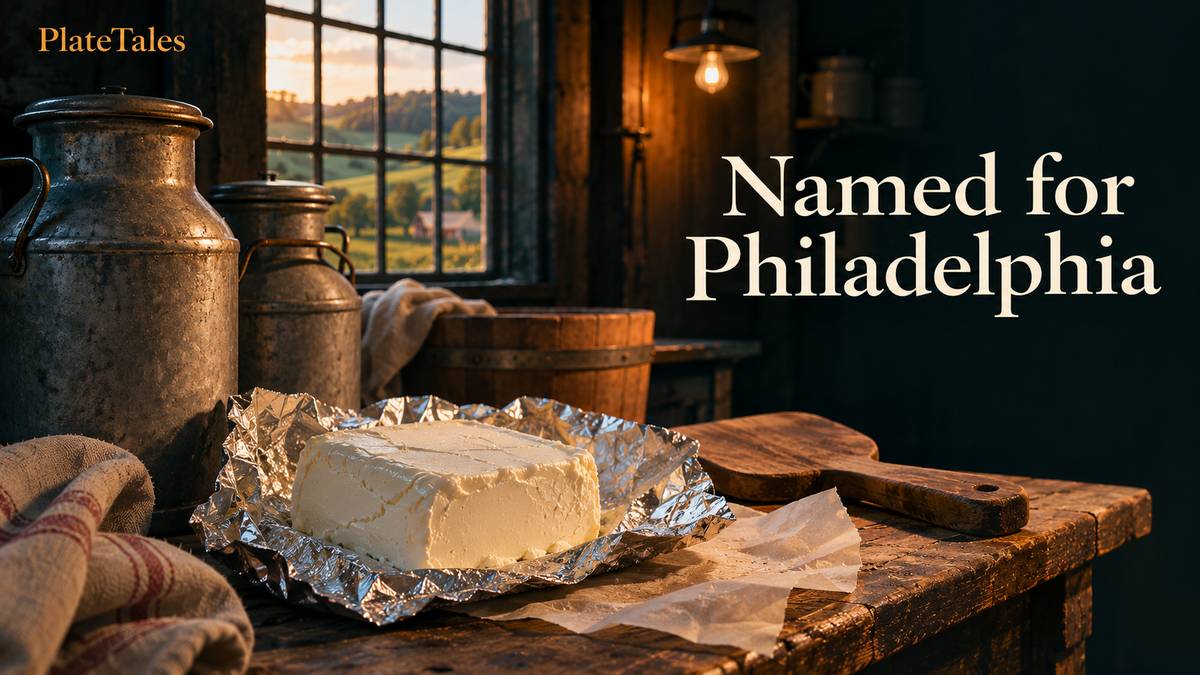
Cream cheese begins in Chester, New York, where dairyman William A. Lawrence started making a cheese richer than French Neufchatel in the 1870s. In 1880 a New York distributor, Alvah Reynolds, began selling it under the name "Philadelphia." The cheese was never made in Philadelphia. The name was a sales decision about reputation.
A dairyman in Chester, Orange County
Lawrence did not invent the idea of a cheese made with cream. Charlene Mires, a historian at Rutgers-Camden, writes in the Encyclopedia of Greater Philadelphia that cream-based cheese reached the Philadelphia region from England, where the upper class favored it, and that farm women around the city made it for local sale. It spoiled quickly, so it stayed close to home. Visitors and cookbooks in the early 1800s praised it.
What Lawrence changed was the scale. Mires gives his dates as 1842 to 1911 and says he opened a cheese factory in Orange County, New York, in 1862. In 1875, after a request from a Manhattan grocer, he became the first to make cream cheese in a factory.
The start date is not settled. A 2019 piece in the Daily Maverick, which draws on the research of Jeffrey A. Marx, says Lawrence began making cream cheese in Chester in 1872, modeling it on Neufchatel but adding more cream. In an interview with the public radio program Marketplace, Marx, a rabbi who has studied the subject, places Lawrence making cream cheese on his Chester farm in 1877. Accounts differ, and the safe statement is that it happened sometime between the early 1870s and 1877.
For the wider background on soft cheeses and aged ones, see our history of cheese.
Why is it called Philadelphia cream cheese?
Because buyers in New York already trusted the word. Mires explains that railroads, from the 1830s on, carried Philadelphia-area cream cheese to New York City, where fine restaurants and markets sold it as "Philadelphia cream cheese." The place name meant quality before any factory used it.
Reynolds (1830 to 1925) joined Lawrence in 1880. Marx told Marketplace that up to then the box simply said it was sold by Lawrence. "Reynolds is a marketing genius," Marx said, and he described Reynolds telling Lawrence the cheese needed a name, and that Philadelphia had a long reputation for fine cheeses. The Daily Maverick says the label changed from "Neufchatel & Cream Cheese" to "Philadelphia." Mires adds that Reynolds chose the name to suggest high quality, and that he made the cheese from 1882 to 1903.
Chester, in other words, made it and Philadelphia only lent its reputation.
| Year | What the sources say |
|---|---|
| 1862 | Lawrence opens a cheese factory in Orange County (Mires) |
| 1872 | Lawrence starts making cream cheese in Chester (Daily Maverick, citing Marx) |
| 1875 | First factory-made cream cheese, for a Manhattan grocer (Mires) |
| 1877 | Lawrence making cream cheese on his Chester farm (Marx, to Marketplace) |
| 1880 | Reynolds joins Lawrence and the Philadelphia name is chosen |
| 1903 | Reynolds sells the brand to the Phenix Cheese Company (Mires) |
| 1928 | Phenix merges with Kraft Foods of Chicago (Mires) |
The square block and the foil
Cheese had mostly been made in round hoops. Marx told Marketplace that Lawrence wrapped his cream cheese in manila tissue, in forms about 3 by 4 inches, and that squares pack tighter into a shipping box than rounds do. He called it one of the moments when a product's shape changes for manufacturing reasons.
Reynolds, in Marx's telling, also suggested tin foil, because a name was easier to imprint on it. A spokeswoman for the later brand owner told Marketplace in 2017 that the company had no details on the origin of the brick shape, but that cheese had been wrapped in foil since the late 1800s.
Mires dates the foil-wrapped block a little later. She writes that in the late 1920s stabilizers made foil-wrapped blocks possible, replacing earlier round packaging. The two accounts do not fit neatly, and a reader should treat the exact moment the brick took its form as open.
In Britain the foil lasted a shorter time. Marketplace reports that the brand there used tin foil only from the 1960s to the 1980s, and that new packaging arrived between 1977 and 1985 with a tub that replaced what the company's own history page called "fiddly foil packages."
Bagel and cream cheese: a Lower East Side pairing
The pairing that now defines New York breakfast came decades after Chester. The Daily Maverick, following Marx's essay on the subject, says that Jewish immigrants on the Lower East Side from the 1880s ate rye bread with schmaltz or butter and pickled herring. Bagels then were hard, pretzel-like rings that people dipped rather than spread.
Between about 1895 and the mid-1920s, the same account says, bagels became plumper and soft enough to slice. They turned into what it calls "a bread for spread." If you wonder how the ring shape came about, our story on why bagels have holes covers that.
In 1923, according to the Daily Maverick, Breakstone Brothers Dairy introduced a five-pound cream cheese block called Downsville Cream Cheese, sold to Jewish retailers and promoted as a bread spread with no mention of bagels. Lox came in as the third piece. Russ & Daughters opened on the Lower East Side in 1914, and the founders' great-granddaughter, Niki Russ Federman, told the paper the lox was "so salty it needed the cream cheese to cut the salinity."
The article places the combination in the mid-1920s, probably on the Lower East Side, where about 30 "appetising" stores sold fish and dairy. It does not name who first halved a bagel and filled it,, and the record is silent on it.
By 1952 the New York Times called it "an old New York Sunday morning tradition: bagels, cream cheese and lox."
From a factory in Chester to a household name
Reynolds sold the Philadelphia brand to the Phenix Cheese Company of New York in 1903, and Phenix merged with Kraft Foods of Chicago in 1928, Mires writes. Advertising then aimed at families and home cooks, pitching the cheese for snacks, spreads and recipes. Mires cites a 1948 advertisement in Ladies' Home Journal as one example.
Mass production moved cream cheese from a luxury to an everyday food, she writes, and the product became tied to New York through bagels and New York-style cheesecake.
The cheese is still made in Lowville, New York, which holds an annual Cream Cheese Festival. At the thirteenth festival the town baked a cheesecake of about 6,900 pounds, recognized by Guinness World Records in 2017.
Questions people ask
Who invented cream cheese?
William A. Lawrence, a dairyman in Chester, New York, is credited with first making cream cheese in a factory. Historian Charlene Mires dates this to 1875, while accounts drawing on Jeffrey Marx give 1872 or 1877. Cream-based cheeses had been made on farms near Philadelphia before then.
Why is Philadelphia cream cheese called that if it comes from New York?
New York distributor Alvah Reynolds chose the name in 1880 because Philadelphia had a long reputation for fine cheese. Railroads had carried Philadelphia-area cream cheese to New York since the 1830s, so buyers already linked the city with quality. The cheese itself was made in Chester, New York.
Is cream cheese from Chester, New York?
Lawrence made the first factory cream cheese in Orange County, where Chester sits, and historian Jeffrey Marx places his production on a Chester farm in 1877. The brand later passed to the Phenix Cheese Company in 1903, which merged with Kraft in 1928. The cheese is still made in Lowville, New York.
When did people start eating bagels with cream cheese?
The Daily Maverick, following Jeffrey Marx, places the bagel, cream cheese and lox combination in the mid-1920s, probably on New York's Lower East Side. A five-pound cream cheese block was marketed to Jewish retailers in 1923. By 1952 the New York Times called the trio an old Sunday tradition.
Filed under Origin Stories
Want more stories like this?
One food history story, every week. No spam, just the stories behind what the world eats.