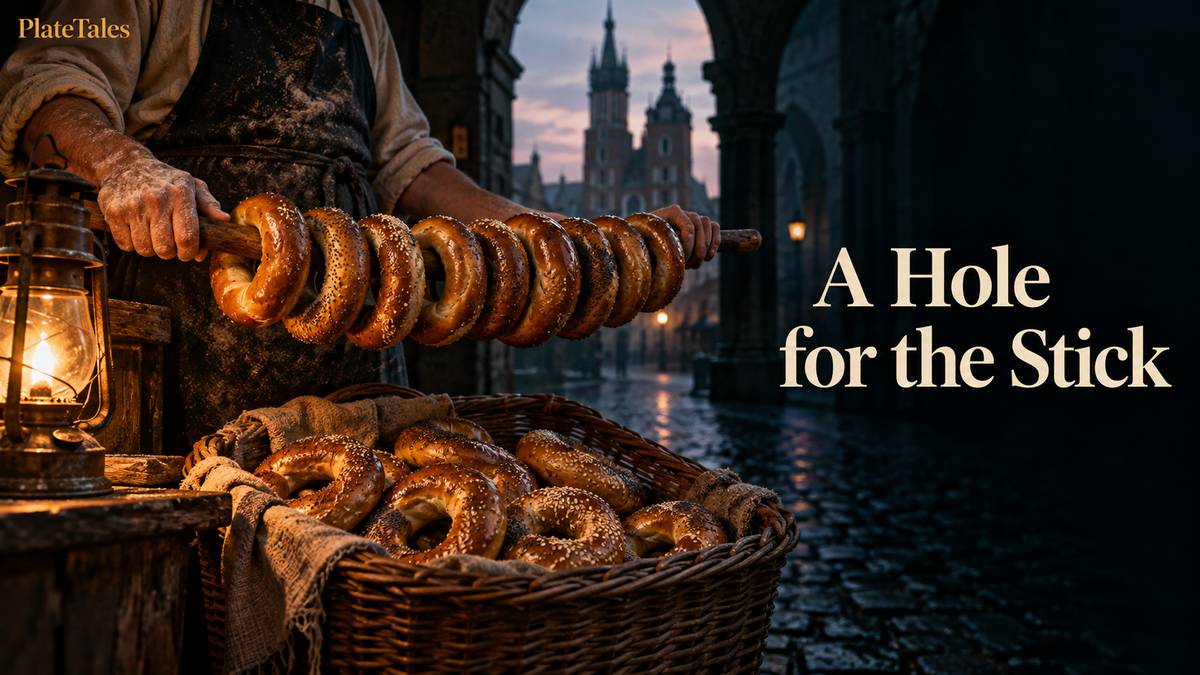
Bagels have holes for two practical reasons. A ring of dense dough cooks through evenly, first in boiling water and then in the oven, and a ring can be threaded on a stick or a string and carried to market. The oldest written mention of the word, in 1610 rules of the Jewish community of Kraków, says nothing about the hole. It did not need to.
By then Kraków had been buying boiled rings of bread for more than two centuries. The other stories about the hole (a king's stirrup, the circle of life, a charm against demons) are either later than the bread or meanings laid on top of a shape that already existed.
The stirrup story, pinned to a battle 73 years too late
The most repeated version goes like this. In 1683 Jan III Sobieski, king of Poland, rode to the rescue of Vienna, which the Ottoman army had under siege. A grateful baker shaped dough like the king's stirrup and called it a beugel, which Joan Nathan's retelling glosses as the Austrian word for stirrup. Hence the bagel, and hence the hole.
The dates kill it. The battle was in 1683, and the Kraków document that first names the bagel is from 1610. The Takeout, going through the legend, called the stirrup story "bunk" for exactly that reason. Nathan, writing about bagel history for Slate in 2008, said the story "is completely speculative and perhaps even fictitious," though it has stuck as food lore.
The siege of Vienna attracts pastry legends the way a dock attracts gulls. The crescent roll gets the same treatment, as our piece on where the croissant really comes from explains. In both cases the bread is older than the battle.
There is a real Sobieski connection, and it has nothing to do with stirrups. In 1496 King John Albert gave Kraków's bakers' guild control over white bread, including the boiled rings called obwarzanki. Nathan says Sobieski was the first king not to confirm that decree, and The Takeout says he lifted a 200-year-old rule that barred Kraków's Jews from baking white bread. If he deserves credit for anything, it is for letting more people make the thing.
What the 1610 Kraków rule actually says
The 1610 regulation is the anchor of every bagel history. It is also where the popular account gets blurry.
The version most people repeat comes from Leo Rosten's The Joys of Yiddish. According to The Takeout, Rosten wrote that the Community Regulations of Kraków in 1610 named bagels as a gift to women in childbirth. His only support was a quote from Ecclesiastes about the circle of life, which is a sermon, not a citation.
Maria Balinska, whose 2008 book The Bagel: The Surprising History of a Modest Bread is the fullest history of the subject, puts the bris at the center. A bris is the Jewish circumcision ceremony held for a baby boy eight days after birth. Sandra M. Gilbert's review of the book in The American Scholar sums it up: "As early as 1610, the Jewish Council of Kraków decreed that bagels might be distributed at celebrations of circumcision."
Balinska, speaking on the Gastropod podcast, put it more broadly: the rule "had to do with birth and bris of a male baby." She read the bagel's presence as a sign it was "something of value." So the birth was part of it, but Rosten's tidy "gift to the mother" is more than the record supports.
What kind of rule was it? Yvette Alt Miller, writing for Aish, says the council was telling families not to throw lavish parties for a bris, partly "to avoid making gentile neighbors envious." It was a rule about how much a family could spend on a celebration. The hole never comes up.
Why do bagels have holes? Ask the baker
Bagel dough is stiff and heavy. Each piece is boiled briefly before baking, and Nathan notes that the boiling "gave the roll an outer sheen and a crunchy, protective crust." A thick ball of that dough could stay raw in the middle while the outside finished. Take out the middle and there is nothing left to undercook.
Aryeh Genger, also writing for Aish, calls the reason for the hole "more practical than aesthetical." With dough this dense, he explains, a baker could not easily tell whether the center of a solid roll was done.
The second reason is handling. Nathan points out that "it's possible to thread such a roll on a stick or a string, facilitating transport." Bagels were also strung on strings and dowels for transport and display. For centuries that was how bagels were sold.
The symbolic meanings came too. Claudia Roden, in The Book of Jewish Food, describes the shape, "with no beginning and no end," as standing for the eternal cycle of life. She records the belief that bagels protected against demons and the evil eye, which is why they were served at circumcisions, during labor, and at funerals with hard-boiled eggs.
Those beliefs are real history, and they explain why the bagel showed up at those moments. They do not explain the shape. A stick through the middle is a simpler motive than a demon.
Balinska's book is built around a tale of the "wise men" of Chelm, a Polish town famous in Jewish folklore for its foolish sages. They travel to a nearby town to learn why its bagels taste better, and the baker tells them: "It's the hole that makes the bagel." Balinska herself asks what the hole represents: "Nothingness? Infinity?" The baker's answer is more use.
Where do bagels come from, if not Vienna?
The ring is older than the word. In Kraków, the first known mention of the obwarzanek is in the court accounts of Queen Jadwiga and King Władysław Jagiełło. An entry dated 2 March 1394 records one grosz spent "for the queen, for rings of obwarzanki."
The name comes from the Polish verb obwarzać, to parboil, the same boil-then-bake method as the bagel. At first, says the Obwarzanek Museum in Kraków, they were baked only during Lent. Street carts in Kraków still sell them, and since 2010 the name has been an EU Protected Geographical Indication, so only bakers in and around the city may use it.
How the Polish ring became the Jewish bagel is less settled. As Gilbert's review summarizes Balinska, the obwarzanek in Poland met a German Jewish pretzel "sometimes called the bagel or beigel." There is a further strand in the Italian ciambella, a ring cake that Balinska says traveled to Poland with a young Italian noblewoman who went on to become queen. Roden calls the bagel of "South German origin," taking its final form in the small Jewish towns of Poland.
These accounts overlap more than they compete. The name looks German, the method looks Polish, and the bakers were Jewish.
Further back the trail goes cold. Boiled-and-baked rings turn up across Europe and western Asia, including the Syrian ka'ak, Italian taralli and the Turkish simit. Nathan traces holed rolls to ancient Egypt and the Mediterranean but notes that neither was boiled, the step that makes a bagel a bagel. For the wider story, see our history of bread.
What does bagel mean?
The English word comes from Yiddish beygl. Wiktionary traces it to a diminutive of Middle High German bouc, a ring, and Roden gives the German meaning as "bracelet."
The Yiddishist Gerald Stillman, quoted in The Takeout, links it instead to the Yiddish word for "to bend," which is what a baker does to a rope of dough. Both point at the same round object. Neither points at a stirrup.
Sticks, baskets and pushcarts
Look at how bagels were sold and the hole stops being a puzzle. Roden describes vendors in Poland selling bagels from baskets or "hanging on long sticks." Hawkers needed a license. Children who sold without one, often orphans helping widowed mothers, risked a beating from a policeman and the loss of their stock.
Jerusalem bagels, Miller notes, are still sometimes "draped on wooden sticks in bakeries." In London's Brick Lane, where bagels (spelled "beigels" there) have been sold since the mid-19th century, bakeries showed them in their windows on vertical wooden dowels up to a meter long.
The emigrants carried the trade with them. Roden writes that many sold bagels from pushcarts on New York's Lower East Side and in London's East End. Her own great-uncle Jacques, who came to New York from Syria at the turn of the century, found peddling so demeaning that he went back to Egypt.
The history of the bagel in New York
By 1900 there were 70 bakeries on the Lower East Side, according to Nathan, and in 1907 the International Beigel Bakers' Union was formed. Later Bagel Bakers Local 338 controlled the city's bagel trade for decades, with contracts at nearly all the bakeries in and around the city and workers who made every bagel by hand.
In 1951, Miller writes, The New York Times covered a strike by the city's bagel bakers and had to explain the bagel to its readers as a "glazed surfaced roll with the firm white dough." Our story on how immigration built American food covers the wider shift those bakers belonged to.
Then came the machines. Daniel Thompson started work on the first commercially workable bagel machine in 1958. Harry Lender, a baker originally from Chelm, had opened a bagel bakery in New Haven, Connecticut, in 1927.
Here the sources split on a small point. Some histories say that in 1954 Lender perfected a method of freezing the bagels, while Nathan credits his son Murray, who bought a freezer after coming home from the Korean War in 1956. Either way, the family put bagels in supermarket freezers. The Lenders leased the very first Thompson machine in 1963, and Kraft bought the company in the spring of 1984.
The hole came through all of it, though the stick did not. A machine-made frozen bagel in a polyethylene bag needs no string. In February 1988 Mimi Sheraton reported in Time that at the busiest Burger King in St. Louis, around 30 percent of the breakfast crowd was choosing a bagel.
Questions people ask
Did a Polish king invent the bagel with a stirrup shape?
No. The story ties the bagel to Jan III Sobieski and his 1683 rescue of Vienna, but a Kraków document from 1610 already names the bagel, 73 years earlier. Joan Nathan called the stirrup tale "completely speculative and perhaps even fictitious," and The Takeout called it "bunk" on the same dating grounds.
What does the word bagel mean?
The English word comes from Yiddish beygl, which Wiktionary traces to a diminutive of Middle High German bouc, a ring. Claudia Roden gives the German meaning as "bracelet." The Yiddishist Gerald Stillman instead links it to the Yiddish word for "to bend," which is what a baker does to a rope of dough.
Is the bagel the same thing as the Polish obwarzanek?
They are close relatives, not the same bread. The obwarzanek is a ring of dough parboiled and then baked, and Kraków court accounts record one grosz spent on obwarzanki on 2 March 1394. Since 2010 the name has been an EU Protected Geographical Indication, so only bakers in and around Kraków may use it.
How did bagels become a New York food?
Jewish emigrants from Poland brought the trade with them and sold bagels from pushcarts on the Lower East Side and in London's East End. By 1900 there were 70 bagel bakeries on the Lower East Side, according to Nathan, and the International Beigel Bakers' Union formed in 1907.
Why were bagels once sold on sticks?
The hole let sellers thread bagels on a stick or string for carrying and display. Claudia Roden describes vendors in Poland selling them from baskets or "hanging on long sticks," and Jerusalem bakeries still sometimes drape bagels on wooden sticks. In London's Brick Lane, windows showed them on wooden dowels up to a meter long.
Filed under Origin Stories, Migration Stories
Want more stories like this?
One food history story, every week. No spam, just the stories behind what the world eats.