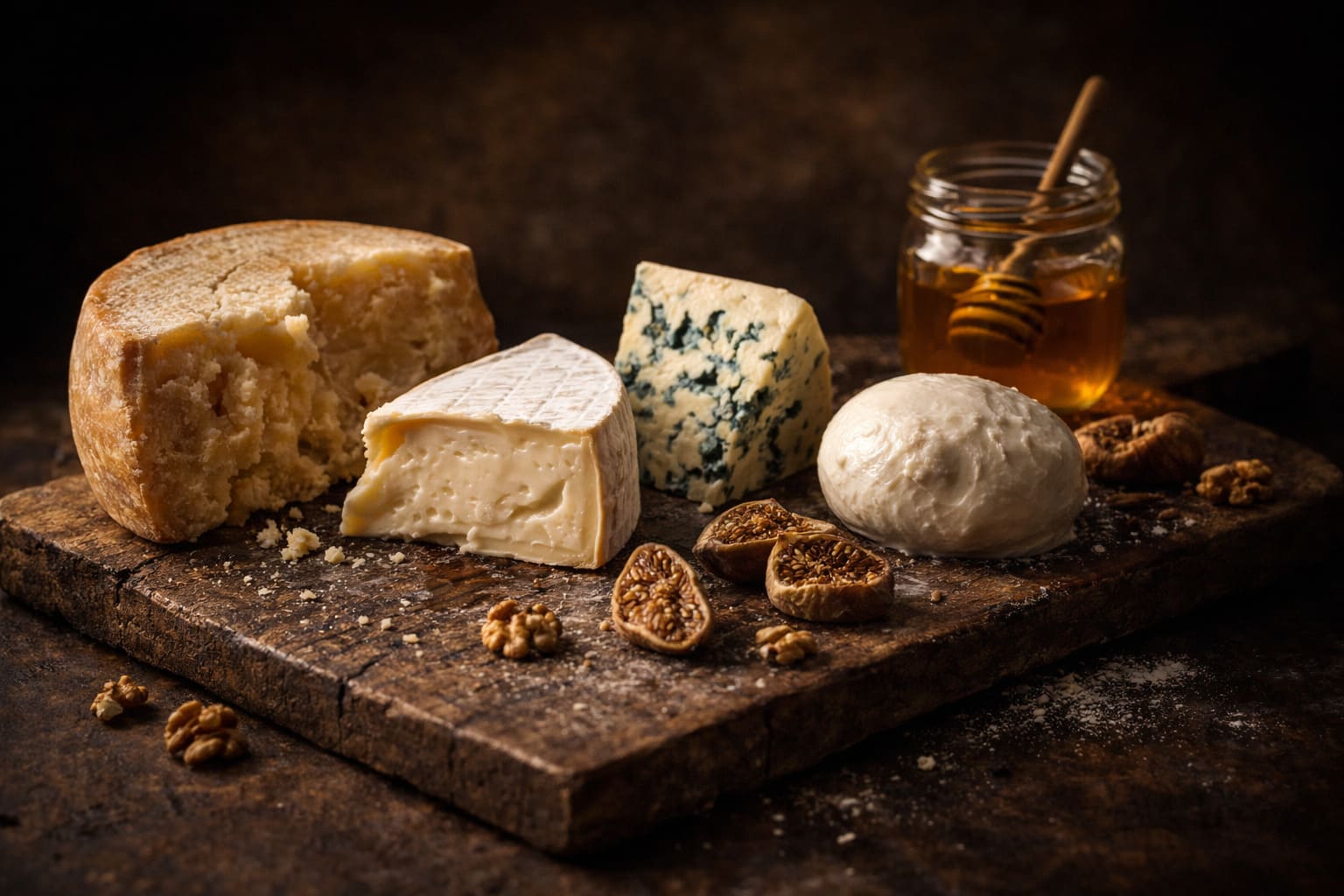
The history of cheese begins with no known inventor. The earliest hard evidence is milk fat on pottery strainers from Kuyavia, in present-day Poland, dated to about 5500 BCE, and people were probably making curds from milk well before that. The famous tale of a traveler whose milk curdled in a pouch made from an animal's stomach is a legend, not a record. It may still be close to what happened.
The traveler and the stomach pouch
The story usually runs like this. An Arab trader fills a bag made from a sheep's stomach with milk and sets off across the desert. When he stops to drink, the milk has split into pale lumps and a thin liquid. Heat, motion and the lining of the bag have done the work.
No ancient text tells it. Reference works describe it only as a legend with several variations, and none names the trader or the year. What the tale gets right is the chemistry. Britannica explains that milk forms a curd when its main protein, casein, clumps together, either because the milk sours or because it meets rennin, an enzyme found in the stomach of young animals and sold as rennet. Early cheesemaking may well have depended on the stomach linings of sheep and goats, which hold that enzyme, so the idea of an accidental first batch is plausible. It is a guess, though, not a finding.
Britannica puts the likely timing more safely: cheesemaking probably began soon after people first took milk from wild or domesticated animals.
What the pottery from Poland adds to the history of cheese
The oldest archaeological evidence comes from Kuyavia, where strainers with holes in them were found coated with milk-fat molecules. Dated to about 5500 BCE, they look like tools for separating curds from whey. There is no conclusive evidence of where cheesemaking began, and some proposals reach back to about 8000 BCE, when sheep were first domesticated.
The next oldest trace sits far to the south. On the Dalmatian coast of Croatia, the earliest evidence in the Mediterranean dates to about 5200 BCE. So by the time anyone was building cities, cheese was already an old food in two quite different places.
A strainer is not a recipe, and nothing here tells us what that cheese tasted like. Probably it was soft and fresh. Aged, pressed cheese needs more know-how, and the written proof for it comes much later.
Cheese in Egyptian tombs and on Chinese mummies
Egyptian cheese appears in tomb murals from about 2000 BCE. A scientific paper published in 2018 reported cheese dating to about 1200 BCE inside Egyptian tombs.
The oldest cheese that has survived as an actual object is older still. It was found on mummies at the Xiaohe Cemetery in the Taklamakan Desert of Xinjiang, China, and dates to as early as 1615 BCE. Dairy shows up in that same cemetery in other ways: a 2021 study led by Fan Zhang found milk proteins in the dental calculus of people buried there, placing them at about 2100 to 1700 BC.
Then there is Homer. The Odyssey, composed in the 8th century BCE, shows the Cyclops Polyphemus curdling half his sheep and goat milk and setting it aside in wicker strainers. A poet could assume his listeners already knew the process.
Britannica adds that milk from cows, and presumably other animals, was used for cheese by about 1000 BCE, and quotes the Bible's mention of "cheese of the herd" brought to King David.
How Rome turned cheese into a written craft
By the first century CE, cheesemaking had writers. Columella's De Re Rustica, from about 65 CE, describes coagulating milk with rennet, pressing the curd, salting it and aging it. Pliny the Elder's Natural History, from 77 CE, lists Roman cheese varieties and treats cheesemaking as a mature art across the empire.
That is a different picture from a pouch in the desert. Here are pressing, salt and cellars, with a farm manager's tone of voice. Rome also fed an army, and portable, long-lasting foods mattered; for that side of the story see the history of military rations, and for what else was on Roman tables see ancient Roman recipes.
Monks, abbeys and the 962 claim
The popular line is that monasteries saved cheese after Rome fell. The sources read for this article do not support that as a sweeping claim. The standard accounts say only that many monastic establishments and abbeys kept milk animals, and that their cheeses often bore a cross in the middle.
One named case shows how fuzzy the record is. Maroilles, from northern France, is often said to have been first made in 962 by a monk at the Abbey of Maroilles. The cheese certainly takes its name from the village and was a favorite of several French kings, including Philip II, Louis IX, Charles VI and Francis I. But the 962 origin is a commonly repeated report, not a firmly documented fact.
So it is fair to say abbeys made cheese and that some famous cheeses have monastic stories attached. It is not fair to treat each of those stories as proof.
Why fermented dairy was easier to live with
Most adults worldwide cannot digest the sugar in fresh milk well. Lactase persistence, the trait that lets adults do it, spread only in the last 10,000 years, alongside animal domestication. One common European variant rose to significant frequency about 7,500 years ago in the central Balkans and Central Europe.
Fermentation matters here. Britannica notes that ripening breaks lactose down into products such as lactic acid, and people without the persistence trait may still tolerate cheese and yogurt. Whey carries away most of the lactose too. That helps explain why cheese is old: milk spoils fast, and cheese is one of the oldest ways to keep it. Britannica says cheesemaking reduces about 10 volumes of milk to one of cheese. For the larger picture of preserving food through microbes, see the history of fermentation.
From farm kitchens to the factory
British colonists brought cheddar to North America and began making it soon after arriving. By 1790, American-made cheddars were being exported back to England. The Oxford English Dictionary lists the first known use of "American cheese" in a Frankfort, Kentucky, newspaper in 1804.
The next change came from Switzerland. In 1911, Walter Gerber and Fritz Stettler added sodium citrate to melted Emmentaler, looking for a cheese that would last longer. They found the mixture set solid again once cooled. In 1916, James L. Kraft filed a US patent on a method of storing cheese by sterilizing it, which halts ripening. That patent did not use emulsifiers; the first US emulsifier patent went to George Herbert Garstin and was granted in 1921.
Shelf-stable slices came after that. Kraft introduced the first commercially available, shelf-stable sliced processed cheese in 1950, and Clearfield Cheese Co. sold individually wrapped slices in the US in 1956. Under US rules in 21 CFR Part 133, a product called pasteurized process cheese food must be at least 51 percent cheese by final weight. Today's Kraft Singles do not qualify as process cheese under those regulations, and after a December 2002 FDA Warning Letter to Kraft, some of its products were relabeled.
Cheese is far from the only food credited to a lucky accident; foods invented by accident looks at others, and how many of those tales hold up.
Questions people ask
When was cheese first made?
The earliest archaeological evidence is milk-fat residue on strainers from Kuyavia, in present-day Poland, dated to about 5500 BCE. Some proposals reach back to about 8000 BCE, when sheep were domesticated, but there is no conclusive evidence of where or exactly when cheesemaking began.
What is the oldest cheese ever found?
The oldest preserved cheese found so far came from mummies at the Xiaohe Cemetery in the Taklamakan Desert of Xinjiang, China, and dates to as early as 1615 BCE. Cheese from Egyptian tombs has been dated to about 1200 BCE.
Did an Arab trader really discover cheese in a sheep's stomach?
There is no ancient record of it. The tale of an Arab trader storing milk in an animal's stomach is told as a legend with variations. The idea is plausible, since stomach linings contain rennet, but it remains a guess about how cheesemaking started.
What did the Romans write about cheese?
Columella's De Re Rustica, from about 65 CE, describes curdling with rennet, pressing, salting and aging cheese. Pliny the Elder's Natural History, from 77 CE, lists Roman cheese varieties and treats cheesemaking as a mature art in the Roman empire.
When did processed cheese begin?
In 1911 in Switzerland, Walter Gerber and Fritz Stettler added sodium citrate to melted Emmentaler and found it set solid again. James L. Kraft filed a US patent in 1916 for storing cheese by sterilizing it, and Kraft introduced sliced processed cheese in 1950.
Filed under Fermentation, Accidental Inventions
Want more stories like this?
One food history story, every week. No spam, just the stories behind what the world eats.