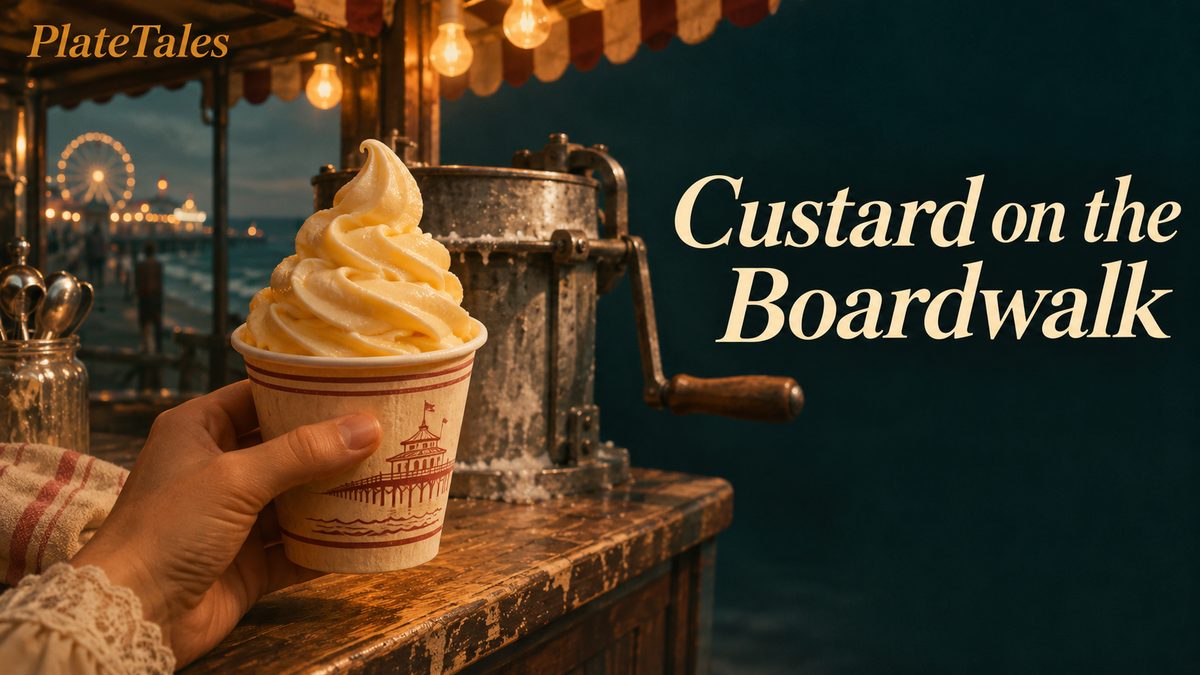
Frozen custard is soft frozen ice cream made with egg yolk, and by the company's own account it began on the Coney Island boardwalk in 1919, when brothers Archie and Elton Kohr added eggs to a mix that kept melting in the salt air. In the United States the name has a legal meaning: the federal rule for ice cream, 21 CFR 135.110, says frozen custard must contain 1.4 percent egg yolk solids by weight.
That is the short version. The long version has a date that does not quite fit, a tennis champion in St. Louis, and a federal regulation that treats the dessert as an ice cream with a different name on the sign.
What is frozen custard, by law?
The Code of Federal Regulations does not give frozen custard a section of its own. It sits inside the standard for ice cream, 21 CFR 135.110. Ice cream must weigh at least 4.5 pounds to the gallon, carry at least 10 percent milkfat and contain less than 1.4 percent egg yolk solids by weight. Once the yolk passes that line, the rule changes the name: the food may be called "frozen custard," "french ice cream" or "french custard ice cream."
The rule adds an allowance for flavors with bulk. Where chocolate, fruit or nuts take up part of the weight, the yolk content may be lower in proportion, but "in no case" below 1.12 percent of the finished food. A chocolate custard can therefore legally carry less yolk than a vanilla one.
Note what the regulation leaves out. It says nothing about the dessert being served soft, or churned slowly with little air, or made fresh in the shop. Those are habits of the stands, not requirements of the law. A hard-packed pint with enough yolk is frozen custard on paper, and soft-serve with too little is not. The history of soft serve is a separate story with its own legal definitions.
What the Kohr family says happened
The fullest account of the origin comes from the Kohr family's own history page, so it is a company telling its own story and should be read that way. It says the brothers Archie (26), Clair (21) and Elton (17), of Swiss descent, delivered milk and homemade ice cream by horse-drawn wagon. An uncle, Sylvester Kohr, told them about a machine called the Meisenhelter Ice Cream Freezer, patented in 1914.
They got a machine, took it to the Delaware Fair one fall and lost money. Uncle Sylvester then suggested the seashore. The brothers set up a booth on the Coney Island boardwalk and sold the soft product, first named "Frozen Desert," for a nickel a cone. The page says they sold more than 18,000 cones on the first weekend.
Then came the problem that gives the dessert its reason to exist. The cones melted fast in the salt air. According to the Kohr history, Archie and Elton added eggs to the mix, which made it stiffer, creamier and slower to melt. They renamed it "Frozen Custard," the family says, because it did not meet the ice cream standards of identity and they disliked the old name.
That last detail matches the regulation. Ice cream had a legal standard, the yolky product fell outside it, and a new name followed. The federal rule still works that way.
The year that does not fit
The Kohr page dates the Coney Island booth to 1919, and the same page says the family acquired its first machine in 1920 and took it to the Delaware Fair that fall. Both cannot come first.
Other accounts do not settle it. Untapped New York, in a 2021 piece by Bella Druckman, repeats the Coney Island story and the "more than 18,000 cones" figure, and says only that the brothers were handed the freezer by an uncle and failed in Delaware first. The Kohr company's homepage adds another wrinkle, saying Elton D. Kohr started the company in York, Pennsylvania, in 1918, and that the Seaside Heights stand has operated "since 1923."
So treat 1919 as the family's date for the Coney Island booth, not a documented one. No source opened for this article reproduces a newspaper notice, a license or a receipt from the boardwalk that summer. What the record does support is the sequence: a failed fair, a seaside booth, and a recipe change in response to heat.
The brothers split
Elton Kohr branched off in 1923, according to the family history, and opened his first Kohr's Frozen Custard store in Atlantic City in 1924. The company still operates on the New Jersey shore. Untapped New York adds that the original Coney Island shop no longer exists, though custard is still sold on that boardwalk.
How custard reached the Midwest
The tale of how the dessert travelled west is thinner than the popular version suggests. Untapped New York says custard reached the 1933 Chicago World's Fair and then became a Midwestern staple. Table Magazine says it moved to traveling carnivals, and that the 1933 fair helped popularize it in Wisconsin and Missouri. Neither piece cites a record of a particular stand at the fair, so the fair is best read as a widely repeated waypoint, not a proven starting gun.
The carnival route has a named person attached. Ladue News, a St. Louis-area magazine, reported that Ted Drewes Sr., who ran a swimming pool and a skating rink and was a champion tennis player, joined a traveling carnival circuit to earn winter money selling frozen custard. By that account he opened a first stand in Florida in 1929, a St. Louis stand on Natural Bridge Road in 1930, one on Grand Boulevard in 1931 and the Chippewa Street location in 1941.
Those dates put a custard stand in St. Louis three years before the Chicago fair opened. If the Ladue News account is right, the fair did not introduce the dessert to the Midwest so much as arrive in a region that already had it.
Why Milwaukee claims the crown
Milwaukee is called the unofficial frozen custard capital of the world, and Untapped New York says its creameries took up the idea and earned the title. The claim is a reputation, not a ranking. Nobody certifies a capital of custard.
A 2016 Milwaukee Journal Sentinel feature is headlined "Frozen custard didn't start in Wisconsin, but it's still the custard capital," which concedes the Coney Island origin up front.
The city's own custard families tell it as a chain of apprenticeships. Milwaukee Magazine says Paul Gilles opened a stand at 75th and Bluemound in 1938 after working as a teenager at Clark's Frozen Custard. CBS 58 reports that the first custard stand in Milwaukee was Joe Clark's, which makes Gilles the second, a point the Gilles family itself makes about the "oldest in Wisconsin" label.
Leon Schneider got his start as a night manager at Gilles, then opened Leon's on South 27th Street on May 1, 1942, when the area had three custard stores, according to a quote from his son Ron Schneider in the CBS 58 piece. Ron later built custard machines, and the same report says other operators bought their first machines from him.
In 1950 Elsa Kopp, born Elsa Moll in Germany, started Kopp's with her husband Karl, at 60th and Appleton. Milwaukee Magazine says she met Leon Schneider at a bakery where he maintained the custard machines, and that Schneider and Art Richter, who owned a stand called The Milky Way, helped her into the business. Her husband had Parkinson's, so she first worked at The Milky Way.
The history of the milkshake and the history of ice cream cover the cold-dessert trade that surrounds all of this, and the accidental inventions shelf holds other foods that began as a fix for a problem.
Milwaukee Magazine's writer Bobby Tanzilo describes the three families as rivals bound by "quality first." Who counts as first depends on the telling, since Clark came before all three.
Questions people ask
Is frozen custard the same as ice cream?
Not under United States federal rules. Ice cream under 21 CFR 135.110 has less than 1.4 percent egg yolk solids, while frozen custard must contain at least 1.4 percent by weight. Both need at least 10 percent milkfat. The same regulation lets a product above the yolk line be sold as frozen custard, french ice cream or french custard ice cream.
Who invented frozen custard on Coney Island in 1919?
The Kohr brothers, Archie and Elton, are credited. The Kohr family history says they added eggs to their soft ice cream so it would melt more slowly in the salt air at their Coney Island boardwalk booth. The page's own dates conflict, since it also places their first machine in 1920, so 1919 is the family's date, not an independently documented one.
Why do people call Milwaukee the frozen custard capital?
Untapped New York reports that Milwaukee creameries adopted frozen custard after it spread from Coney Island to the Midwest, earning the city the title "Unofficial Frozen Custard Capital of the World." The label is a reputation based on the city's many stands, not an official ranking or award.
How much egg yolk must frozen custard contain?
Federal rules require frozen custard to contain 1.4 percent egg yolk solids by weight of the finished food. When bulky flavors such as chocolate, fruit or nuts are added, the yolk content may fall in proportion, but never below 1.12 percent of the finished food, according to 21 CFR 135.110.
Filed under Accidental Inventions
Want more stories like this?
One food history story, every week. No spam, just the stories behind what the world eats.