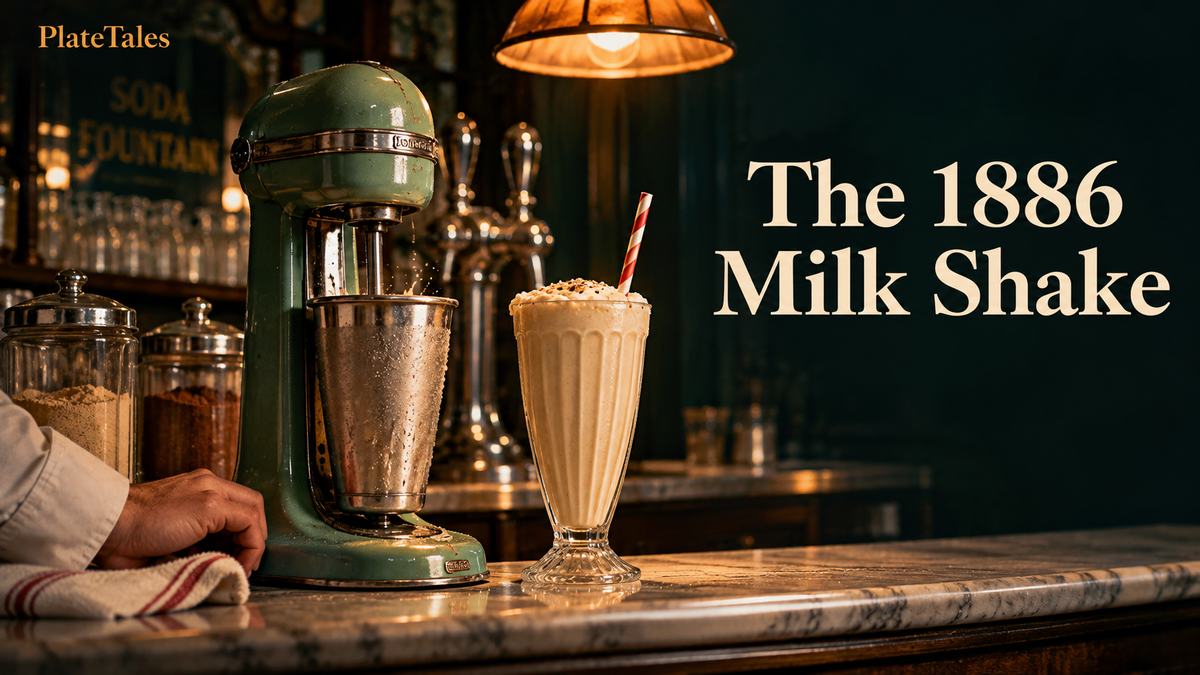
Ask who invented the milkshake and the record offers no name. The earliest dated newspaper items in Barry Popik's collection of citations are two Georgia soda-fountain notices from May 1886, one in Macon and one in Atlanta. The name later moved to ice cream drinks, and motor-driven mixers made after 1911 turned a hand-shaken drink into a counter staple.
So there is no single soda jerk to credit. What the record does show is a word that changed its meaning and a series of machines that changed the drink.
What the first milk shakes were
The Macon Weekly Telegraph of 21 May 1886 ran an advertisement from L. W. Hunt & Co.'s soda fountain, claiming that its milk-shake was "the most delicious drink ever sold in Macon." Five days later the Atlanta Constitution carried a notice from Beermann's Palace Soda Stand, at the corner of Peachtree and Decatur streets, offering "Ice cream soda and milk shakes." Both are listed by Popik as the earliest dated citations he found.
Many popular accounts say the term first appeared in print in 1885 for a "sturdy, healthful eggnog type of drink, with eggs, whiskey, etc." Popik repeats that description but gives no 1885 source for it, and neither did any other source checked for this article. So the whiskey story is a claim to treat with care, not an established first.
What is clear is that the drink was being sold at American soda fountains by the mid-1880s, beside ice cream soda. Around 1900 the name had come to cover drinks flavored with chocolate, strawberry or vanilla syrup. Ice cream was by then a soda-fountain staple, a subject the history of ice cream covers in full.
The mixer patent of 1911
Shaking by hand is slow. The first motor-driven answer in this story came out of Racine, Wisconsin.
US patent 1,005,653, titled "Agitator implement," was filed on September 20, 1910 and issued on October 10, 1911. Its inventor was Frederick J. Osius of Racine. The patent describes a portable, motor-driven mixer for stirring liquid beverages: a disk on a motor shaft, lowered into a vessel on a spring-balanced standard, which closed the circuit as it went down and opened it again when raised. The disk had smooth faces and a smooth edge so it could spin fast without throwing liquid out of the cup.
Popik dates the arrival of Hamilton Beach drink mixers at soda fountains to 1911. A counter clerk with a mixer could make an evenly blended drink in seconds, without a shaker and without tired wrists.
The patent does not mention milkshakes at all, only beverages and similar mixtures, so the link between the Osius disk and the soda fountain rests on how such mixers were used, not on the patent text. A grip clip held the vessel in place, and the whole device sat on a base post on the counter.
Stephen Poplawski's bottom-motor mixer
A second Racine design turned the arrangement upside down. Stephen J. Poplawski, assigned to the Arnold Electric Company, filed his "Beverage mixer" on February 18, 1922. The patent, US 1,480,914, was granted on January 15, 1924.
In it, an electric motor sits inside a stand, and a container with a rotating agitator near its bottom rests on top. Setting the container on the stand couples the agitator shaft to the motor shaft and closes a switch that starts the motor. The motor and switch are enclosed in the stand to protect them from spilled liquid.
Like the Osius patent, it never says "milkshake." It describes mixers "usually found at so-called soda fountains." Popik lists Poplawski's 1922 invention among the steps toward the modern drink mixer, and the patent shows the design that put the motor under the cup.
Where malted milk came from
Malt is the other half of the story, and it started as food for infants and invalids.
William Horlick of Racine, Wisconsin, filed a patent in 1882 for a "Granulated Food for Infants and Process of Preparing the Same," granted on June 5, 1883 (US 278,967). It describes a dry food made from finely ground barley malt and cereals macerated in fresh milk. The mash is heated to about 150 degrees Fahrenheit so that the starch is converted into dextrine and grape-sugar, heated again to about 170 degrees, pressed, and the liquid evaporated to a dry granular powder that dissolves again in water.
The patent says the method uses no added water and no baked flour, which is how its author separated it from the malt extracts and infant foods already on sale. Nothing in it concerns ice cream or soda fountains. The powder reached the fountain later, and mixed with ice cream and milk it became the "malt."
The drugstore clerk credited with the malted
Popular accounts give the first malted milkshake to a Walgreens fountain employee named Ivar "Pop" Coulson, who added two scoops of vanilla ice cream to the standard malted milk drink, sold as Horlick's Malted Milk. The result was called a "malted" or a "malt."
Popik repeats the account but gives it no date, and no contemporary document in the sources checked for this article confirms it. Take the story as the usual credit, not as a proven first. The date of 1922 that often goes with it could not be confirmed here and is left out.
Earl Prince, the Multimixer and a very busy counter
By the 1930s, according to the Illinois State Museum, Earl Prince and Walter Fredenhagen of Illinois found that the existing soda fountain machines could not handle their "One in a Million" malted milkshakes. Their answer was a heavy-duty, motor-driven mixer with a centrally mounted shaft, the Multimixer.
Ray Kroc, the museum says, obtained exclusive rights to sell the machine across the United States. A California restaurant owned by Maurice and Richard McDonald ran eight Multimixers in an assembly line for milkshakes, hamburgers and french fries, and Kroc built on that idea. In 1955 he opened his first restaurant in Des Plaines, Illinois. The meeting of the shake machine and the burger stand is part of the longer tale told in who invented the hamburger.
A cousin with a different texture, the thick frozen dessert served in the American Midwest, is covered in the history of frozen custard.
Milkshake history in the newspapers
Newspapers did not always agree on how a shake should be made. The Denton Journal of Maryland wrote in 1937: "For a 'frosted' shake, add a dash of your favorite ice cream." By then the word could mean a flavored milk drink with ice cream added as an extra, which is nearer to how it is used today.
Questions people ask
Who invented the milkshake?
No single person did. The earliest dated newspaper citations found for "milk shake" are two Georgia soda-fountain items from May 1886, in Macon and Atlanta. The drink changed into the modern ice cream version over later decades, helped by motor-driven mixers such as the Osius patent of 1911 and Stephen Poplawski's 1922 application.
What was in the first milkshake?
It is not certain. A widely repeated description calls an 1885 milk shake a sturdy eggnog-type drink with eggs and whiskey, but the researcher who repeats it, Barry Popik, gives no 1885 source. By about 1900 the name described drinks flavored with chocolate, strawberry or vanilla syrup.
Where did the malted milkshake come from?
Malted milk powder came from William Horlick of Racine, Wisconsin, who received a patent for a malt and milk food for infants in 1883. The malted milkshake is usually credited to Walgreens employee Ivar "Pop" Coulson, who added vanilla ice cream to malted milk, though the story has no confirmed date.
What was the Multimixer?
The Multimixer was a heavy-duty, motor-driven milkshake mixer with a centrally mounted shaft, developed by Earl Prince and Walter Fredenhagen in Illinois in the 1930s. The McDonald brothers ran eight of them in their California restaurant, and Ray Kroc obtained exclusive rights to sell the machine nationwide.
Filed under Accidental Inventions
Want more stories like this?
One food history story, every week. No spam, just the stories behind what the world eats.