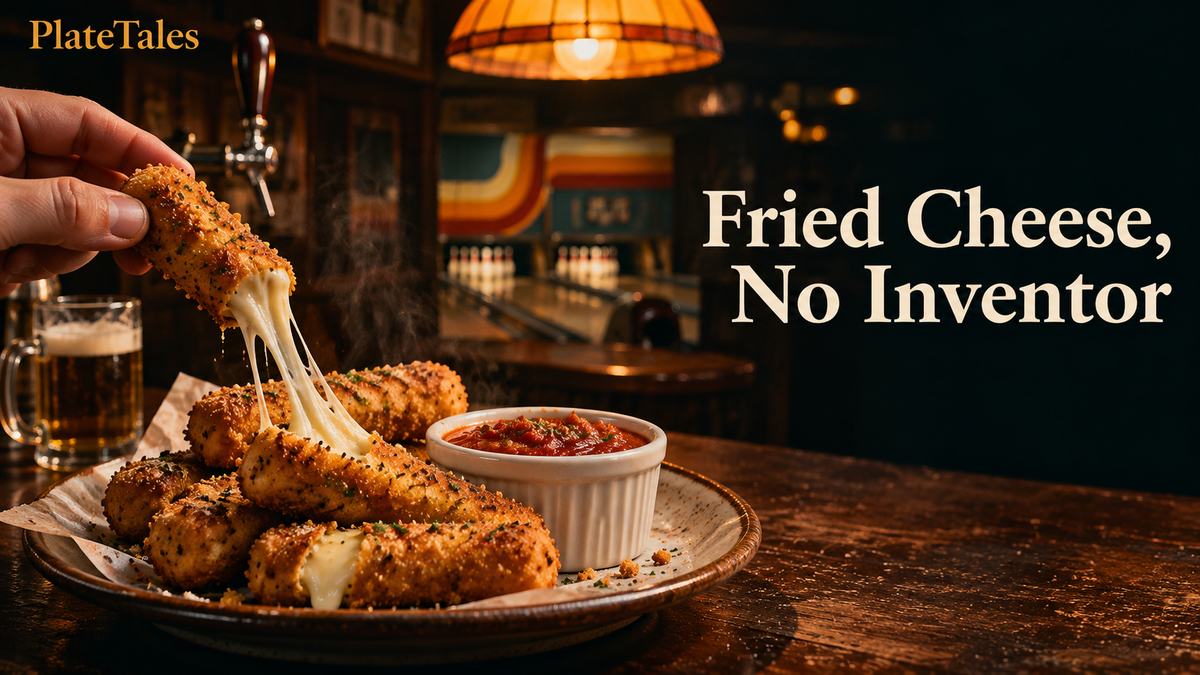
The mozzarella stick, a stick of mozzarella breaded and deep-fried, has no known inventor and no confirmed first menu. Food historians interviewed by Thrillist in 2017 place its rise in American bars and bowling alleys in the late 1970s and early 1980s, after pizza had made mozzarella cheap and common. Fried cheese itself is far older, but the link between the two is thinner than the popular story says.
The 1393 recipe everyone cites
Almost every article on this snack starts in Paris. Le Menagier de Paris, a household manual written around 1393 in the voice of an older husband instructing a young wife, contains a recipe, headed "Pipefarces" in Janet Hinson's English translation: beat egg yolks, flour, salt and a little wine into a batter, roll thin slices of cheese in it, and fry them in an iron skillet with oil. The text adds that the same dish can be made with beef marrow.
It is a real recipe, and it is the usual proof that fried cheese is ancient. The trouble is the leap from there to the bar menu. The cheese is not named as mozzarella, the pieces are thin slices rather than a stick, and nothing connects the Paris kitchen to an American fryer six centuries later.
Dr. Joel Jensen, a food historian Thrillist interviewed, put it bluntly: whoever wrote that medieval text would barely see any resemblance between his recipe and the modern stick. In Jensen's view the modern snack has more in common with pizza and French fries than with the long history of frying cheese in Europe.
Where the Italian claim runs out
Mozzarella is an Italian cheese, and the word carries that connotation wherever it goes. Dr. John Gennari, a professor of cultural studies at the University of Vermont who has written about Italian-American food, told Thrillist that the sticks will always be considered Italian for that reason, "But they're not Italian."
His argument is about timing and place. Italian immigrants arrived in large numbers in the early 1900s, and the dishes they left behind drifted into something new in America. Pizza is the clearest case. Gennari noted that the word "pizza" was used on a broad scale in the press only around a 1944 New York Times article, and that the food was not fully popular until well into the second half of the century. If you want the longer version of how that happened, the story is in the origin of pizza.
The mozzarella stick, Gennari said, is less an evolution of a European dish than a product of that pizza boom. When Americans learned to like pizza, mozzarella became a common commodity, and sticks became an easy sell. The earliest evidence Gennari could find dated to the late 1970s.
The pizza boom that filled the cheese supply
The supply side has a documented example from Wisconsin. The Fond du Lac Reporter, in a January 2025 profile, describes how Baker Cheese of St. Cloud, Wisconsin, a family firm that bought its first cheese factory in 1916, moved from cheddar toward mozzarella after pizza boomed in the 1950s. The change took about twenty years.
That firm is usually credited with a close cousin of our subject. In 1978, the Reporter says, it introduced ropes of mozzarella as a snack, the string cheese sold today. It became a hit in bars and at parties, and the company automated the work to keep up. Individually wrapped pieces reached store coolers in the 1980s.
String cheese is not a mozzarella stick, and nobody should claim the Bakers fried anything. The point is narrower: by the late 1970s, Wisconsin plants were turning out mozzarella in snack-size shapes for the bar trade, and a cheese shaped like a stick is exactly what a bar cook with a fryer would reach for.
Fryers, bowling alleys and a deep-fried habit
Dr. Amy Bentley, a professor of food studies at New York University, offered Thrillist the equipment explanation. New frying technology in the late 1960s and early 1970s made frying cheap and efficient, which let fast-food outlets multiply and also let small kitchens, such as those in sports bars, dives and bowling alleys, add deep-fried food to their menus.
Bentley's list of reasons the dish suited those rooms is practical. Fried items are durable, they keep for a while in a warming tray, and melted cheese appeals to nearly everyone. Jensen added that a cook with a fryer was probably looking for something new beside French fries, chicken and onion rings, and saw the public take to mozzarella.
Both Jensen and Gennari told Thrillist that sticks were not common before the late 1970s and early 1980s, and both believed they arrived first in bowling alleys and sports bars. You can read how the neighbouring bar snacks got there in the history of onion rings and who invented nachos.
A 2021 piece by Lauren Cabral for Back Then History likewise places the modern stick in 1970s American sports bars and bowling alleys, though it names no inventor and cites no documents for the claim.
Jensen went further and called the stick the point at which people decided they could deep-fry almost anything. That is his opinion, not a documented chain of events, but it is a fair description of what followed, from fried pickles to state fair stunts.
Mozzarella sticks history on paper: what survives
Documents are thin. Thrillist reports that in the New York Public Library's database of historic restaurant menus, the earliest mention of mozzarella sticks is from 1987, at a New York City place called the Chicken Ranch. That is a floor, not a birth certificate: a menu that survives to be digitized is a late witness for a snack that was already spreading through taverns.
There is also no tall tale of the kind that clings to chicken wings, with a named cook, a named night and a leftover ingredient. Thrillist's own verdict is that it would be nearly impossible to pinpoint the birthplace. A dish that a hundred kitchens could have invented independently, once the cheese and the fryer were both on hand, may simply not have one.
This is why the usual headline, an answer in a single name, is misleading. What the sources support is a convergence: cheap mozzarella from the pizza years, fryers small enough for a tavern kitchen, and a crowd that wanted something hot and salty to eat with a cold drink. Bentley made that last point about temperature and texture contrast.
Frozen sticks
By the time the snack reached chain menus, much of it arrived pre-made. Thrillist quotes an anonymous line cook who says the sticks come frozen in blocks and go straight into the fryer. That detail is from a single unnamed cook in 2017.
Questions people ask
Who invented mozzarella sticks?
No one has been identified. Historians quoted by Thrillist in 2017, including Joel Jensen and John Gennari, trace the modern stick to American bars and bowling alleys in the late 1970s and early 1980s, but they found no named inventor, restaurant or date for the first one.
Are fried cheese sticks really from medieval France?
Fried cheese is. Le Menagier de Paris, from about 1393, describes slices of cheese rolled in an egg, flour and wine batter and fried in an iron skillet. Joel Jensen says its author would barely recognize the modern mozzarella stick, so the link is one of idea, not descent.
When did mozzarella sticks appear in the United States?
Food historians John Gennari and Joel Jensen told Thrillist they were uncommon before the late 1970s and early 1980s. The earliest mention Thrillist found in the New York Public Library's historic menu collection is from 1987, at the Chicken Ranch in New York City.
Why did fried mozzarella take off in bars and bowling alleys?
Amy Bentley, a professor of food studies at New York University, links it to cheap, efficient frying equipment from the late 1960s and early 1970s. Fried foods keep in a warming tray, melted cheese suits most people, and the snack pairs with cold beer or soda.
Filed under Accidental Inventions
Want more stories like this?
One food history story, every week. No spam, just the stories behind what the world eats.