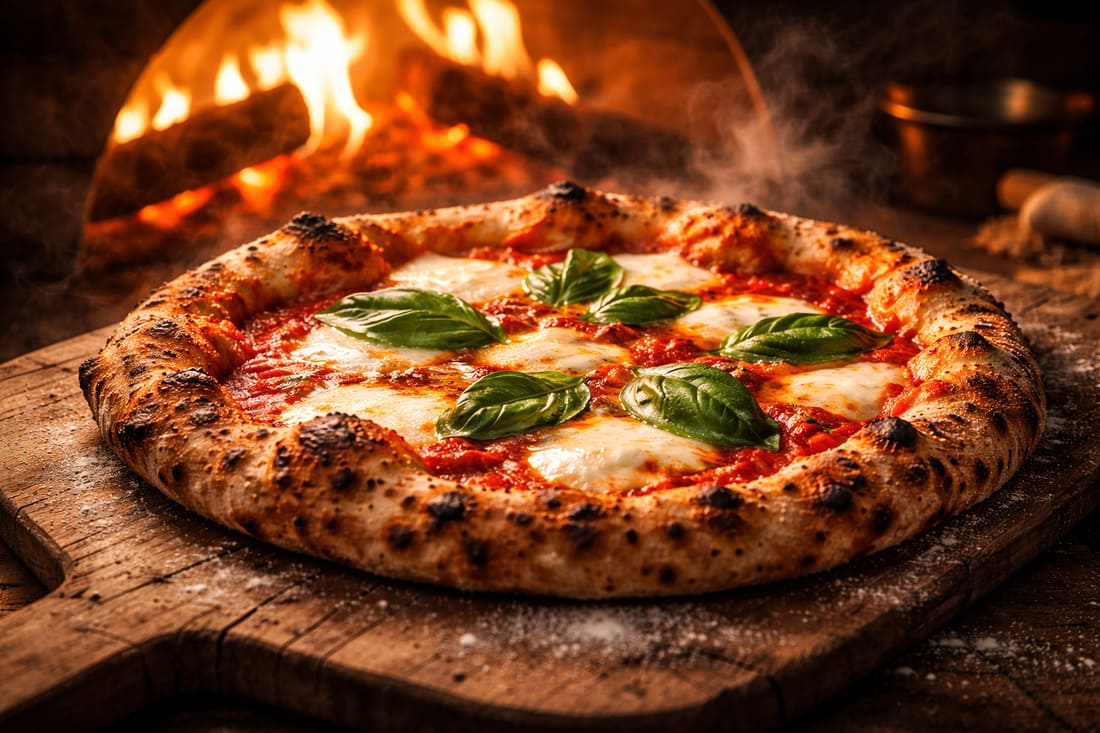
The origin of pizza is a slow one. Topped flatbreads are ancient, the word "pizza" is on paper in Gaeta in 997, and the dish most of us would recognize, with tomato on top, took shape in Naples between roughly the 1700s and the early 1800s. No single inventor appears in the record, and the best-known creation story, the Margherita pizza made for a queen in 1889, does not hold up well.
Bread with things on it is older than any recipe
Put something on a flat bread and bake it, and you have the idea behind pizza. Nobody can name the first person to do it, because cooks around the Mediterranean were doing it for centuries before anyone wrote about it.
The accounts that circulate are thin but consistent. Ancient Greeks are said to have topped their bread with oil, herbs and cheese. Persian soldiers under Darius the Great reportedly baked flatbreads with cheese and dates on their shields. A fresco found at Pompeii in 2023 may show a pizza-like dish, though "may" is the operative word. Treat all of this as ancestry, not as pizza. The Neapolitan dish needed ingredients and a city that none of these cooks had.
For more on the bread underneath, see the history of bread, and for the Roman side of the table, ancient Roman recipes.
Twelve pizzas for the bishop of Gaeta, 997
The oldest known use of the word sits in a Latin notarial document from Gaeta, a port town then under Byzantine rule, in the collection known as the Codex diplomaticus Caietanus. Dated May 997, it sets the rent a tenant owes the bishop. At Christmas he must deliver twelve pizzas, a pork shoulder and a kidney. At Easter, twelve pizzas and a couple of chickens.
That is all the document tells us. It does not say what a pizza was in 997, whether it was round, whether it had cheese, or whether anyone in Gaeta would have recognized a modern pie. A food historian can say only that the word existed and that it was something you could count out by the dozen and hand to a bishop. Giuseppe Nocca, of a hotel school in Formia, is cited as identifying it as the first written use.
The English language was slow to catch up. English speakers borrowed "pizza" from Italian only in the 1930s, and before that they often called it "tomato pie."
When did tomatoes land on the bread?
The tomato is the problem for anyone who wants an ancient pizza as we know it. It came from the Americas, so it cannot appear on any flatbread before the sixteenth century. Britannica calls the tomato an early sixteenth-century import and notes that Roman-style pizza often leaves it off altogether. The longer story is in how tomatoes came to Italy.
Carol Helstosky, in Pizza: A Global History (2008), places the development of modern pizza from Neapolitan flatbreads in the eighteenth or early nineteenth century. Earlier toppings in Naples included garlic, salt, lard and cheese. Some sixteenth-century Neapolitan flatbreads were already being called pizza. When tomato joined them is uncertain, and the sources disagree. One later account says poor Neapolitans were commonly adding it by the late eighteenth century, but the earliest tomato-topped pizza in the sources checked is a description from 1830.
Naples in the 1800s, from stalls to rooms with tables
Until about 1830 pizza was sold from open-air stands and bakeries. Then Neapolitan pizzerias began to offer rooms with tables where customers could eat on the spot. Antica Pizzeria Port'Alba is said to have opened that same year. Research by Antonio Mattozzi found 54 pizzerias in Naples in 1807, which tells us the trade was already large before the era of the famous tomato pie.
Visitors noticed. In Le Corricolo, in 1843, Alexandre Dumas described the variety of pizza toppings he found in Naples. That is a travel writer reporting a street food, and a good sign that by then pizza was ordinary in the city.
In more recent times Naples has turned its pizza into a protected thing. Pizza napoletana has been a traditional speciality guaranteed product in the European Union since 5 February 2010, and UNESCO inscribed the art of the Neapolitan pizzaiuolo on its list of intangible cultural heritage in 2017.
The Margherita story and what the paper trail says
The popular version goes like this. On 10 June 1889, the royal palace at Capodimonte summoned the Neapolitan pizza maker Raffaele Esposito to cook for Queen Margherita. He made three pizzas. She preferred the one in the colors of the Italian flag: red tomato, white mozzarella, green basil. He named it after her, and a letter of thanks from the queen's household is said to hang in the shop that is now Pizzeria Brandi. Britannica repeats it only as "popular legend."
The historian Zachary Nowak took it apart in a 2014 article in Food, Culture & Society. The authenticity of the letter is doubtful. No newspaper of the time reported a royal pizza visit. And the story, along with the name Margherita, was promoted mainly in the 1930s and 1940s, a period when Italy had its own reasons to wrap a national dish in royal and patriotic colors.
The pizza itself, tomato, cheese and basil, is older than 1889 in at least some accounts. What was invented later was the tale.
How pizza reached New York
Italian immigrants carried pizza to the United States in the late nineteenth century, first in the neighborhoods where they settled, according to Helstosky. Surviving traces are small. A "pizzeria" turns up in print in 1894. A New York baker named Filippo Milone advertised in 1903. On 6 December 1903 the New York Tribune Illustrated described a "pomidore pizza," and a Boston newspaper wrote about pizza in 1904.
Lombardi's on Spring Street in Manhattan is usually named as the first American pizzeria, with a license dated 1905. Its founder, Gennaro Lombardi, was long believed to have opened a grocery in 1897. A 2019 review of his birth record and naturalization papers found that he arrived in November 1904 at age 17, listed as a laborer. If he worked at 53 1/2 Spring Street in 1905 he was probably an employee, and the research points to Filippo Milone as the man who opened the pizzeria. The owners chose the spot because it had a coal-fired oven.
The original Lombardi's closed in 1984 and reopened about a decade later one block away. During the early months of the COVID-19 pandemic, the new building owner destroyed the coal oven. For the wider picture, see how immigration changed American food.
After the war, a ready market
Britannica says the American pizza industry boomed after World War II, until there was scarcely a hamlet without a pizzeria. Gayle Turim, writing for History.com, says veterans of the Italian campaign, who had been introduced to Italian food, "proved a ready market for pizza in particular." That is a more careful claim than the popular line that soldiers brought pizza home, and it is the one the sources support.
Italian Americans then carried the dish west, and the American version was later exported worldwide. On Spring Street, the coal oven that gave the first pizzeria its reason to exist was destroyed during the pandemic.
Questions people ask
What is the oldest written mention of pizza?
The oldest known use of the word pizza is in a Latin document from Gaeta dated May 997, in the Codex diplomaticus Caietanus. It requires a tenant to give the bishop of Gaeta twelve pizzas, a pork shoulder and a kidney at Christmas, and twelve pizzas and a pair of chickens at Easter.
When did tomatoes first go on pizza?
Tomatoes cannot predate the sixteenth century, because they came from the Americas. In Naples, the eighteenth and early nineteenth centuries are when modern tomato pizza developed, according to historian Carol Helstosky. The exact first date is uncertain, and the earliest tomato pizza description cited in reference sources is from 1830.
Was the Margherita pizza really named after a queen?
Probably not. The legend says Raffaele Esposito made it for Queen Margherita in Naples on 10 June 1889. Historian Zachary Nowak found that no newspaper of the time reported the visit, the queen's thank-you letter is of doubtful authenticity, and the story and name were promoted in the 1930s and 1940s.
When did pizza arrive in the United States?
Italian immigrants brought pizza to the United States in the late nineteenth century. The earliest newspaper traces date from the 1890s and early 1900s, and Lombardi's in New York City, with a license dated 1905, is traditionally called the first American pizzeria, though a 2019 review credits Filippo Milone with opening it.
Filed under Origin Stories
Want more stories like this?
One food history story, every week. No spam, just the stories behind what the world eats.