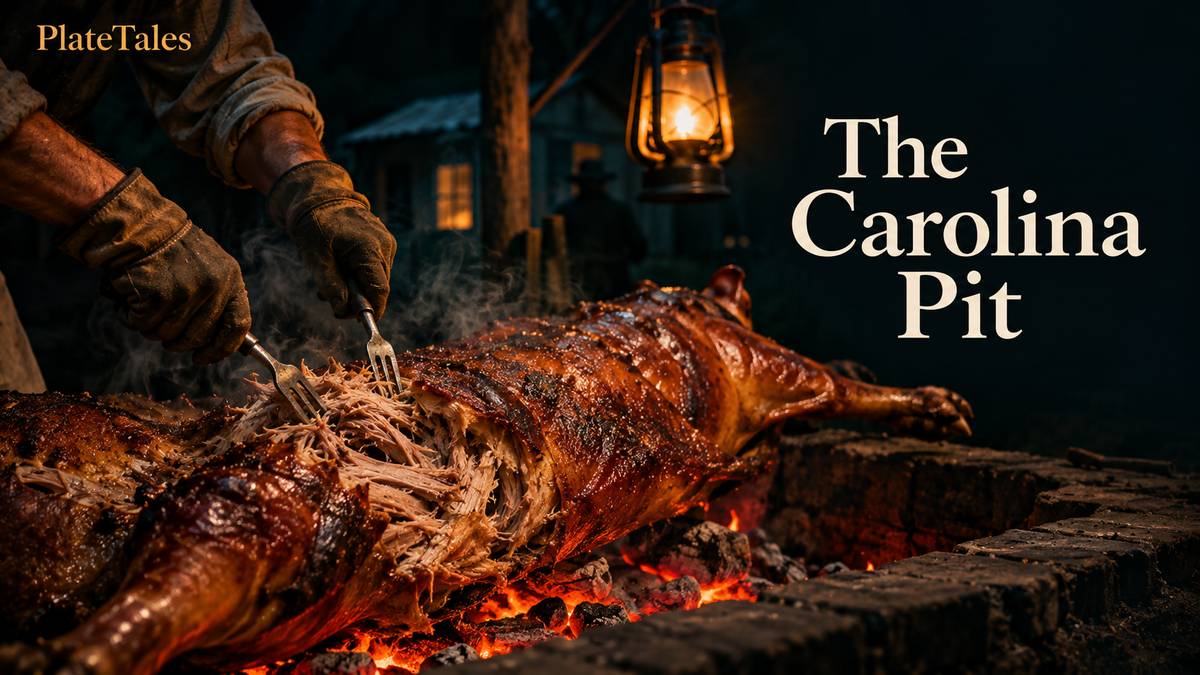
Pulled pork is shredded smoked pork shoulder, and its history runs through the Carolinas: the Spanish put pigs ashore in the Southeast in the 1500s, English colonists in North Carolina learned to cook them over wood coals, and by the late 1600s eastern cooks were basting them with vinegar, salt and pepper. The shoulder-only version came later, in Lexington, around the time of the First World War.
Pulled pork starts with pigs, then fire
Nobody recorded the first pulled pork, and the sources for the earliest period are thin. The Whole Hog Barbecue Series, a project that documents eastern North Carolina cooking, gives the outline: Spanish explorers brought pigs to the Southeast in the 1500s, and the animals thrived in North Carolina. By the middle of the 1600s, people in the West Indies were roasting meat on a wooden frame over coals, and the page says Native Americans in the eastern part of what is now the United States probably cooked in a similar way before English colonists copied it.
The word itself gives a clue. The same page traces "barbecue" to the Spanish "barbacoa," itself taken from a Taino word for a frame of sticks set on posts. A popular alternative, that it comes from the French "barbe a queue," meaning whiskers to tail, was proposed in 1829 and is rejected by nearly every scholar, according to that page. It is a good story for a whole-hog cook to tell and a bad one to rely on.
The dish, in other words, is older than the name "pulled pork," and the record for the name itself is much thinner than the record for the pig.
Whole hog and the vinegar sauce
Eastern North Carolina kept the whole animal. The animal is cooked over wood coals, and the meat is typically chopped; the page notes that in the east the word is often pronounced "bobby-q." The Whole Hog Barbecue Series dates the eastern sauce to the late 1600s and calls it America's original barbecue sauce: vinegar, salt and pepper, nothing else. It adds that tomatoes were widely thought poisonous in those years, so they were not an option.
That last claim is the page's own explanation and no document is cited for it, so treat it as the tradition's account. What the same page says with more confidence is the date tomatoes lost their bad reputation: around 1820, when they were known to be safe to eat. Cooks in western North Carolina and the Piedmont then began adding tomato catsup and brown sugar.
That is the root of the Carolina divide, and it is a divide about sauce and cut of meat more than about quality. The eastern cook wants the whole hog and a sauce of vinegar and pepper. The western cook wants the shoulder and a sauce with a little color.
The people who tended the pits
Names of early pitmasters are scarce, and most of the ones that survive belong to people recorded by accident. One is Marie Jean, whom the Southern Foodways Alliance profiles. Born enslaved in Arkansas in the 1780s, she was in charge of a big Fourth of July barbecue at Pine Bluff on July 4, 1840. Judge J. W. Bocage's memoir describes her as "superintending" it. Two months later, on September 13, 1840, a bill of sale recorded that her owner, Colonel James Scull, freed her for $800. Historian Cindy Grisham suggests the money may have come from catering large events at plantation homes along the Arkansas River.
Marie Jean was not a Carolina pitmaster, and the record does not tie her to pork pulled in North Carolina. She appears here because she is one of the few early Southern barbecue cooks the record names: she ran a feast for a town, and a judge remembered it in writing.
Lexington, the shoulder and a little ketchup
The Piedmont version has a better paper trail, because it is recent. John Shelton Reed, a writer on Southern culture and co-author of Holy Smoke: The Big Book of North Carolina Barbecue, told WFDD in 2025 that Lexington's barbecue began around the First World War, with pop-up stands in places where people gathered, such as the courthouse square.
Reed ties the style to the people who made it. Many of the early cooks were of German descent. "Where you have this Piedmont-style barbecue is basically where you find Lutherans," he said.
Lexington cooks changed two things. They used only the pork shoulder, not the whole hog, and their sauce was essentially the eastern vinegar sauce with a little tomato ketchup added, which made it redder and slightly sweeter.
| Style | Meat | Sauce |
|---|---|---|
| Eastern North Carolina | Whole hog, chopped | Vinegar, salt, pepper |
| Lexington (Piedmont) | Shoulder only | Vinegar sauce with some ketchup |
How far the sources go
The two halves of the story rest on different footing. Reed's Lexington account comes from a living historian of Southern food, speaking about a style that is barely a century old. The eastern story rests on a project page that gives dates but names no historian, and its claim about tomatoes is tradition, not a cited document. A careful reader should hold the 1600s vinegar sauce as the region's own account of itself, likely but not proven.
What goes on the side
The slaw and the fried cornmeal are part of the argument too. Reed told WFDD that hush puppies joined the Lexington plate around the 1950s; before that they were mainly served at fish restaurants. The tangy cabbage that sits on the bun or beside the plate has its own story in the history of coleslaw.
For the cousin of this dish that is cooked as a rack, not shredded, see the history of barbecue ribs. The wider question of how a regional food becomes part of a region's idea of itself is a theme in our cultural identity stories.
Lexington now holds an annual barbecue festival in the fall that draws tens of thousands of visitors, and a wall of fame beside City Hall honors the early pitmasters and supporters of the style.
Questions people ask
What is the difference between eastern and Lexington barbecue?
Eastern North Carolina barbecue cooks the whole hog and dresses the chopped meat with a vinegar, salt and pepper sauce. Lexington, in the Piedmont, uses only the pork shoulder, and its sauce is that same vinegar base with a little tomato ketchup added, which makes it redder and slightly sweeter.
Where does the word barbecue come from?
Most scholars trace barbecue to the Spanish "barbacoa," taken from a Taino word for a frame of sticks set on posts. The idea that it comes from the French "barbe a queue," whiskers to tail, was proposed in 1829 and is rejected by nearly all scholars.
When did Lexington barbecue start?
Lexington barbecue began around the First World War, according to John Shelton Reed, co-author of Holy Smoke: The Big Book of North Carolina Barbecue. Pop-up stands appeared in gathering places such as the Lexington courthouse square, and many early cooks were of German descent.
Who cooked the early barbecues in the South?
Few names survive. One documented pitmaster is Marie Jean, an enslaved cook who oversaw a large July 4, 1840 barbecue in Pine Bluff, Arkansas, according to Judge J. W. Bocage's memoir, and who was freed for $800 that September by her owner, Colonel James Scull.
Filed under Cultural Identity
Want more stories like this?
One food history story, every week. No spam, just the stories behind what the world eats.