Southern fried chicken probably came to the American South as a Scottish habit, was turned into a regional signature by Black cooks, and first reached print in Mary Randolph's The Virginia House-Wife in 1824. No single person invented it. The record shows a method (frying joints of chicken in hot fat) that crossed the Atlantic in the 1700s and a flavor that was worked out in Southern kitchens, most of them run by enslaved women.
The popular story says West Africa. The recipes say otherwise.
For a long time the answer was simple. Southerners boasted that only Black cooks, many of them enslaved, could make "authentic" fried chicken, and writers tied that skill to West Africa, where people had eaten chicken and deep-fried food for centuries.
Adrian Miller, the James Beard-winning author of Soul Food: The Surprising Story of an American Cuisine, One Plate at a Time, checked that against cookbooks from around the world and reached a more awkward conclusion. West African chicken dishes, he wrote for BBC Travel in 2020, were closer to a fricassee: chicken lightly fried, then braised for a long time in a seasoned sauce, like Senegalese chicken yassa. That is not the crisp, floured bird of a Virginia Sunday table.
Palm-oil frying and the ritual use of chickens in West Africa are real, and they matter for what came next. They just do not make a direct line to the skillet.
A 1747 recipe and a dinner on Skye
The clue that points north is in print. Hannah Glasse's The Art of Cookery Made Plain and Easy (1747) has a recipe titled "To marinate chickens." Quarters of chicken lie in vinegar with pepper, salt, a bay leaf and cloves for three or four hours, get dipped in a thick batter of flour, wine and egg yolk, and are fried "in a good deal of hog's lard." Glasse was English and the book was published in Dublin, so it proves a British habit and not specifically a Scottish one.
Scotland comes in through James Boswell. In 1773 he wrote in his diary of a fried chicken dinner served by an elderly tacksman at Coire-chat-achan on the Isle of Skye. Stana Nenadic, a historian at the University of Edinburgh, pointed to that entry in an essay on eighteenth-century Scottish cooking, as Miller reports.
The theory that ties these together comes from John F. Mariani, who wrote in The Encyclopedia of American Food and Drink that the Scots, who "enjoyed frying their chickens rather than boiling or baking them as the English did," may have carried the method to the South. Miller notes that Mariani offered no proof. It is a likely scenario, not a documented one.
What Mary Randolph printed in 1824
Randolph, a white Virginian from a slaveholding family and a distant relative of Thomas Jefferson, published The Virginia House-Wife in 1824. Miller calls it the first regional American cookbook and its fried chicken the first widely accepted printed American recipe. Her instruction is short: cut the chickens up "as for the fricassee," dredge them with flour, salt them, and fry them a light brown in a good quantity of boiling lard.
The recipe has no spice beyond salt, which is plainer than Glasse's. The kitchens where such dishes were actually cooked were staffed by Black women, and Miller's reading is that enslaved cooks probably began from recipes supplied by Scottish slaveholders and, over generations, made the dish their own. Cooks who seasoned and fried well enough, he argues, caused it to lose its Scottish identity.
Hence the rival claims, which the evidence handles unevenly:
| Claim | What the record shows |
|---|---|
| West African origin | Chickens and frying are old there, but the dish was a braised fricassee |
| Scottish origin | Frying in fat is documented in Scotland by 1773, and in Glasse's 1747 book |
| Invented by Randolph | She published the first widely accepted American recipe; she did not invent it |
Why Southern fried chicken was a Sunday dish
Before the Civil War, fried chicken was labor. Someone had to kill the bird, pluck it, clean it, cut it up, season it and flour it. That kept it for special occasions, usually from spring to autumn, at Fourth of July gatherings and at dinner after church.
Enslaved people were often allowed to raise chickens and sell or barter eggs, which gave the bird a value in Black households that it did not have in the planter's accounts. In Black churches the pastor, as guest of honor, got the best pieces first. Miller records that the breast was called the "preacher's parts" into the 1950s, and that the dish earned the names "Gospel Bird" and "Sunday Cluck."
The same cooking that fed families on Sundays pairs naturally with Southern biscuits on a Sunday table, and the wider tradition is told in the history of soul food.
The women of Gordonsville
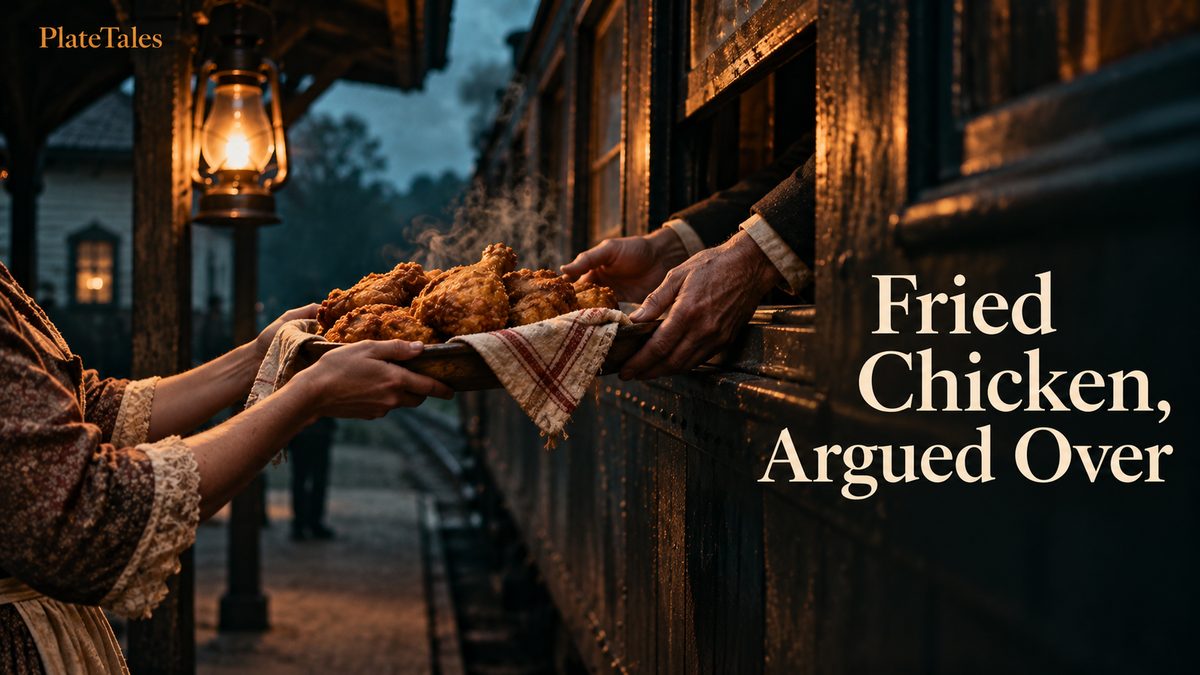
After the war, fried chicken became a business. Gordonsville, Virginia, grew up around its railroad depot after the first line arrived in 1840, according to the town's own history page. Trains had no dining cars, and passengers waited for food at the stop.
Psyche Williams-Forson, a professor at the University of Maryland, wrote in Building Houses out of Chicken Legs: Black Women, Food, and Power that when weary passengers arrived, Black women rushed to offer them food that included fried chicken. Fried chicken travels well without refrigeration, so white travelers bought it through open train windows. Miller reports that the town of about 900 people became known as the "Fried Chicken Capital of the World" in the second half of the 1800s.
A food writer's account of the trade cites an 1873 travelogue, The Pine and the Palm Meeting, written by northern journalists on a goodwill tour, which describes vendors carrying servers on their heads and selling pies, cakes, eggs and sandwiches along with the chicken. The same account says few written records survive of the women's own lives. Many, it says, bought and owned their homes with the money.
The route came to be nicknamed the "Chicken Bone Express." Names of individual vendors and prices are thin in the sources, so this article leaves them out.
A stereotype built on a skill
Fried chicken, one of the few foods enslaved people could raise and sell for themselves, was later turned against them. The 1915 film The Birth of a Nation shows newly elected Black legislators in the South Carolina statehouse "lolling in their chairs, their feet bare, eating chicken and drinking whiskey," as the Jim Crow Museum at Ferris State University describes the scene. The film played it as mockery.
The history in this article is the answer to that. The dish rests on documented Black skill and Black entrepreneurship, and the stereotype ignores both.
From a Sunday dinner to the national menu
Boneless strips came later and have their own story in the history of chicken tenders, while the sandwich version is in the history of the fried chicken sandwich. Randolph's skillet recipe stands near the start of both.
Miller dates the mass market to the 1950s, when "Colonel" Harland Sanders started franchising a Southern-style roadside chicken after working out how to fry it much faster. Until World War Two, Miller writes, fried chicken in the US was food for special occasions. In 1960 the average American ate 28 pounds of chicken a year. Miller puts the current figure, from the National Chicken Council, at 99 pounds.
Questions people ask
Who invented fried chicken?
No one person did. Frying chicken in fat appears in Hannah Glasse's 1747 English cookbook and in a 1773 Boswell diary entry from the Isle of Skye. Mary Randolph printed the first widely accepted American recipe in The Virginia House-Wife in 1824, and enslaved Southern cooks developed the seasoned dish that followed.
Is fried chicken Scottish or West African?
The method of frying chicken pieces in fat is better documented in Scotland and Britain, and probably reached the South with Scottish settlers. West African cooks fried food and used chicken, but their chicken was usually lightly fried and then braised. Southern fried chicken most likely combines both traditions.
What was Gordonsville, Virginia, known for?
Gordonsville, Virginia, was nicknamed the Fried Chicken Capital of the World in the second half of the 1800s. Black women sold fried chicken and other food to passengers through train windows at the railroad stop, since trains then had no dining cars.
What did Mary Randolph's 1824 fried chicken recipe say?
Mary Randolph's recipe in The Virginia House-Wife told cooks to cut the chickens up as for a fricassee, dredge them well with flour, sprinkle them with salt, and fry them light brown in a good quantity of boiling lard. It had no spices beyond salt.
Filed under Cultural Identity
Want more stories like this?
One food history story, every week. No spam, just the stories behind what the world eats.