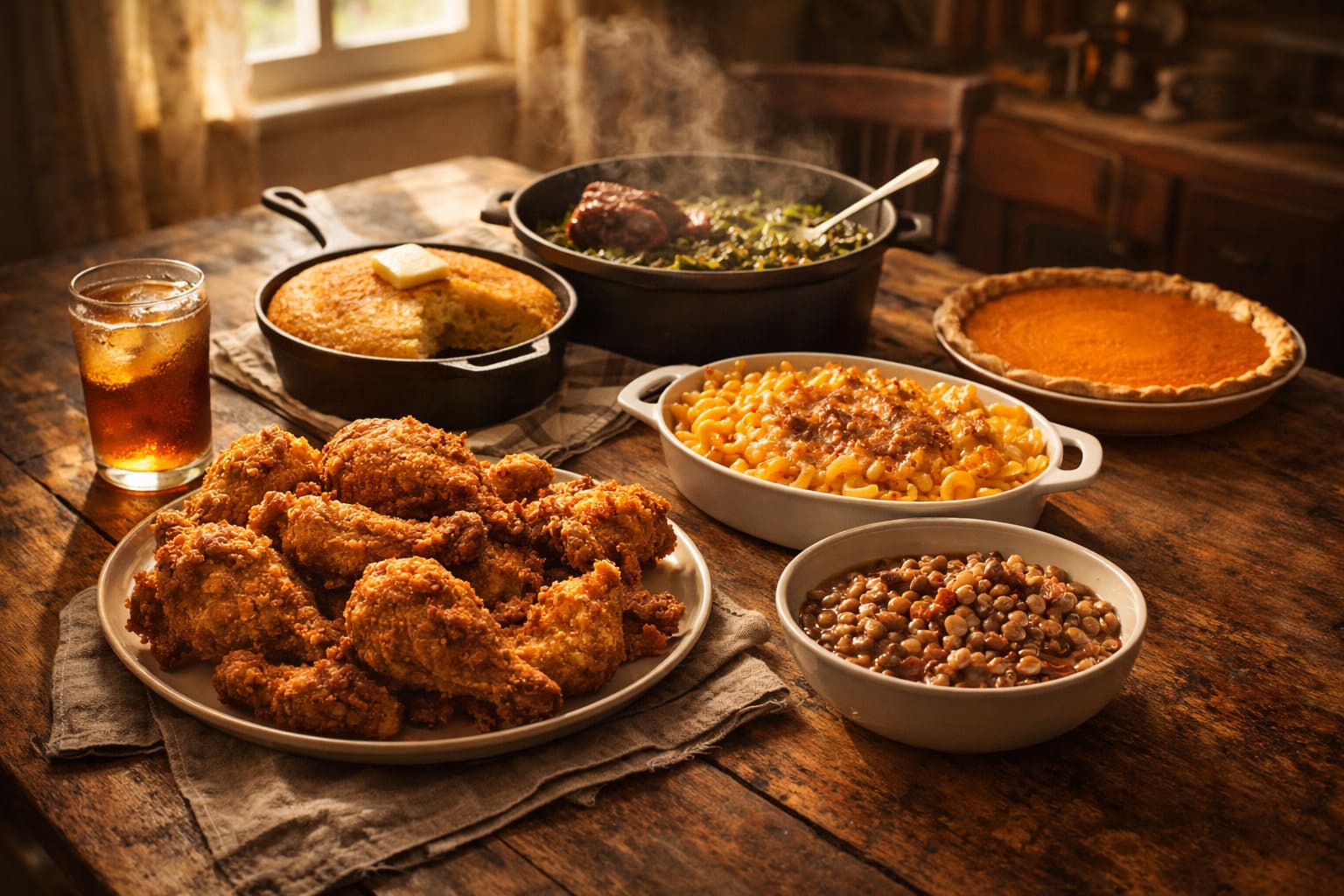
The history of soul food runs through two centuries of plantation kitchens and one decade of naming. The cooking itself grew from the foods of enslaved West and Central Africans in the American South, mixed with European and Native American ingredients. The label "soul food" is much newer: it caught on in the 1960s, during the Black Power movement.
When did people start calling it soul food?
The dishes are old. The phrase is not. Scholars place its popularity in the 1960s and 1970s, when "soul" was a common word for Black American culture, as in soul music. One of its earliest appearances in print is in The Autobiography of Malcolm X, published in 1965. LeRoi Jones, who later took the name Amiri Baraka, wrote an article titled "Soul Food" and argued for the cooking as part of Black identity.
So nobody in 1850 asked for soul food. They called it dinner. The name arrived when Black Americans, many of them far from the South by then, wanted a word for the food that tied them to it.
The label was also contested from the start. Laretta Henderson has argued that in the 1960s middle-class Black Americans used soul food to align themselves with working-class Black Americans and to distance themselves from white middle-class values. Not everyone agreed it deserved a celebration.
What enslaved people were given, and what they added
Rations were thin and repetitive. Accounts of typical allowances describe a peck of cornmeal and three to four pounds of pork a week. Frederick Douglass described the monthly allowance on Maryland's Eastern Shore in his autobiography, and Booker T. Washington, born enslaved in Franklin County, Virginia, in 1856, described his own childhood diet in Up from Slavery.
People stretched those rations. John Blassingame's The Slave Community (1972), built on slave narratives, documents how enslaved families added to their allowances by hunting, fishing and keeping gardens. Greens were boiled down and the cooking liquid, pot liquor, was drunk rather than thrown out.
None of this was a gift. It was what a person could make of the food available to them. The claim that soul food was invented from scraps is true as far as it goes, but it leaves out that the cooks also had skills and crops from home.
Rice, okra and black-eyed peas: the African part
Researchers at Mercer University have noted that rice, millet, okra, black-eyed peas, yams and other legumes were eaten aboard slave ships, partly because they stayed edible on long voyages. Once grown in the Americas, several became staples of Southern cooking. Sea Island red peas, a West African cowpea variety, reached the sea islands of South Carolina through the slave trade.
Other details are small but specific. Sesame came to South Carolina in 1730, and Thomas Jefferson noted that enslaved people used it in stews, breads and puddings. Guinea fowl arrived in the American South in the early sixteenth century, carried by the Spanish via the Caribbean, and was cooked with rice, as it was in West and Central Africa.
Regional detail matters here. Researchers such as Amy Lynne Young have studied differences between coastal and inland foodways, and Adrian Miller, a soul food historian, points to West African habits such as greens cooked with meat and deep-fried fritters. A pot of rice in the Carolina Lowcountry has a different family tree from a pot of greens in the Piedmont. For a related African rice story, see the history of jollof rice and the longer story of rice.
The cooks whose names survived
Enslaved women were the main cooks on many plantations, and they taught their children. Most of them are unnamed. A few are not.
Hercules Posey cooked for George Washington at Mount Vernon. His dishes were popular enough with the families who dined there that he was allowed to earn money selling leftovers. He was never freed, and eventually escaped.
James Hemings, brother of Sally Hemings, was Thomas Jefferson's head chef. He trained in Paris and learned to make macaroni pie, and he is credited with helping bring it to the United States. It later became a standard side dish on soul food tables.
Thomas Downing was born enslaved in 1791 on Chincoteague Island, Virginia. He gained his freedom in 1819 and opened Downing's Oyster House in New York City around 1825, where he became known as the "Oyster King of New York."
Cookbooks, 1866 to 1970
Written recipes by Black cooks came late, and the earliest books are few. Malinda Russell, born free in Tennessee in 1812, published A Domestic Cook Book in 1866. It is the first known cookbook by a Black American woman. Russell leaned toward northern dishes, so it is not a soul food book in the later sense.
In 1881 Abby Fisher, born around 1831 in Orangeburg, South Carolina, to an enslaved mother, published What Mrs. Fisher Knows About Old Southern Cooking in San Francisco. She could neither read nor write, so she dictated it to friends.
| Year | Book | Author |
|---|---|---|
| 1866 | A Domestic Cook Book | Malinda Russell |
| 1881 | What Mrs. Fisher Knows About Old Southern Cooking | Abby Fisher |
| 1911 | Good Things to Eat | Rufus Estes |
| 1958 | The Historical Cookbook of the American Negro | National Council of Negro Women |
| 1970 | Vibration Cooking | Vertamae Grosvenor |
Edna Lewis followed with a series of books between 1972 and 2003, among them A Taste of Country Cooking.
How the Great Migration carried it north
Historians count about six million Black Americans who left the rural South between the 1910s and 1970, in two waves. The first, from 1910 to 1940, was about 1.6 million people, heading mostly for cities such as New York, Chicago, Philadelphia and Detroit. The second, at least five million, added western cities including Los Angeles, Oakland and Seattle. See also how immigration and migration reshaped American food.
The food went with them. In northern cities soul food restaurants became Black-owned neighborhood gathering places. Sylvia Woods, born in Hemingway, South Carolina, in 1926, moved to Harlem as a teenager, started at Johnson's Luncheonette in 1954, and in 1962 she and her husband opened it as Sylvia's Restaurant. In Montgomery, Alabama, Georgia Gilmore opened the Club from Nowhere in 1955 and fed civil rights leaders during the bus boycott.
Not every northerner welcomed it. According to a 2018 study by Wallach, some northern-born Black Americans looked down on southern migrants who preferred soul food.
Is soul food just Southern food?
Bob Jeffries, author of a Soul Food Cookbook, put the boundary this way: "While all soul food is Southern food, not all Southern food is soul." Adrian Miller says soul food tends to be more intensely seasoned and to use more kinds of meat than white Southern cooking, and jokes that when white Southerners put sugar in cornbread, it becomes cake.
Inside the Black Power era the food was argued over. Elijah Muhammad and Dick Gregory opposed it as a remnant of oppression and on health grounds, and many Black Americans were offended that the Nation of Islam rejected pork. Stokely Carmichael argued soul food was not true African food, given its European and colonial influences. Others saw it as a source of pride.
Both camps had a point, and the argument is part of the history. In the 1930s the Works Progress Administration paid writers to collect slave narratives, and historians including Blassingame, Michael Twitty and Jessica B. Harris have mined them for what enslaved people ate. Harris's High on the Hog appeared in 2011 and Twitty's The Cooking Gene in 2018.
Questions people ask
What is the difference between soul food and Southern food?
Soul food is the cooking of Black Southerners and their descendants, while Southern food is the wider regional cuisine. Cookbook author Bob Jeffries said all soul food is Southern, but not all Southern food is soul. Historian Adrian Miller describes soul food as more intensely seasoned and using more kinds of meat.
Why is it called soul food?
The phrase "soul food" became popular in the 1960s and 1970s, during the Black Power movement, when "soul" was a common word for Black American culture. One of its earliest print appearances is in The Autobiography of Malcolm X in 1965. LeRoi Jones, later Amiri Baraka, also wrote an article titled "Soul Food."
Which soul food ingredients came from Africa?
Rice, millet, okra, black-eyed peas and yams were eaten aboard slave ships and later grown in the Americas, becoming Southern staples. Sea Island red peas, a West African cowpea, reached South Carolina's sea islands through the slave trade. Sesame arrived in South Carolina in 1730, and Thomas Jefferson noted enslaved people used it in stews and breads.
How did the Great Migration spread soul food?
About six million Black Americans left the rural South between the 1910s and 1970, many for New York, Chicago, Detroit and later western cities. They opened Black-owned restaurants that became neighborhood gathering places, such as Sylvia's in Harlem, which Sylvia Woods and her husband opened as a soul food restaurant in 1962.
Filed under Cultural Identity, Origin Stories
Want more stories like this?
One food history story, every week. No spam, just the stories behind what the world eats.