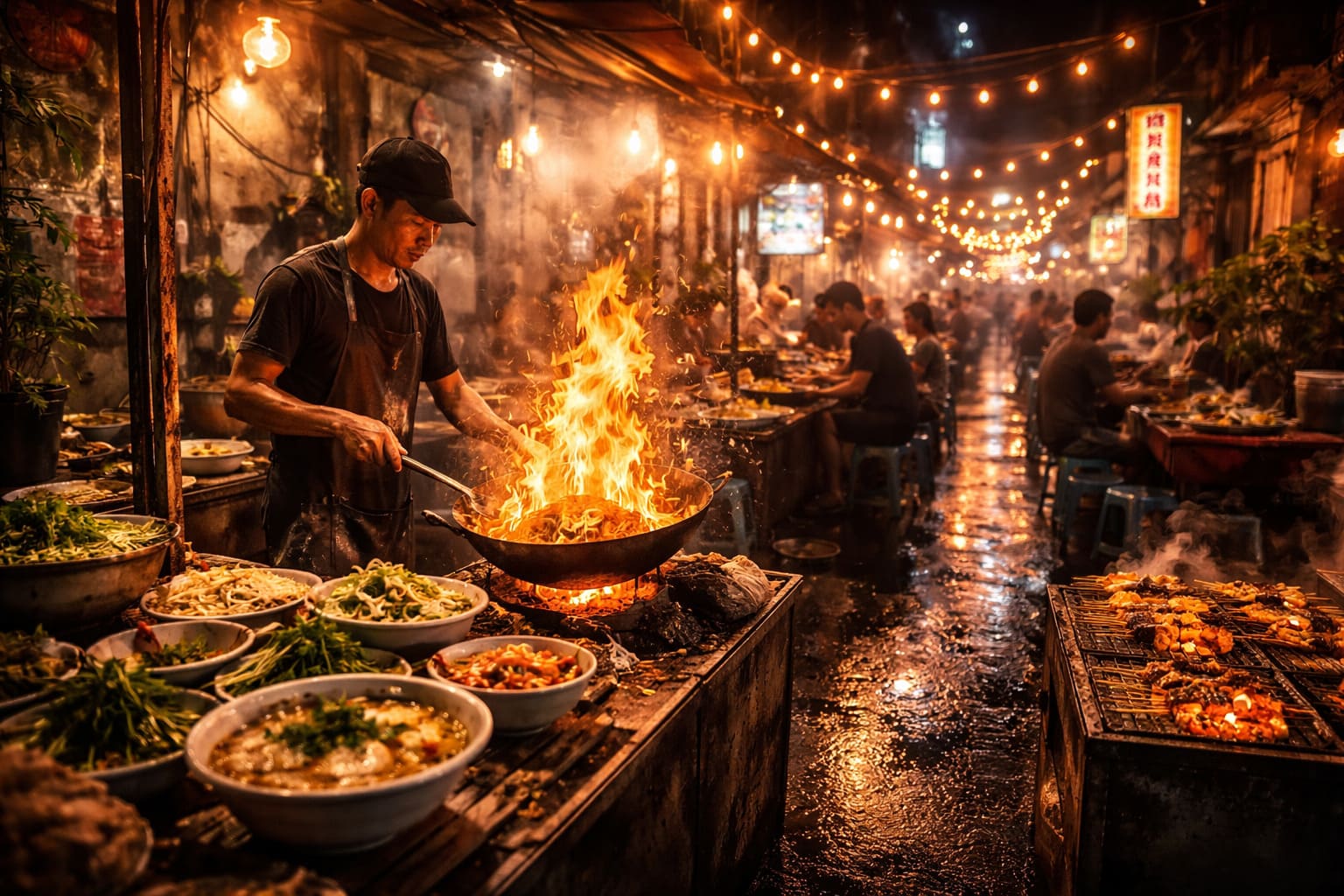
Southeast Asian street food history is not one story but several laid on top of each other. Chinese settlers who married locally, Indian cooks who arrived under British rule, a Thai government with a nation to build, and a Singapore state that moved the stalls indoors each left a dish you can still order for a few dollars.
Anyone selling "the origin of Southeast Asian street food" is simplifying. The region has no single beginning, and the paper trail for a bowl of noodles is usually thin. What we can follow are individual dishes, and a handful of them have better records than you might expect.
Southeast Asian street food history begins with settlers
The Peranakans are the descendants of early Chinese migrants who settled in Penang, Malacca, Singapore and parts of Indonesia and intermarried with local Malays. Their cooking mixes Chinese, Malay, Javanese and South Indian influences. The pantry is local: coconut milk, galangal, candlenuts, lemongrass, pandan, tamarind and belachan, the fermented shrimp paste. Flavor comes from a rempah, a spice paste pounded in a mortar.
The mix shifts by place. Penang's version leans toward Thai taste, with more tamarind and sourness, while Singapore and Malacca lean toward Indonesian cooking and coconut milk. Laksa shows the split neatly: sour asam laksa belongs to Penang, and the coconut-rich laksa lemak to Singapore and the southern Malay peninsula.
No clean date marks the start of this cooking, and sources that survey it are thin on the early centuries. What the evidence supports is the process: settlers, marriage into local families, and local ingredients going into Chinese-style dishes until nobody could separate the two.
How kuai tiao reached Thailand
Stir-fried rice noodles came to Thailand from China centuries ago. The Thai name for the noodle, kuai tiao, comes from a Teochew word for a thick rice noodle, which tells you which Chinese community carried it.
That makes pad thai a puzzle. The dish's full early name was kuai tiao pad thai, and the shortening came later. Food writer Kasma Loha-unchit argues that Thai Chinese immigrants created it, and points out that a dish named after its own country suggests the cook was not quite at home in it. Historian Mark Padoongpatt says it dates to the 1930s and was tied to nationalism, and describes it as not a traditional dish "going back hundreds of years."
Phibun, the noodle cart and a national dish
Plaek Phibunsongkhram became prime minister in 1938 and ran a cultural campaign meant to build "Thai-ness." One part of it was a national noodle dish. According to a Priceonomics account drawing on historians, his government released and promoted a recipe, and the Public Welfare Department handed out recipes and many carts for selling it. The slogan was "Noodle is your lunch."
Phibun reportedly thought it would improve a rice-heavy diet and that cooking in clean pans would improve national hygiene. The campaign also came with a ban on Chinese and other foreign food vendors, which is an odd fate for a dish with Chinese roots.
Accounts differ on the details. Some say Phibun ran a competition to create the dish. His son said the family had been cooking it before it became government policy. The popular wartime story, that a rice shortage caused by war and floods pushed the government to promote noodles, is commonly repeated but poorly documented. Either way, within a few years, pad thai vendors filled Thailand's streets, and Phibun's son called it "Thailand's first fast food."
Roti canai and the Indian stall
In Malaysia, the flatbread that came with Indian migrants is roti canai. "Roti" comes from a Sanskrit word for bread. "Canai" most likely comes from a Malay word for rolling dough thin, though less likely theories link it to the city of Chennai or to the chickpea stew it is often served with.
In Singapore it is roti prata, a name traced to the Indian paratha or parotta. One theory holds that Indian traders introduced the bread to Aceh in northern Sumatra in the 17th century and that it spread across the Dutch East Indies by the early 1800s. Another account puts its arrival in Malaya in the British period, around the 19th century. The sources do not settle it, and both Singapore and Malaysia claim it as a local specialty. In Indonesia it goes by other names, including roti cane and roti maryam.
The bread spread through mamak stalls, the Indian Muslim food stands that became part of breakfast in cities and villages alike. For a wider look at how South Asian cooking traveled, see how curry spread around the world.
Pho: a soup with two disputed names
Vietnam's best-known street dish has a start that is easier to bracket than most. Modern pho took shape between about 1900 and 1907 in northern Vietnam, southeast of Hanoi in Nam Dinh Province, then a major textile market. A 1907 short story uses the word, and a 1931 dictionary is the first to define it as a soup.
It began on the street. Vendors carried mobile kitchens on poles, usually at dawn and dusk. Hanoi's first fixed stands opened around 1918, and a villager from Van Cu opened the first "Nam Dinh style" stand in Hanoi around 1925.
Where the name comes from is argued. A popular Western claim links it to the French pot-au-feu, backed by the fact that beef became more available under French rule, but many scholars dispute it because the two dishes differ so much. Another proposal, from a 1957 dictionary by Hue and Gouin, says pho shortens a Chinese phrase for beef noodles sold by Chinese immigrants in Hanoi. Neither is settled. Our history of pho goes further into the bowl itself.
After the 1954 partition, more than a million people fled North Vietnam for the South. Pho, less common there before, became popular, and southern cooks added lime, bean sprouts, herbs, hoisin and chili sauce. Southern pho is generally sweeter and cloudier.
Singapore moves the stalls indoors
Singapore did something different with its street vendors. Hawker centres sprang up in the 1950s and 1960s during rapid urbanization, partly to replace unhygienic food preparation by unlicensed street hawkers. Early ones had a poor reputation: poorly managed, sometimes without running water, and troubled by stray animals and pests.
The state kept tightening. In 1987 it introduced a demerit point system for food and hygiene standards, and upgrading of the centres began in the 1990s. In 2011 it announced plans for ten new hawker centres with about 600 stalls over the following decade.
In 2016 two stalls, Hong Kong Soya Sauce Chicken Rice and Noodle and Hill Street Tai Hwa Pork Noodle, became the first street food vendors to receive a Michelin star. Hawker Chan lost its star in 2021.
UNESCO describes hawker centres as "community dining rooms," where people of different backgrounds gather for breakfast, lunch and dinner, and notes that some of the oldest hawkers began working in the 1960s. It added Singapore's hawker culture to its Representative List of the Intangible Cultural Heritage of Humanity on 16 December 2020.
Questions people ask
Who brought Chinese cooking to Malaysia and Singapore?
Chinese migrants settled in Penang, Malacca and Singapore, and the Peranakans descend from those who intermarried with local Malays. Their cooking combines Chinese, Malay, Javanese and South Indian influences, using coconut milk, galangal, lemongrass, pandan and belachan shrimp paste. No source gives a single date for when it began.
Is pad thai an ancient Thai dish?
No. Stir-fried rice noodles reached Thailand from China centuries ago, but pad thai itself dates to the 1930s and 1940s, when Prime Minister Plaek Phibunsongkhram promoted it as a national dish. The government distributed recipes and noodle carts under the slogan "Noodle is your lunch." Accounts differ on exactly who created it.
When did pho first appear in Vietnam?
Pho took its modern form between about 1900 and 1907 in Nam Dinh Province, southeast of Hanoi. The word appears in a 1907 short story, and a 1931 dictionary was the first to define it as a soup. Hanoi's first fixed pho stands opened around 1918, after street vendors had carried it on poles.
When did Singapore hawker culture get UNESCO recognition?
UNESCO added Singapore's hawker culture to its Representative List of the Intangible Cultural Heritage of Humanity on 16 December 2020. It describes the hawker centres as community dining rooms where people from many backgrounds eat breakfast, lunch and dinner. Hawker centres themselves date from the 1950s and 1960s.
Filed under Street Food
Want more stories like this?
One food history story, every week. No spam, just the stories behind what the world eats.