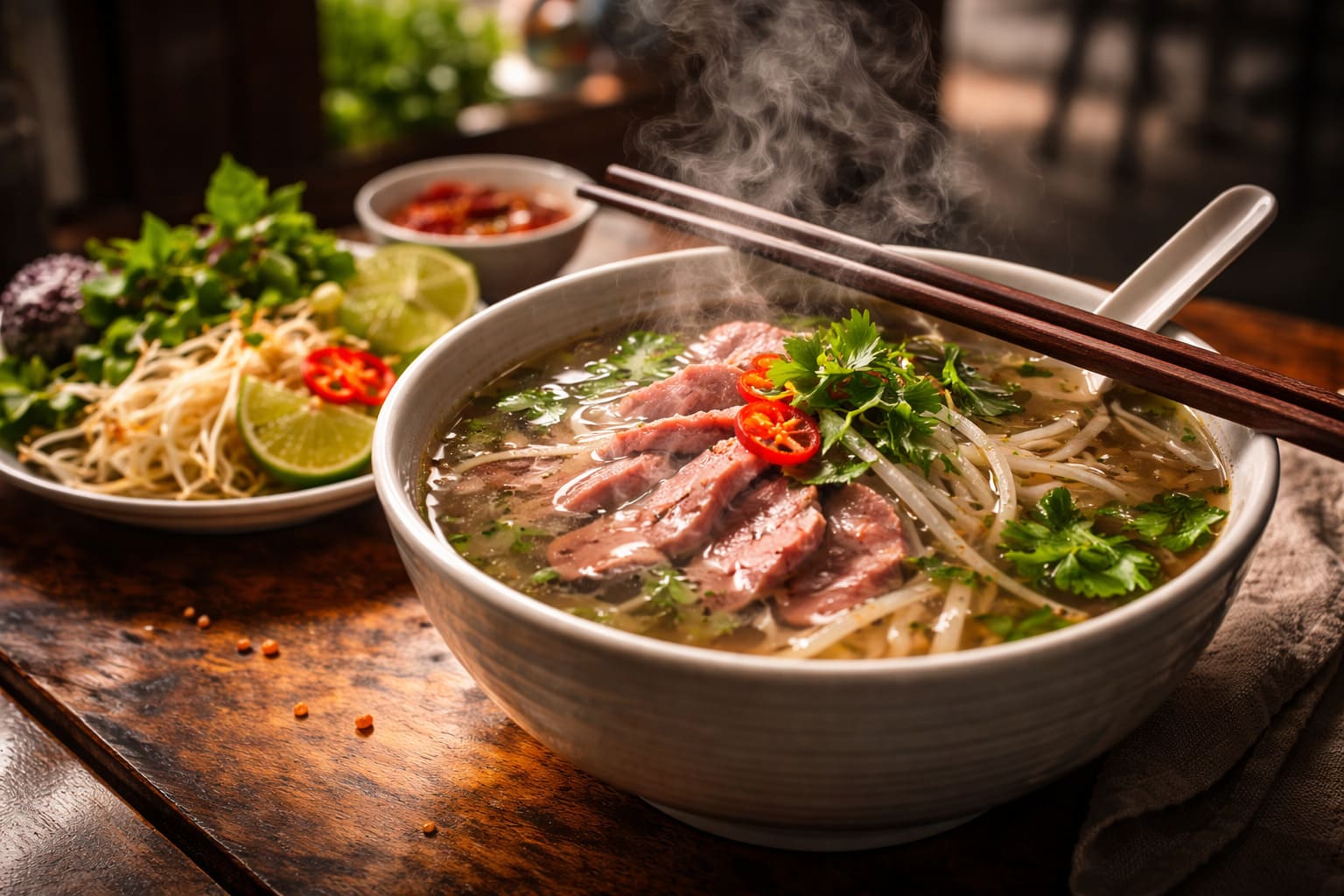
The history of pho is shorter and messier than most people expect. Pho is a rice noodle and beef soup that took its modern form in northern Vietnam in the early 1900s, around Nam Dinh and Hanoi, when the country was under French rule. Nobody can name the inventor, and historians still argue over whether the French, the Chinese or Vietnamese cooks deserve the most credit.
A word that is missing from the old dictionaries
If pho were centuries old, it would turn up in old word lists. It does not. Vietnamese-language reference works are blunt on this point: Alexandre de Rhodes's Vietnamese-Portuguese-Latin dictionary of 1651 leaves it out, and so do dictionaries published in 1895 and 1898. The novelist Nguyen Cong Hoan (1903-1977) recalled that in 1913 a bowl from a street seller cost between 2 and 5 xu. A Vietnamese dictionary from around 1930 defined the word as thin rice noodles cooked with beef.
French-language writing catches the dish on the street a little earlier. Historian Erica J. Peters points to Jean Marquet's 1919 novel Du village a la cite, in which vendors call out something like "Yoc Pheu!", as possibly the earliest print use. In 1928 Jean Tardieu heard a seller crying "Pho-o!" in Hanoi. The soup was a sound on the street before it was a word on the page.
Why beef, and why then
Before French rule, Vietnamese cooks leaned on pork, poultry, fish and seafood, and cattle were plough animals. Beef was not everyday food. Under the colonial administration, which ran from 1887 to 1954, Hanoi grew into the capital of French Indochina (see also French cuisine), and the new European population wanted beef. Butchers slaughtered working cattle and sold the bones to street vendors, according to the Michelin Guide's account of the dish.
That supply is the part most sources agree on. What the vendors did with it is where accounts split. One camp points to Chinese cooks. Cultural historian Trinh Quang Dung argues that workers from Yunnan and Guangdong bought the leftover bones and made a beef noodle soup called nguu nhuc phan, a dish they already knew. Another camp notes that the cooks and customers were Vietnamese, and that the broth, the herbs and the way the soup was sold all grew from local habits.
Nam Dinh or Hanoi?
The most common birthplace given is Nam Dinh Province, about 80 km south of Hanoi, then a textile town with a lot of hungry workers. The villages of Van Cu and Dao Cu are the places usually named as the dish's traditional home. Vietnamese-language sources describe this as a widely held belief, not a documented fact.
Hanoi has its own claim. Some writers say pho first appeared near the Quan Chuong gate, where discarded beef bones were collected and boiled. The Michelin account suggests a simpler reading: a northern style developed in Nam Dinh and Hanoi at about the same time, helped by cattle country, a French Catholic community and the capital next door.
The early soup was sold from a ganh pho, a pair of baskets or pots on a carrying pole, with a charcoal stove on one end. Vu Hong Lien notes that sellers were men, probably because the stockpot was too heavy for a woman to carry. Fixed shops came next, the start of a street food tradition that Southeast Asia shares. Pho Cat Tuong on Cau Go street is said to be among the first Vietnamese-owned stalls to move indoors, and around 1925 a villager from Van Cu opened a "Nam Dinh style" shop in Hanoi. A French painter, Maurice Salge, painted a Hanoi pho vendor in 1913.
Does pho come from pot-au-feu?
The best-known story says the name comes from the French pot-au-feu, the boiled beef dish. Gustave Hue wrote in 1937 that the Vietnamese chao pho was the equivalent of pot-au-feu. A Hanoi variant says the word comes from French soldiers asking for "feu", fire.
Scholars push back. The two dishes are very different, and Peters argues that the French story overlooks how pho began, as a local improvisation. Other theories compete. Hue and Eugene Gouin proposed in 1957 that the word comes from nguu nhuc phan. Some scholars think pho grew out of xao trau, a water buffalo stir-fry served over rice vermicelli, and that around 1908 to 1909 cooks switched to cheaper beef scraps when laborers in the shipping trade created demand. The honest answer is that the origin of the word is not settled.
Chicken, Saigon and the 1954 split
Beef pho came first. Chicken pho appeared in 1939, and Vietnamese sources link it to days when beef was not sold and to the old limits on killing cattle that were needed for farming. The two have sat side by side since.
In 1954 Vietnam was divided, and more than a million people left the north for the south. Northern cooks opened pho shops in Saigon, where the soup changed. The Michelin account says southern bowls took on more fresh herbs, a sweeter broth, and hoisin sauce at the table, while Hanoi kept a plainer style. Meanwhile, in the north, private pho restaurants were nationalized. From 1976 to 1986, state-run eateries served what people called pho khong nguoi lai, "pilotless pho", with a broth flavored by MSG and little or no meat.
Pho goes abroad
After the fall of Saigon in 1975, refugees carried the soup around the world, part of the wider story of how immigration changed American food. The first of what became hundreds of pho restaurants in Little Saigon, in Orange County, California, opened in 1980.
The earliest English-language mention may be in Countess Morphy's Recipes of All Nations, published in 1935. Pho in the north, meanwhile, went back into private hands only after the Doi Moi reforms, and Hanoi's shops are family businesses again.
Questions people ask
Is pho Vietnamese or Chinese?
Pho is Vietnamese, with outside influences. It took its modern form in northern Vietnam in the early 1900s. Some historians credit Chinese workers and a Cantonese beef noodle soup, others credit French demand for beef, and others stress local Vietnamese improvisation. No source names a single inventor.
Where was pho invented?
Pho is generally traced to northern Vietnam, either Nam Dinh Province, about 80 km south of Hanoi, or Hanoi itself. The villages of Van Cu and Dao Cu in Nam Dinh are named as its traditional home. Vietnamese sources treat this as a belief, and the earliest records show street vendors in Hanoi by 1913 to 1919.
Does the word pho come from the French pot-au-feu?
Possibly, but scholars dispute it. Gustave Hue linked pho to pot-au-feu in 1937, yet the two dishes differ greatly. Rival theories trace the word to the Chinese nguu nhuc phan, meaning beef noodles, or to a buffalo dish called xao trau. The question is not settled.
When did pho become popular in southern Vietnam?
Pho spread south after 1954, when Vietnam was divided and more than a million people left the north. Northern cooks opened pho shops in Saigon, where the soup picked up more fresh herbs, a sweeter broth and condiments such as hoisin sauce at the table.
Filed under Origin Stories, Migration Stories
Want more stories like this?
One food history story, every week. No spam, just the stories behind what the world eats.