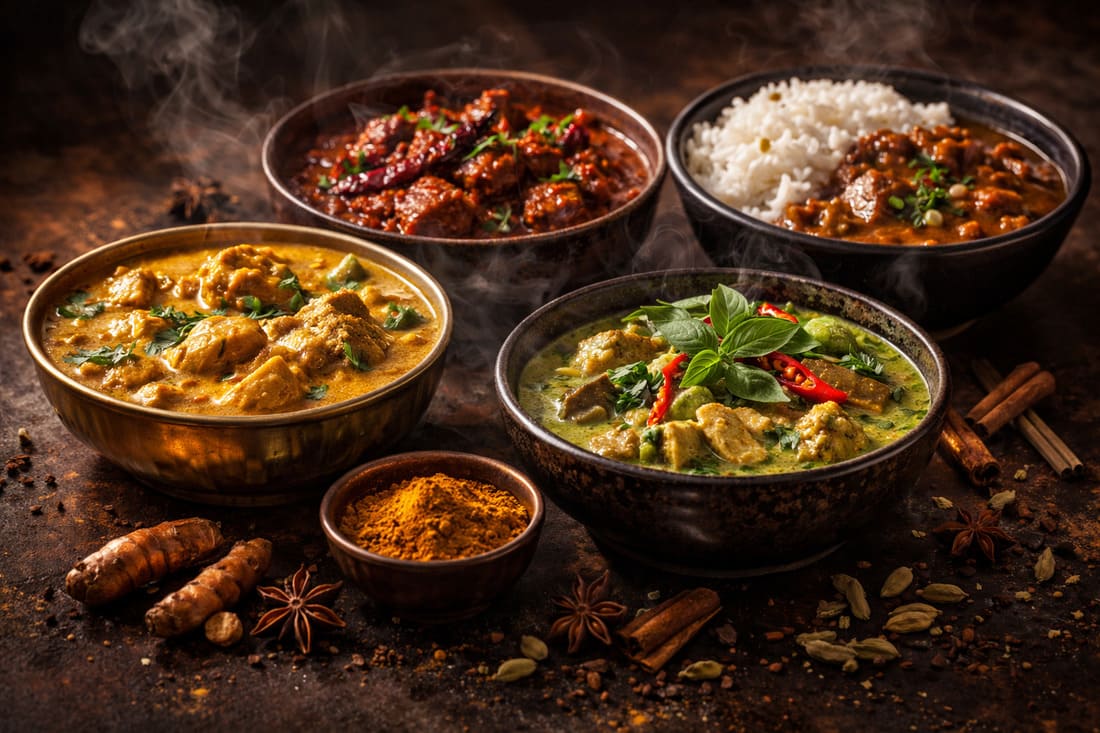
Curry spread around the world because the word and the dish travelled on the same ships. A Tamil word for a sauce was picked up by European traders, a ready-made spice mix was sold to returning East India Company men in the 1700s, and Britain then carried the idea to Japan, Southeast Asia, southern Africa and the Caribbean, where each place rebuilt it from local ingredients.
A Tamil word, and a word that is not curry
The English word "curry" most likely comes from a Dravidian source, probably the Tamil kari, which reached English through Portuguese or Dutch forms such as caril and carrijl. An English translation of a Dutch travel book from 1598 describes a somewhat sour broth called Carriel, eaten with rice. That is among the earliest appearances in English.
One tempting connection is false. The Forme of Cury, a cookbook from the 1390s, has nothing to do with it: its cury comes from the French for "to cook". Nor is the curry tree the source of the name.
The first known English recipe under the word is "Currey the India Way" in Hannah Glasse's The Art of Cookery Made Plain and Easy, published in 1747. By then the word was already doing what it still does, covering a large range of dishes that cooks in India would have called by other names.
How a spice mix became curry powder
South Asian cooks grind and blend spices in many different ways, dish by dish and house by house. Curry powder is something else: a fixed blend meant to be sold. Accounts differ on details, but the broad story is that Indian merchants sold a garam masala-like mix to East India Company men heading home in the eighteenth century. Alan Davidson dates its commercial availability in Britain to the late 1700s, and the British Library holds what is described as the first British advertisement for it.
Crosse & Blackwell and Sharwood's, two of the old British names for the powder, are still on shelves. The dish came with it. Curry was being served in London coffee houses by 1809, and cookbooks of the Raj, such as an 1869 Calcutta volume by "Thirty-Five Years' Resident" with its recipe for "Kurma or Quorema Curry", show Anglo-Indian cooks making their own versions on the spot.
A national dish that nobody can place
On 19 April 2001, Foreign Secretary Robin Cook told the Social Market Foundation in London that chicken tikka masala was "a true British national dish". His argument was that Britain absorbs outside influences: chicken tikka is Indian, and the masala sauce was added to suit a British taste for meat in gravy. Some Indian chefs and commentators were unimpressed.
Where the dish started is argued over. The best-known claim belongs to Ali Ahmed Aslam of the Shish Mahal in Glasgow, who opened in 1964 and who is said to have answered a customer's complaint that the chicken was dry by making a sauce with spices and a tin of tomato soup. A Scottish politician pushed for a protected designation of origin for the dish in 2009 and did not get one. The London restaurateur Iqbal Wahhab has said the soup detail was made up and that he started the story to amuse journalists. Another Glasgow owner, Sultan Ahmed Ansari of the Taj Mahal, claimed the dish in the late 1950s. The food writers Peter and Colleen Grove conclude it was "most certainly invented in Britain, probably by a Bangladeshi chef". Nobody has produced a receipt that settles it.
For more on the British side of the table, see the story of fish and chips, another immigrant dish that became a national one.
Why Japan eats curry on rice
Japan met curry through the British. Writing in The Japan Times, the food writer Makiko Itoh says curry powder and curried dishes most likely arrived through Anglo-Indian officers of the Royal Navy and other British imperial figures, among the first Westerners Japan dealt with after Commodore Perry's Black Ships landed in 1853. Because the dish came from the West, Japanese diners filed it under yoshoku, Western food. Itoh notes it now bears only a passing resemblance to curries elsewhere.
Rice curry appears in Japanese cookbooks in 1872. The Imperial Japanese Navy served it with rice and thickened it with flour, and it is commonly linked to the navy's effort against beriberi. Today the Maritime Self-Defense Force still serves it, often on Fridays.
Domestic curry powder in 1905 made it affordable outside fancy restaurants. Then the home-cooking products arrived:
| Year | Development |
|---|---|
| 1927 | Curry bread appears |
| 1945 | Powdered instant roux |
| 1948 | Curry enters school meals |
| 1950 | Block roux |
| 1963 | House Foods launches Vermont Curry, with apple and honey |
The sweeter, milder blocks suited children, and children grew up into adults who wanted the same flavor. Japan's relationship with another imported dish is told in the history of ramen.
Pastes in Thailand, bread in Durban
Thai curries are a separate tradition. The gaeng family is built on a paste of chilies, shallots or onions, garlic and shrimp paste, and only a few stir-fried dishes call for phong kari, an Indian-style curry powder. Green, yellow and red are the familiar colors.
In South Africa, curry came with migrants from the Indian subcontinent, and Durban is said to have the densest Indian population outside India. The city's bunny chow, a curry served in a hollowed loaf, takes its name probably from bania, a merchant, plus chow. One account holds that the loaf format arose because apartheid kept Black South Africans out of Indian restaurants, so food had to be taken away and eaten in the street. That explanation is reported by the historian Lizzie Collingham, not proven in every detail.
In the Caribbean the carriers were indentured workers brought from India in the nineteenth century to labor in the British sugar industry. Their spices, like the spices of the pepper trade before them, went wherever the ships were going.
Questions people ask
Where does the word curry come from?
The word most likely comes from the Tamil kari, a sauce, and reached English through Portuguese or Dutch forms. A Dutch travel book translated into English in 1598 mentions a broth called Carriel, and Hannah Glasse printed "Currey the India Way" in 1747. It is unrelated to the 1390s Forme of Cury.
Who invented chicken tikka masala?
Nobody knows. The best-known claim is Ali Ahmed Aslam's, at the Shish Mahal in Glasgow in the 1960s, but another Glasgow owner claimed it for the late 1950s and a London restaurateur called the tomato-soup detail invented. Peter and Colleen Grove conclude a Bangladeshi chef in Britain probably created it.
Why is Japanese curry sweet and thick?
Japanese curry came through British influence in the Meiji era and was classed as Western food. The navy thickened it with flour, and home cooks later used instant roux, from powder in 1945 and blocks in 1950. House Foods' 1963 Vermont Curry added apple and honey and became a children's favorite.
What is bunny chow?
Bunny chow is a lamb, chicken or bean curry served in a hollowed loaf of bread, associated with Durban's Indian community in South Africa. Its name probably combines bania, meaning merchant, with chow. One account says the loaf began as a way to carry food away when apartheid barred Black customers from Indian restaurants.
Filed under Origin Stories, Trade Routes
Want more stories like this?
One food history story, every week. No spam, just the stories behind what the world eats.