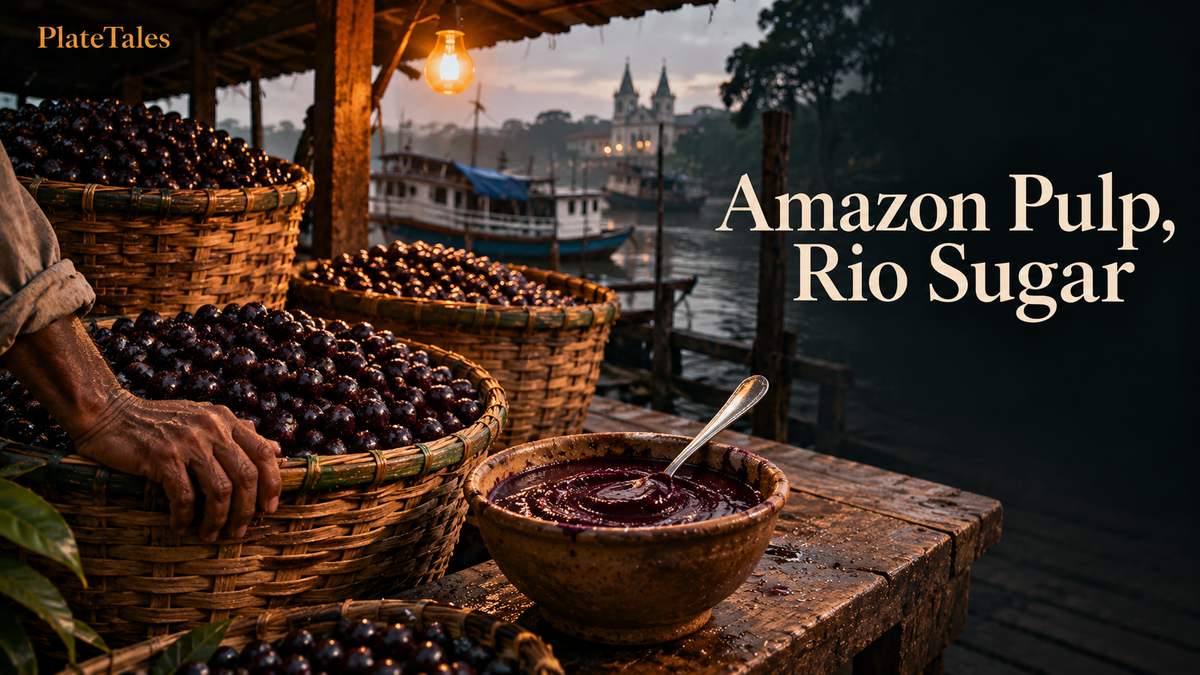
The acai bowl has a short history as a sweet, frozen dish and a very long one as something else. The sweet version took shape in Rio de Janeiro in the 1980s and 1990s, when gyms and beach bars began serving frozen acai pulp with sugar, bananas and granola. The pulp itself is far older: for centuries the river people of the Amazon delta ate it warm, with fish.
That difference is the whole story. The bowl people photograph today is a Rio invention built on a northern staple, and it reached California only in 2001.
Acai palms on the Amazon delta
Acai grows on slender palms across the Amazon delta, and nearly all of Brazil's crop comes from the state of Para. Al Jazeera, reporting an AFP story in 2023, put Para's share at 90 percent of the country's acai. The fruit looks like a blueberry but is mostly stone. John Colapinto, writing in The New Yorker in 2011, described a harvester shinnying fifty feet up a palm with a scrap of burlap looped around his feet, then cutting loose a clump of branches strung with hundreds of fruits. Beneath the dark skin, Colapinto noted, the yellow pulp was hardly thicker than a coat of paint.
Harvesters still climb. In the 2023 report, Jose Diogo, 41, of the village of Igarape Sao Joao in Para, said he could fill 25 baskets on a good day. The berries go by boat to Belem, the state capital, where workers carry them to the market pier and sell them quickly, because the fruit spoils fast.
How the Amazon actually ate it
Colapinto wrote that acai has been a staple of the delta's people since before recorded history, first for the floodplain tribes and later for the ribeirinhos, the river people of mixed Indian and European descent. They soaked the fruit for hours to soften the skin, rubbed the pulp off the stone by hand, and ate the thick purple result with fish or game, or alone like soup. It was not sweet. Colapinto compared the taste to earthy, unsweetened chocolate, and quoted a saying he heard: "Without acai, I'm still hungry."
The 2023 AFP report says the same from another angle: acai is a culinary mainstay of northern Brazil, eaten with manioc flour or alongside fish. A bowl of thick purple pulp with farinha and a fried fish is an ordinary meal there. Nobody in Belem would have called it breakfast dessert.
The move to the city, in the early 1970s
For most of its history acai stayed in the delta. Colapinto dates the first break to the early 1970s, when large numbers of ribeirinhos migrated to the northern cities of Macapa and Belem and took acai with them. They shipped it in by boat and sold it from roadside stands, where they pulped the fresh fruit with motorized mixers and sold it in plastic bags.
Colapinto saw the system still running: vendors, two or three to a block, hung red metal flags outside their shacks with the day's price of acai written on them. The food scientist Herve Rogez, who visited the Amazon in 1994, told Colapinto that consumption in the northern cities was "crazy," greater than that of milk.
Did the Gracie family bring acai to Rio?
The Gracie link is the claim most people repeat, and two published sources do make it. Colapinto wrote that the fruit began to move south to Rio and Sao Paulo in the 1980s "through the vector of the Gracie family," the martial-arts clan whose roots were in the Amazon. The Gracies put acai on a special diet for the jujitsu fighters training in their gyms, which were spreading across Brazil. Their pitch, in Colapinto's words, was that acai was a low-sugar energy booster that did not sit heavily on the stomach.
A 2015 piece in Afar magazine tells it the same way, without naming a year: a family of martial artists put the puree into their athletes' diet, and acai then began to appear on Rio menus. Neither source gives a date for a first bowl or names a first vendor, so the exact moment stays unknown. What the record does show is the route, from a northern food to a southern gym.
Surfers and volleyball players on the beaches of Ipanema, Copacabana and Leblon took it up next, according to Colapinto.
Why Rio made it sweet and frozen
The change in form came from distance. Acai pulp degrades quickly, so it had to be frozen before it was shipped south. Colapinto wrote that in Rio and Sao Paulo it was therefore served like ice cream, and that its almost dirt-like undertaste was made agreeable to city palates with sugar and often guarana, an Amazonian fruit with more caffeine than coffee. Afar adds that sliced bananas and granola came later. Compare the cold, scooped dishes in the history of ice cream: same logic, a frozen sweet that sells itself on a hot beach.
By the 1990s the bowl was everywhere in Brazil. Colapinto lists a television soap opera, Malhacao, and a sketch comedy, Casseta & Planeta, in which a gym-obsessed character drank it for strength, and a song called "Acai" by the singer Djavan. He gives one number that shows the scale: shipments of frozen pulp from the Amazon to Rio rose from two tons a month in 1992 to 830 by the end of the decade.
| Date | What the sources say |
|---|---|
| Before the 1970s | Acai eaten in the delta with fish or alone, never sweetened |
| Early 1970s | River families bring it to Macapa and Belem and sell it at roadside stands |
| 1980s | Gracie jujitsu gyms spread it to Rio and Sao Paulo |
| 1992 | Two tons of frozen pulp a month reach Rio |
| Late 1990s | About 830 tons a month; bowls with granola and bananas on beaches |
| December 1999 | Ryan Black and Edmund Nichols taste it in Brazil |
| April 2001 | First shipping container reaches Los Angeles |
How the acai bowl reached California
Colapinto's account of the American arrival is specific. Ryan Black, a former college football player, and his friend Edmund Nichols tried acai on a trip to northeastern Brazil at the end of 1999. Black described it as "a frozen Slurpee in a bowl," topped with granola and bananas. The two decided to import it, and Black's brother Jeremy joined them in a company called Sambazon.
The first container, twenty tons of frozen puree, arrived in Los Angeles in April 2001, paid for with credit cards and a loan from their stepfather. The big juice chains turned them down, telling them nobody knew what acai was. So the brothers went door to door through the small juice bars of Southern California, and by the end of that summer more than fifty carried it. Afar notes that the bowl then spread among surfers, caught on in Hawaii and later reached San Francisco.
The brothers' plan to open Rio-style acai bars was set aside. They sold the frozen puree instead, and the bowl they pushed was the Rio one, not the Amazon one. That is why a dish in Hawaii or California often arrives with granola and a drizzle, and the fish and manioc flour never made the trip. It also fits the pattern in the history of the smoothie, where a blender and a juice bar turn a regional fruit into a menu item.
What the boom did in Belem
Exports grew from 60 kilograms in 1999 to more than 15,000 tonnes in 2021, according to the 2023 AFP report. Para produced almost 1.4 million tonnes in 2021, worth more than a billion dollars to the state. Diogo said his harvest money was paying for a brick house.
The same trade logic runs through the story of trade routes in food: a local crop becomes a commodity, and the people who ate it first meet a new price.
There were costs. Colapinto reported in 2011 that the boom had brought motorboats to the river communities, and with them soda and potato chips that partly displaced acai in local diets. In the northern cities, he wrote, the fruit had become too expensive to be a staple for the urban poor. In 2023 the biologist Madson Freitas of the Museu Goeldi in Belem told AFP that left alone, a hectare holds 50 to 100 acai plants, and that past 200 the area loses 60 percent of the diversity of other native species. He calls the change "acai-ification."
Questions people ask
Is the acai bowl a traditional Brazilian dish?
In two forms. Acai pulp eaten warm with fish and manioc flour is the traditional Amazon meal in Para. The cold, sweetened bowl with granola and bananas is a later Rio de Janeiro invention of the 1980s and 1990s, built from the same fruit. Both are Brazilian, but they are not the same dish.
Did the Gracie family really start the acai trend?
The New Yorker and Afar both say a martial-arts family, which the New Yorker names as the Gracies, fed acai to jujitsu fighters in the 1980s, and that this helped carry it from the Amazon to Rio. Neither source dates a first bowl, so the Gracies are credited with spreading it, not with inventing it.
When did acai bowls reach the United States?
The first container of frozen acai puree, about twenty tons, reached Los Angeles in April 2001, shipped by Ryan Black, Jeremy Black and Edmund Nichols of Sambazon. They sold it to Southern California juice bars. Bowls then spread through surf communities in California and Hawaii and reached San Francisco.
Why is acai frozen when it is sold outside Brazil?
Acai pulp spoils quickly. In Belem the berries are sold within hours of landing at the pier, and for shipment to Rio and abroad the pulp was pasteurized and frozen. That is why the bowl outside the Amazon is served cold and thick, like ice cream, instead of the warm pulp eaten with fish.
How much acai does Brazil export?
According to a 2023 AFP report, Brazilian exports of acai and its derivatives grew from 60 kilograms in 1999 to more than 15,000 tonnes in 2021. Para, which produces about 90 percent of the country's acai, harvested almost 1.4 million tonnes that year, worth more than a billion dollars to the state.
Filed under Trade Routes
Want more stories like this?
One food history story, every week. No spam, just the stories behind what the world eats.