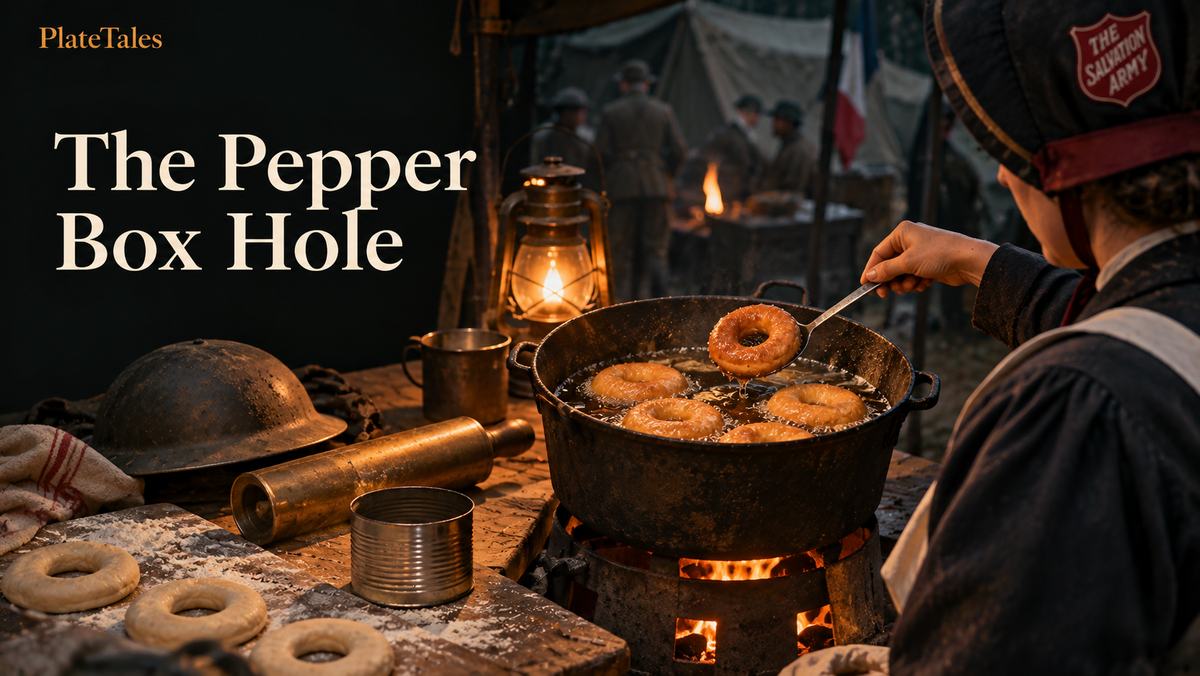
The doughnut had no single inventor, exactly. Dutch settlers in New Amsterdam are said to have brought fried "oily cakes" called olykoeks, and a Maine ship captain named Hanson Gregory claimed in an old-age interview that he cut the first hole in one with a pepper box. The ring only became a national habit after 1917, when women of the Salvation Army fried dough for soldiers in France.
The olykoek and the doughnut proper
The oldest layer of the story is also the thinnest. David A. Taylor, writing for Smithsonian magazine in March 1998, says the doughnut "supposedly" reached Manhattan, then still New Amsterdam, under the Dutch name olykoeks, "oily cakes." The word he chooses is supposedly, and it is a fair one. These were lumps of fried dough. They had no hole and no ring.
Taylor adds that archaeologists keep turning up what look like fossilized bits of doughnut in the middens of prehistoric Native American settlements. He offers that as a curiosity, not a lineage, and it does not connect to the Dutch cakes in any chain of evidence he gives.
So the honest answer to "where do doughnuts come from" is a shrug with a Dutch accent: fried dough is old and everywhere, and the New York kitchen is one tradition among several.
Hanson Gregory and the pepper box
The hole has a named claimant. Gregory was a New England ship captain, and Taylor's account begins with his mother, Elizabeth Gregory, who made a deep-fried dough using the nutmeg, cinnamon and lemon rind of her son's cargo. Some tellers say she made it so Hanson and his crew could keep a pastry on long voyages. She put hazelnuts or walnuts in the center, where the dough might not cook through, and called the result doughnuts.
Her son's claim was smaller: the hole. Taylor reports that in an interview with the Boston Post at the turn of the twentieth century, Gregory recalled the moment some fifty years before. He had used the top of a round tin pepper box to cut into the middle of a doughnut "the first doughnut hole ever seen by mortal eyes."
That is the whole primary account, and it is Gregory's own memory, told half a century late. Taylor lists the rival stories without choosing: that Gregory wanted to stint on ingredients, that he thought a hole would be easier to digest, or that in a storm he spiked a doughnut on a spoke of the ship's wheel to keep both hands free. A man who has told a tale for fifty years will tell it well, and none of the versions can be checked against a document from the time.
| Claim | Who tells it | What backs it |
|---|---|---|
| Dutch olykoeks reached New Amsterdam | Smithsonian magazine, 1998 ("supposedly") | No document cited |
| Gregory punched the first hole with a pepper box | Gregory, to the Boston Post, about 1900 | His own recollection, 50 years on |
| Gregory spiked one on a ship's wheel | Unnamed "doughnut historians" | Told as rumor |
Doughnut Lassies in France, 1917
The doughnut went from regional treat to national object during the First World War, and the best-documented scene in this story is a camp in eastern France. Lorraine Boissoneault reported in Smithsonian magazine in 2017 that in September 1917 four Salvation Army women reached the camp of the 1st Ammunition Train, 1st Division, a few miles from the trenches. They had gas masks, helmets and revolvers. What they lacked was flour, sugar and rolling pins.
Two of them, Margaret Sheldon and Helen Purviance, collected spare rations for dough and used shell casings and wine bottles as rolling pins. They filled a soldier's helmet with lard to fry braided crullers. Later they made a cutter in the true ring shape from an empty condensed milk can and a narrow tube of camphor ice, according to John T. Edge's book Donuts: An American Passion, as Boissoneault cites it.
Purviance wrote home about a single day's work: two women cooking 2,500 doughnuts, eight dozen cupcakes, fifty pies, 800 pancakes and 255 gallons of cocoa, with one more girl serving. The Salvation Army sent only about 250 volunteers to the front, but the "Donut Lassies" mattered far out of proportion to that number. Theodore Roosevelt Jr. wrote after serving in France that before the war he had thought the Salvation Army "a well-meaning lot of cranks," and now whatever help he could give them was theirs.
One of the lassies, Stella Young, told the Boston Globe years later that a piece of shrapnel tore through her tent and a doughnut pan while she was away from the stove. Many of the men, she said, were 16 or 17.
One caution from Taylor: the word "doughboy" had nothing to do with doughnuts. It dates to the Civil War, when cavalry mocked foot soldiers, perhaps because of their round brass buttons or the flour they used to polish white belts.
In the Salvation Army's own telling, Purviance hoped that this "home touch" would do more for the men who ate the donuts than satisfy a physical hunger. The organization started National Donut Day in 1938 to honor these women, and says the returning doughboys carried a taste for doughnuts home.
Adolph Levitt and the machine in the window
Taylor dates the first doughnut machine to 1920 in New York City, where Adolph Levitt, a refugee from czarist Russia, was selling fried doughnuts from his bakery. Hungry theater crowds pushed him, Taylor writes, to build a gadget that turned out the rings faster. The machine put the process behind glass, and people stopped to watch.
A University of Southern California digital history project on doughnuts and the Salvation Army adds that Levitt opened what became the Mayflower Doughnut Shop in Times Square, the first link in a chain that grew into the Doughnut Corporation of America, and that most doughnut shops of the 1920s were small family businesses buying from him.
By 1931 the New Yorker was describing a Broadway shop where doughnuts "float dreamily through a grease canal in a glass enclosed machine." Taylor puts Levitt's earnings at about $25 million a year by then, mostly from wholesale supply to bakers. The 1934 Chicago World's Fair billed doughnuts as "the food hit of the Century of Progress." A doughnut cost less than a nickel.
Watching the machine, Taylor notes, taught generations of onlookers that "the doughnut hole is built in, not cut out."
For a sibling puzzle about a ring of dough, and more origin stories, see why bagels have holes.
Why do doughnuts have holes?
The practical answer is that a ring fries evenly. Taylor's account of Mrs. Gregory's nut-filled centers points at the same problem: the middle of a thick ball of dough can stay raw while the outside browns. Nobody in the sources read here states this as the reason Gregory gave. His own words speak only of cutting the hole, not of why, so the reason stays an inference.
Questions people ask
Did Hanson Gregory really invent the doughnut hole?
Gregory claimed it, but the evidence is his own recollection. Smithsonian magazine reports that he told the Boston Post around 1900 that he cut the first hole about fifty years earlier, using a tin pepper box. No document from the 1840s is cited, so the claim stays unproven.
What did the Doughnut Lassies do in the First World War?
The Doughnut Lassies were Salvation Army women who served American troops in France. From September 1917, Margaret Sheldon and Helen Purviance fried doughnuts near the trenches using shell casings and wine bottles as rolling pins, and Purviance reported 2,500 doughnuts made in a single day.
What is an olykoek?
Olykoek is a Dutch word for "oily cake," a lump of fried dough. Smithsonian magazine says doughnuts supposedly came to New Amsterdam, now Manhattan, under that name. The olykoek was not ring-shaped, so it counts as an ancestor of the doughnut and not the doughnut itself.
When was the first doughnut machine made?
Adolph Levitt, a Russian-born baker, built the first doughnut machine in New York City in 1920, according to Smithsonian magazine. Crowds at his bakery wanted doughnuts faster than hand work allowed. By 1931 his machines were earning him about $25 million a year, mostly from wholesale sales.
Filed under Origin Stories
Want more stories like this?
One food history story, every week. No spam, just the stories behind what the world eats.