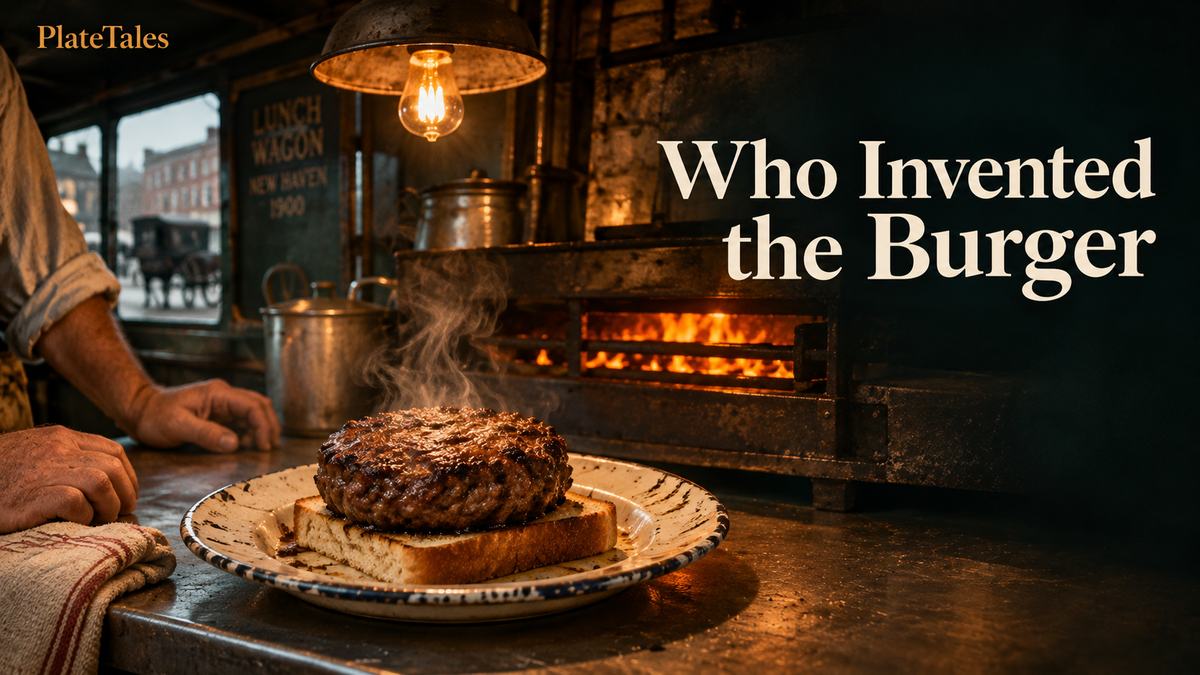
Nobody can say for certain who invented the hamburger. At least five American towns claim the first one, from Seymour, Wisconsin to New Haven, Connecticut to Athens, Texas, and each claim rests on family memory or local pride rather than a dated document. What the paper record does show is that the name came from Hamburg steak, a chopped-beef dish that German migrants carried across the Atlantic, and that the sandwich was common in American print by the mid-1890s.
The dish that gave the hamburger its name
Start with the steak, because the sandwich is named after it. Hamburg steak was minced beef, lightly salted, sometimes smoked, usually served with onions and breadcrumbs. It was popular enough in the port of New York that the oldest English-language document for it is an 1873 Delmonico's menu, where chef Charles Ranhofer's version cost 11 cents, twice the price of a plain beef fillet.
Germany had a cousin of its own. A bread-roll snack called "Rundstuck warm" was being sold in Hamburg by 1869, though it may have held roasted beefsteak rather than a ground patty. By the 1880s the American newspapers had caught up: a Boston Journal piece in 1884 mentioned a "Hamburg steak," and a Walla Walla, Washington menu in 1889 listed hamburger steak.
So the meat existed, and so did the name. The open question is who first put it between bread and handed it to someone who needed a free hand.
Charlie Nagreen and the Seymour fair, 1885
The Seymour Historical Society in Wisconsin credits Charlie Nagreen, who is said to have been 15 when he sold a meatball sandwich at the 1885 Seymour Fair. The story goes that customers could not walk around the grounds while eating a plate of meatballs, so he flattened one and put it between bread. The society says he named it after Hamburg steak.
It is a good story, and the town has built a festival around it. What is missing is a printed record from 1885.
The Menches brothers and an empty sausage cart
Frank and Charles Menches say they sold beef sandwiches at the 1885 Erie County Fair in Hamburg, New York, after the pork sausage ran out. The town name makes a tidy coincidence. The historian Joseph Streamer disputes the butcher's identity in that account, and Frank Menches's New York Times obituary places the event at the 1892 Summit County Fair in Akron, Ohio, which is a different fair, a different state and seven years later.
Louis Lassen and the Library of Congress
Louis' Lunch in New Haven is the best-documented claimant as a business. Louis Lassen was born Ludvig Lassen in 1865 to a Danish family in Schleswig, came to New Haven in 1881, and opened a lunch wagon in 1895. The family says that around 1900 a hurried customer asked for something to take away, and Lassen put ground steak between two slices of toast.
In 2000 the Library of Congress recognized Louis' Lunch as the creator of the hamburger, after Representative Rosa DeLauro backed the claim. That gives the story an official air. It also gives critics an easy target: the food writer Josh Ozersky argues that a patty on toast is not a hamburger, and George Motz points out that hamburger buns did not exist in 1900.
The restaurant still cooks its burgers in vertical cast iron broilers made in 1898, serves them on square toast, and does not allow ketchup. The Lassen family has run it for four generations.
Fletcher Davis and a Texas resolution
Athens, Texas has the most official claim of all. In 2007 the Texas Legislature passed House Concurrent Resolution 15, which designates Athens the "Original Home of the Hamburger." The resolution says Fletcher "Uncle Dave" Davis moved from Missouri to Athens in the 1880s, worked at a pottery, cooked for company picnics, and later opened a lunch counter on the courthouse square. It describes his sandwich as ground beef with mustard, mayonnaise, onion and pickles on bread slices, and says it reached the 1904 World's Fair in St. Louis.
The evidence behind that is thinner than the resolution suggests. The columnist Frank X. Tolbert researched Davis in the 1970s. The resolution itself cites a McDonald's management training center and a New York Tribune reporter at the fair who wrote that a vendor created the sandwich. According to Texas Co-op Power, no one has found that Tribune article, and the etymologist Barry Popik searched Tribune databases and found no record of hamburgers sold at the 1904 fair. The legislature, in other words, ratified a family and local tradition.
Oscar Bilby and the bun
Some people argue that a hamburger needs a bun, and that moves the prize to Tulsa. Oscar Weber Bilby's family says he served the first hamburger on a yeast bun on July 4, 1891, at his farm. In 1995 Oklahoma Governor Frank Keating called Tulsa the real birthplace of the hamburger. The Bilby account needs better sourcing, because it comes from the family rather than from a contemporary document.
What the printed record shows
Here is what can be dated, and what cannot.
| Date | Place | Source type |
|---|---|---|
| 1885 | Seymour, Wisconsin | Local history, no 1885 print record cited |
| 1891 | Tulsa, Oklahoma | Family account |
| 1893 | Reno, Nevada | Reno Evening Gazette, "hamburger sandwich" (cited by Popik) |
| 1896 | Chicago | Chicago Daily Tribune, five-cent "hamburger steak sandwich" |
| 1900 | New Haven, Connecticut | Family account, later recognized by Library of Congress |
| 1904 | St. Louis | Reported Tribune article, not located |
The earliest firm print evidence is the 1893 Reno mention, and then the Chicago Daily Tribune on July 5, 1896, which described a five-cent "hamburger steak sandwich" sold from a "Sandwich Car." Both predate Louis Lassen's 1900 and the St. Louis fair of 1904, the event that gave the hamburger national exposure.
That points to a simpler explanation than any single inventor. Ground beef was cheap and already named after a German port. Fairs, lunch wagons and railroad stands all needed food that could be eaten standing up. It is easy to imagine several cooks in several towns making the same sandwich in the 1880s and 1890s without knowing about one another, which is also what an ABC News piece suggests. The sandwich has a cousin in the story of who invented the sandwich, and a rival for fairground fame in the history of hot dogs. Like many dishes in the foods invented by accident list, it may simply have had no single moment of invention.
From Wichita to White Castle
The hamburger became a respectable meal later. Joshua Ozersky credits a grill cook named Walter Anderson in Wichita, Kansas, with the first modern hamburger sandwich in 1915 or 1916. Anderson and E.W. "Billy" Ingram founded White Castle in 1921. White Castle itself traces the dish to a Hamburg cook named Otto Krause, who is said to have fried a beef patty in butter with an egg on top in 1891.
By 1930 the steak was usually served in a sandwich, and that sandwich was what people meant by the word hamburger. Louis' Lunch still closes every August for vacation.
Questions people ask
Why is a hamburger called a hamburger?
The name comes from Hamburg steak, a dish of minced beef, lightly salted and served with onions and breadcrumbs, which German migrants carried to the United States. It was on a Delmonico's menu in New York in 1873. The sandwich took the name when someone put that chopped beef between bread.
What is the earliest printed evidence of the hamburger sandwich?
The earliest firm print evidence is a 1893 mention of a "hamburger sandwich" in the Reno Evening Gazette, cited by the etymologist Barry Popik. The Chicago Daily Tribune followed on July 5, 1896, describing a five-cent "hamburger steak sandwich" sold from a "Sandwich Car." Both predate Louis Lassen's family date of 1900.
Did Louis' Lunch in New Haven invent the hamburger?
Louis' Lunch in New Haven, Connecticut says Louis Lassen put ground steak between two slices of toast around 1900, and the Library of Congress recognized it in 2000. Critics note that a patty on toast is not a bun hamburger, and the 1893 and 1896 print mentions came earlier.
Which town has an official claim to the first hamburger?
Athens, Texas has the most formal claim. In 2007 the Texas Legislature passed House Concurrent Resolution 15, naming it the "Original Home of the Hamburger" after Fletcher "Uncle Dave" Davis. The evidence is thin, though: the New York Tribune article it cites at the 1904 St. Louis fair has never been found.
Filed under Origin Stories
Want more stories like this?
One food history story, every week. No spam, just the stories behind what the world eats.