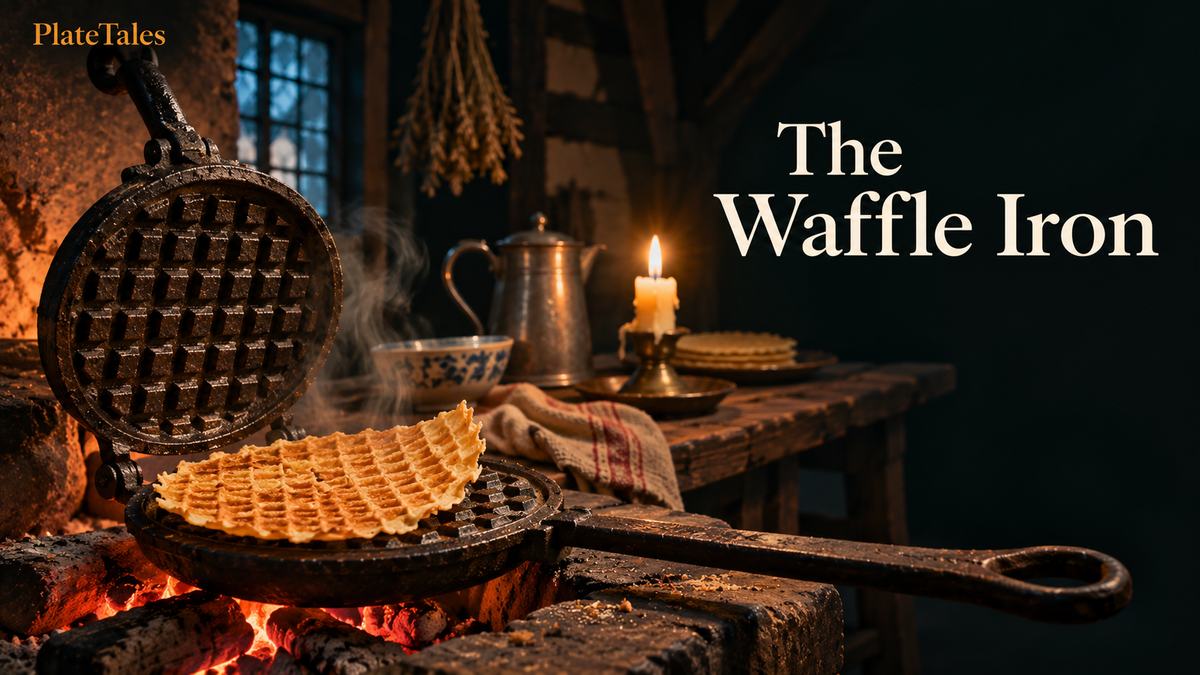
The credit for the waffle belongs to no single inventor. It grew out of the iron plates used to bake communion wafers and thin festival cakes in medieval Europe, reached America with Dutch colonists in the 1620s, and got its American patent on 24 August 1869, when Cornelius Swartwout of Troy, New York, was granted a patent for an "Improvement in Waffle-Irons." The thick Belgian version most diners serve came much later, from a booth in Queens in 1964.
The iron came first, and the waffle followed
The honest answer starts with metal. A waffle is a batter pressed and cooked between two hinged plates, and the plates are the invention. The National Museum of American History notes that the waffle iron can be traced back to ancient Greece, though its own collection of irons begins in the early 18th century.
Before there were waffles as we know them, there were wafers. Musea Brugge, the city museum service of Bruges, explains that the French word for the thin version, oublie, comes from the Latin oblatum, a gift of sacrifice. The basic wafer was grain flour and water, the same stuff as a communion wafer, baked in a tong-shaped iron held over an open fire. If the baker looked away, the wafer stuck.
Two irons from a Burgundian court
The best physical evidence in Belgium is not a recipe but a pair of irons. The Gruuthuse Museum in Bruges holds two 15th-century wafer irons that Musea Brugge describes as among the oldest known in the Low Countries. One carries the arms of John the Fearless (1371-1419) on one face and a six-pointed star on the other. The second, made around 1430 to 1450, bears the arms of Philip the Good, holly and an image of the Mystic Lamb.
Both were tied to Easter. The museum says that baking wafers was a typical Easter custom, and that holly and the lamb both pointed to the Passion. Why the irons were made is unknown. The museum suggests they may have been gifts from the dukes to allies, and then adds, plainly, "We are left guessing."
Their plates have shallow notches, so what came off them was thin and crisp, nothing like a modern waffle. Musea Brugge adds that 16th-century cookbooks also carry recipes for thick, airy waffles with diamond shapes, closer to what a diner would call a waffle now.
Waffles at the carnival
Outside the court, the waffle was street food. The Bruges museum points to Pieter Brueghel the Elder's 1559 painting The Fight between Carnival and Lent, to works by Joachim Beuckelaer, to border miniatures in Books of Hours, and to a late 15th-century drawing of a waffle baker attributed to Hieronymus Bosch. In these pictures, waffles belong to Carnival, Shrove Tuesday and street fairs.
That makes them cousins of other fat-season foods. If you want the griddle version of the same Shrove Tuesday habit, the story of pancakes runs alongside this one, and so does the one about French toast.
The word itself arrived later than the thing. The Smithsonian's museum records that "waffle" first appears in English in Robert Smith's Court Cookery in 1725, and that waffles in that period were eaten sweet, with butter, syrup or fruit, or savory, with kidney stew.
Dutch irons in New Amsterdam
The New-York Historical Society says the early Dutch residents of New York made treats like these in wafer irons, and that they came out thin, crisp and served rolled up. It holds an iron dated about 1720 to 1820 in its Folk Art Collection. The National Museum of American History puts the arrival of waffle-making in America with Dutch colonists in the 1620s.
Those irons had long handles, called reins, because they were used in an open hearth. The museum's earliest examples are two hinged plates at the end of such handles, and one family in Morgantown, West Virginia, used a ring-of-squares iron with a central rosette between 1810 and 1850. Once the wood stove came in, the handles got shorter, since the iron now sat on a cooktop.
Swartwout and the stovetop iron of 1869
That brings us to the date that gives National Waffle Day its place on the calendar. On 24 August 1869 the U.S. Patent Office issued a patent to Cornelius Swartwout of Troy, New York, for an improvement in waffle-irons. The museum says that its drawing looks very like irons used today, with one big difference: it still needed a fire.
Swartwout was not the first person to bake a waffle, and the patent did not create the waffle. It covered a better iron for a stove. The museum also notes that the inventor's surname appears with more than one spelling, Swartwout and Swarthout, in the records.
By the late 19th century American makers were selling irons in the same style. The museum holds one from about 1890 that a family in Winchester, Virginia, used over a wood-fired stove from 1890 to 1940 before donating it.
From the stove to the breakfast table
Electric heat came next. According to the museum, the Simplex Electrical Company of Boston made what was probably the first electric waffle iron about 1906. It was a rectangle on four stout feet with six round plates in two rows, and the front row flipped over onto the back one. Its electrical contacts were exposed, because appliance safety rules did not exist yet.
Commercially successful models for the home, from General Electric and Landers, Frary & Clark, did not follow until well into the 1910s. By the 1920s the iron had moved to the breakfast table, and Robeson Rochester sold a chrome-plated set with percolator, batter bowl and syrup pitchers in the late 1920s and through the 1930s.
By the middle of the century, boxed mixes and frozen waffles had arrived in American kitchens as well.
Belgian waffles and the 1964 World's Fair
The thick, deep-pocketed waffle people call Belgian has a younger story than the name suggests. Musea Brugge says Belgium's association with waffles "is not that old" and that Maurice Vermeersch (the museum's spelling) introduced the Brussels waffle as a national favorite at the 1964 World's Fair in New York.
The New-York Historical Society gives the family's names as Maurice and Rose Vermersch and their daughter MariePaule, who ran a stand in the fair's Belgian Village. They first called their product "Brussels waffles," until they realized Americans did not know Brussels was the capital of Belgium. They changed the name to "Bel-Gem" waffles, which quickly became "Belgian waffles."
The family served more than 2,500 waffles a day, topped with whipped cream, powdered sugar and sliced strawberries. A fairgoer quoted by the Society, Richard Post of Lawrence, Long Island, remembered that "There was absolutely no polite way to eat it."
| Year | What the sources record |
|---|---|
| 1620s | Dutch colonists bring waffle-making to America |
| 1725 | "Waffle" first printed in English, in Court Cookery |
| 1869 | Swartwout's patent for a stovetop waffle iron |
| About 1906 | First electric waffle iron, made in Boston |
| 1964 | Belgian waffles served at the New York World's Fair |
Questions people ask
What is the waffle iron's history before 1869?
Waffle irons are older than the United States. The Gruuthuse Museum in Bruges holds two Burgundian wafer irons from the 15th century, and the National Museum of American History holds American irons from the early 18th century. Swartwout's 1869 patent covered a stovetop design, not the first iron.
When is National Waffle Day, and why?
National Waffle Day falls on 24 August, the date in 1869 when the U.S. Patent Office issued Cornelius Swartwout of Troy, New York, a patent for an improvement in waffle-irons. The National Museum of American History ties the day to that patent, which described an iron that still needed a fire for heat.
Did Belgian waffles come from the 1964 World's Fair?
Belgian waffles became known in America at the 1964 New York World's Fair, where Maurice and Rose Vermersch and their daughter MariePaule sold them in the Belgian Village. Waffles themselves are far older in the Low Countries. The "Belgian" name stuck after the family dropped "Brussels waffles," which Americans did not recognize.
When did waffles come to America?
Waffle-making reached America with Dutch colonists in the 1620s, according to the National Museum of American History. The word "waffle" itself appears in English for the first time in 1725, in Robert Smith's Court Cookery. Early waffles were eaten sweet, with butter or syrup, or savory, with kidney stew.
Filed under Origin Stories
Want more stories like this?
One food history story, every week. No spam, just the stories behind what the world eats.