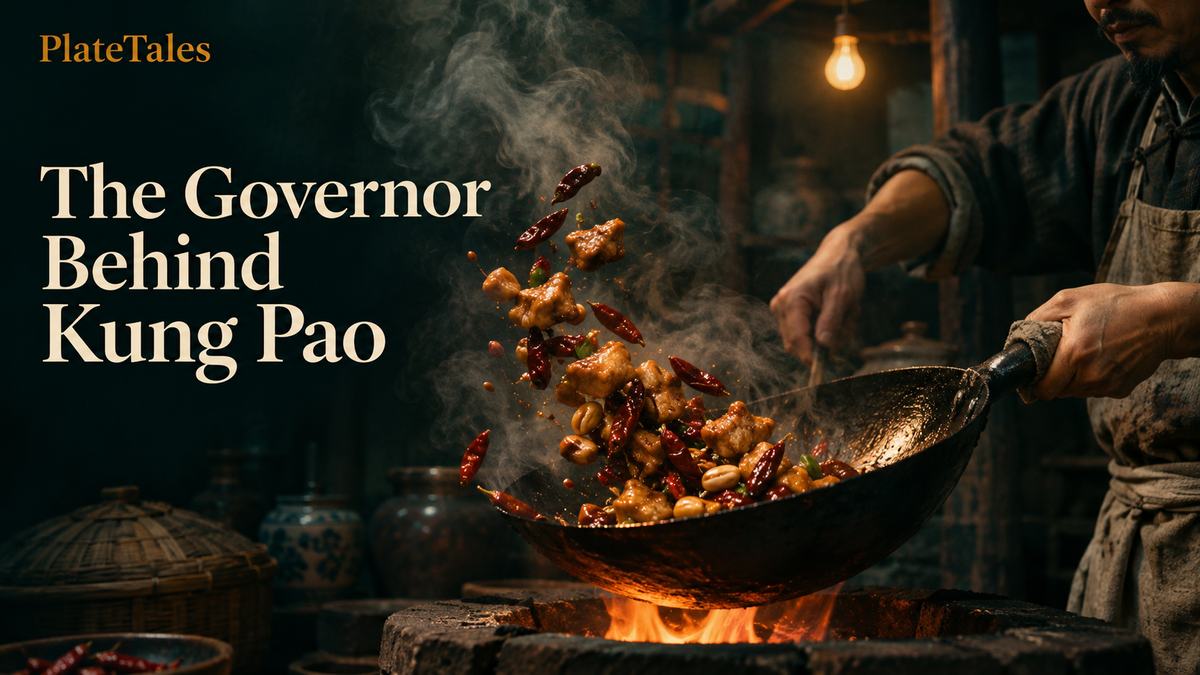
Kung pao chicken is named after Ding Baozhen, a Qing dynasty official who governed Sichuan in the late 1800s and was known by the honorary title Gongbao, "palace guardian". That much is solid. Who actually cooked the first plate, and why, is not, and the best-known tales about it are the ones the food writer Fuchsia Dunlop herself calls doubtful.
Who was Ding Baozhen?
Ding was a real and fairly important man. Biographies drawing on a Guizhou government page, the Dujiangyan Irrigation System Museum and Arthur Hummel's 1943 reference work on eminent Qing figures give his birth in Pingyuan in Guizhou province, in 1820 or 1821 depending on which source you trust. He entered government service in 1854. He served as governor of Shandong from 1867 to 1876, then moved to Sichuan, where he was governor-general from October 1876 until he died in Chengdu in April 1886.
His best-documented work has nothing to do with chicken. In Sichuan he oversaw the rebuilding of the Dujiangyan irrigation works, and a statue of him stands at the Erwang Temple in Dujiangyan. Sources even disagree on his death year: one cited biography says 1896, while the date given elsewhere is 1886.
What does "Gongbao" actually mean?
Ding held the court title Taizi Shaobao, roughly a junior tutor or guardian of the crown prince. People shortened it to Gongbao, "palace guardian", and used it as a polite nickname, so he became "Ding Gongbao". The dish's Chinese name, gongbao jiding, reads as "Gongbao's diced chicken".
There is a second layer. The character for Ding, his surname, is also the word for a small cube. So the name is a pun: the official, and the neat cubes of chicken. Whether the pun was planned by the first cook or noticed later, nobody has shown.
"Kung pao" is simply the older Wade-Giles spelling, which is the one most English menus inherited.
Who invented kung pao chicken?
Nobody knows. Dunlop, in her book Land of Plenty, lists the competing stories and does not pick one. In one, Ding brought the dish with him from his home province of Guizhou. In another, he ate it at a modest restaurant while travelling in plain clothes to see how ordinary people lived. In a third, a chef invented finely chopped chicken because Ding had bad teeth, a version Dunlop calls rather implausible.
None of these stories comes with a recipe book, a menu or a dated document from Ding's own lifetime, at least not in anything read for this article. They are the kind of tale that attaches itself to a famous name after the dish is already famous. The honest summary is that the name points to Ding, the stories point in three directions, and the first written trace of the cooking is missing from the sources available here.
Is kung pao chicken from Sichuan or Guizhou?
The dish is classed as Sichuan cooking, and the Sichuan method is the one most cookbooks give: diced chicken marinated with Shaoxing wine, dried chiles fried in oil until they darken, a little Sichuan pepper, and peanuts fried until golden. The flavor is not the numbing "mala" profile of many Sichuan dishes.
Guizhou has its own claim, and it is not frivolous, given that Ding was born there. A Guizhou version uses a fermented chile paste called ciba, with larger cubes of chicken that are usually left with the skin on. Some literature lists Guizhou as the origin, citing a Chinese cookbook from 1965. That is a claim worth knowing about, but it is a modern cookbook assigning a place, not a nineteenth-century record.
| Version | Chile | Chicken |
|---|---|---|
| Sichuan | Dried whole chiles, a little Sichuan pepper | Small cubes |
| Guizhou | Fermented ciba chile paste | Larger cubes, often skin-on |
How the evidence stacks up
It helps to separate three layers, because they have very different weight.
The first layer is the name. The link between the dish and Ding's Gongbao title is stated consistently across the accounts read here, and the title itself is a matter of the official record. This is the firmest part.
The second layer is the origin tales: Guizhou import, the disguised governor, the toothless governor. They are all told in the present tense of folklore, with phrases such as "said to have" and "supposedly". Dunlop sets them side by side and trusts none of them enough to say so. A reader who hears one told with confidence at a restaurant table should treat it as one of three.
The third layer is the date. The usual dating is the mid-to-late nineteenth century, which is simply the span of Ding's career as a governor. It is an estimate drawn from the name, not a date found in a document.
One more detail makes the Sichuan claim reasonable without proving it. Ding spent the last decade of his life, from 1876 to 1886, as the top official in Sichuan, so a dish carrying his title would naturally be tied to Sichuan kitchens, even if the idea came from his Guizhou childhood or his travels. Nothing in the sources read here settles which.
The years the name was dangerous
The best-documented chapter is the strange one. Dunlop writes that during the Cultural Revolution the dish was condemned as politically incorrect because it carried the title of an imperial official. Radicals renamed it. The two names she gives are hong bao ji ding, which she translates as "fast-fried chicken cubes", and hu la ji ding, "chicken cubes with seared chiles". Other accounts give the second one only, as húlà jīdīng (糊辣鸡丁), render it "spicy chicken", and say the original name was rehabilitated under Deng Xiaoping's reforms, a claim with no cited source. Dunlop herself says the original name came back in the 1980s.
So for a period the dish survived by shedding its aristocrat. The cooking stayed the same, the pun on Ding disappeared with the title, and a Qing governor was edited out of his own dinner. When the old name returned, so did he.
What happened when it reached America
Outside China the recipe drifted. Western versions, sold as kung pao, kung po or "chicken with chili and garlic", often add orange or orange juice, ginger, garlic, chicken broth, sugar, cornstarch, and vegetables such as onion, bell pepper or carrots. Whole roasted peanuts are common, and pork, duck, shrimp or tofu sometimes replace the chicken. The sweet, sticky, brown dish many Americans know shares a name and a few ingredients with the Sichuan original, and not much else.
That drift is part of a bigger pattern in which Chinese cooks adapted dishes to local ingredients and tastes, a story told in how immigration changed American food. It also shows how a dish can become a marker of who a cook thinks they are, a theme in how food shaped cultural identity. You can find more name-and-origin puzzles in our origin stories collection.
Ding Baozhen, meanwhile, gave his name to a dish he may never have ordered. He died in Chengdu in April 1886, and the name he was known by is still on menus from Chengdu to Chicago.
Questions people ask
What does Gongbao mean in kung pao chicken?
Gongbao is the shortened form of Taizi Shaobao, the court title held by Ding Baozhen, a Qing governor of Sichuan. It is usually rendered "palace guardian". The Chinese name of kung pao chicken, gongbao jiding, reads as "Gongbao's diced chicken", and "kung pao" is the older Wade-Giles spelling of the same word.
Why was kung pao chicken renamed during the Cultural Revolution?
During the Cultural Revolution, kung pao chicken was condemned as politically incorrect because its name carried the title of an imperial official. Radicals renamed it, and Fuchsia Dunlop gives the replacements hong bao ji ding ("fast-fried chicken cubes") and hu la ji ding ("chicken cubes with seared chiles"). The original name returned in the 1980s.
How is Sichuan kung pao chicken different from the American version?
The Sichuan dish uses small cubes of chicken marinated in Shaoxing wine, dried chiles fried until dark, a little Sichuan pepper and fried peanuts. American kung pao often adds orange, ginger, garlic, sugar, cornstarch and vegetables such as bell pepper or carrots, and can swap the chicken for pork, shrimp or tofu. The result is sweeter and stickier.
Is kung pao chicken from Sichuan or Guizhou?
Kung pao chicken is classed as Sichuan cooking, and Ding Baozhen was governor-general there from 1876 to 1886. Guizhou, where Ding was born, also has a claim, and some literature, citing a 1965 Chinese cookbook, lists it as the origin. Guizhou's version uses fermented ciba chile paste and larger, often skin-on cubes of chicken.
Filed under Origin Stories
Want more stories like this?
One food history story, every week. No spam, just the stories behind what the world eats.