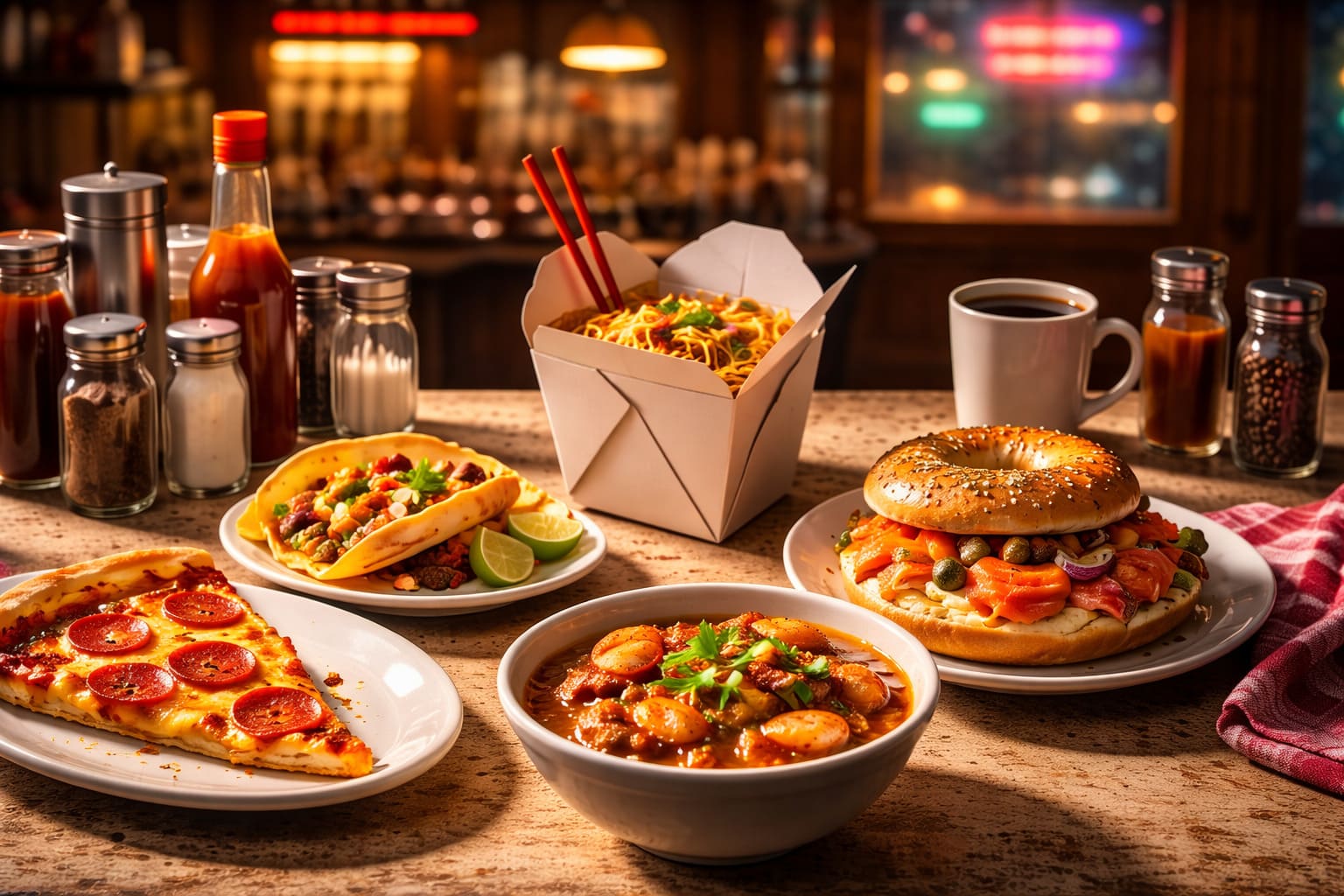
Immigration changed American food by supplying almost every dish Americans now treat as ordinary, and then rewriting those dishes once they arrived. Italian, German, Chinese and Mexican cooks adjusted what they knew to new ingredients, new prices and new customers. Spaghetti with meatballs, chop suey and the combination plate are products of that adjustment, and several were unknown in the places their makers came from.
What did Italian immigrants cook at home, and what did they cook in America?
Italians arrived steadily from the 1870s through the 1920s, most of them through Ellis Island. Historian Hasia Diner, in her book on immigrant food, describes poor Italians of that era eating mostly hard bread and soups, with meat kept for celebrations. In the United States the same families could afford soft bread, flour, meat, cheese, eggs, olive oil and dried pasta.
So the cooking changed. Italian-American "red sauce" food kept the plain methods of the old country but piled on meat, cheese and eggs. Spaghetti and meatballs descends from Neapolitan festival dishes, though the original meatballs were much smaller, and in Italy they are not served on top of pasta. Chicken parmesan, fried and covered with sauce and cheese, is a similar American arrangement. Fettuccine Alfredo began as a dish made by the Roman restaurateur Alfredo di Lelio from 1914, and the heavy sauce Americans know is virtually unfamiliar in Italy.
Neighbors from different regions swapped recipes in the same tenements, which blended Neapolitan and Sicilian habits into one style. Few Italian-American cookbooks appeared before the 1960s, so recipes traveled by word of mouth while the wider public learned "Italian" cooking from Anglo-American cookbooks.
Who opened the first pizzeria?
The usual answer is Gennaro Lombardi, at 32 Spring Street in Manhattan, with a license dated 1905. The tradition adds that he sold "tomato pies" from a grocery store as early as 1897. Later research disputes it. Work published in 2019 suggests Lombardi arrived in 1904 as a laborer and may have been an employee rather than the owner, and other pizzerias are now said to predate Lombardi's by more than ten years. The full story of the dish is in our piece on the origin of pizza.
How did German immigrants shape what Americans eat and drink?
Germans were the largest immigrant group from 1840 to 1890, and about five million arrived between 1840 and the First World War. They concentrated in the Midwest. By 1900, more than 40 percent of Cincinnati was of German descent, and Milwaukee was nicknamed "the German Athens" because German brewers there built Pabst, Schlitz, Miller and Blatz.
Germans are also credited with bringing the hot dog and the hamburger. The record is thin. The Hamburg steak, a chopped beef patty, is documented in Germany for centuries. The earliest specific American record of it in a sandwich is a Chicago Daily Tribune item of July 5, 1896, describing a "Hamburger steak sandwich" sold from a sandwich car for five cents. Hamburger steak sandwiches were advertised in American papers across the 1890s.
Everything before that is a claim. A New Haven lunch counter says Louis Lassen made the first one around 1900. A Wisconsin historical society credits Charlie Nagreen with selling meat sandwiches at a county fair in 1885. The Menches brothers have their own story, and Frank Menches's obituary placed it at an Ohio fair in 1892, not the New York one the family tells of. No conclusive argument has settled it, and it is quite possible that more than one cook had the idea at the same time. For the sausage side of the story, see the history of hot dogs.
Why is American Chinese food so different from food in China?
The first mass migration of Chinese to North America began in 1848, mostly toward the California Gold Rush. According to Andrew Coe, a historian of Chinese food in America, most of these migrants came from a poor group of coastal counties in Guangdong that he calls the Toisan region. Their home cooking was mixed vegetable dishes and fried noodles, not the banquet cuisine of Guangzhou. Because Toisanese people dominated the early Chinatowns, their food came to define "Chinese" for most Americans.
California whites at first tolerated the newcomers, then turned on them. Congress signed the Chinese Exclusion Act on May 6, 1882, barring Chinese laborers for ten years. The Chinese population of the United States fell from about 105,000 in 1880 to 61,000 in 1920. Restaurants and laundries were among the few businesses open to those who stayed, and restaurant owners became eligible for merchant status in 1915.
The chop suey craze
Chop suey is the dish that built the trade. Coe finds no mention of it on the West Coast before 1900, and traces its first American use to New York. In 1883 a Chinese-language newspaper editor, Wong Chin Foo, offered $500 to anyone who could prove Chinese people ate rats or cats, got no takers, and wrote an article praising Chinese cooking, including a stew he called "chop soly." Bohemian diners began to visit Mott Street, and one reporter in the 1880s paid sixty-three cents for a meal that began with chop suey. The original was an earthy stew of chicken livers, gizzards, tripe, mushrooms and bean sprouts.
Then it was cleaned up. As restaurants moved uptown after 1896, cooks swapped organ meats, which looked suspiciously like rat, for plain pork, chicken or beef, fixed the vegetables at bean sprouts, celery, water chestnuts, bamboo shoots and onion, and cooked them until soft. Coe calls this "improved" chop suey the founding dish of Chinese-American cuisine. The dish could cost as little as 15 cents a bowl. From 1900 on, he writes, Americans ate it with an appetite they had shown no other foreign food, and Chinese-American restaurants spread to nearly every town.
The famous story that Li Hung Chang's chefs invented it on a visit in 1896 does not hold up. Coe notes that the one dish his cooks never prepared was chop suey, and a newspaper of the time already called it a dish that had "gained some celebrity." In the 1960s, new immigration laws brought cooks from Hong Kong and Taiwan with different dishes, and chop suey faded from menus. In China itself the term means "odds and ends," something close to Chinese hash.
The fortune cookie is another product of California, adapted from a Japanese cracker called omikuji senbei, and not a Chinese tradition at all.
Where does Tex-Mex come from?
Tex-Mex began as the cooking of Tejanos, Texans of Mexican descent, a mix of native Mexican and Spanish foods from the years when Texas belonged to New Spain and then Mexico. The word is more recent than the food. "TexMex" first abbreviated the Texas Mexican Railway, chartered in 1875, and the Oxford English Dictionary's earliest print use for food is a 1963 New York Times Magazine article, although earlier newspaper uses turn up from 1922 and 1960. Chef Adan Medrano prefers "Texas Mexican," arguing that the cooking predates the border itself.
In San Antonio, working-class Tejana and Mexican women, the "chili queens," sold chili-flavored beef stew in public squares. A San Antonio chili stand at the 1893 World's Columbian Exposition in Chicago gave many Americans their first taste of chili. By the 1950s, Tex-Mex restaurants were built around combination plates served with American-style cheeses.
Many Americans took that menu for Mexican cooking itself. In 1972 Diana Kennedy's book The Cuisines of Mexico laid out how Mexican cuisine differs from the Americanized version, and food writer Robb Walsh later called it a breakthrough. The story of one dish that traveled in both directions is in our history of tacos.
Why does the same pattern keep repeating?
Look at the dishes together. The Italian meatball, the chop suey stew and the combination plate each began as a plain home dish, met a cheaper or more suspicious American market, and took a new shape. The customers were often curious about the strangers who cooked, and sometimes hostile to them. In 1890s New York, the same people who joined slumming parties in Chinatown also repeated street rhymes about Chinese people eating rats.
How food shapes who gets counted as American is the subject of our piece on food and cultural identity. Eisenhower's favorite meal, Coe reports, was delivery from Washington's Sun Chop Suey Restaurant: chicken chop suey, fried rice and egg foo young, with almond cookies for dessert.
Questions people ask
Which immigrant groups changed American cooking the most?
Italians, Germans, Chinese and Mexicans left some of the deepest marks. Italians arriving between the 1870s and 1920s built red-sauce cooking, Germans, the largest immigrant group from 1840 to 1890, shaped American brewing and are credited with the hot dog and hamburger, Chinese cooks created chop suey, and Tejanos developed Tex-Mex.
Is Italian-American food the same as Italian food?
No. Italian immigrants could afford meat, cheese, eggs and white bread in America that they rarely ate at home, so their cooking grew richer. Spaghetti and meatballs descends from Neapolitan festival dishes with smaller meatballs, and in Italy meatballs are not served on pasta. The heavy Alfredo sauce known in the United States is virtually unfamiliar there.
Is chop suey a real Chinese dish?
Partly. Chop suey comes from the home cooking of Toisan, a poor group of coastal counties in Guangdong, and the name means mixed pieces or odds and ends. The brown-sauce version Americans ate was shaped in New York after the 1880s, with organ meats replaced by plain pork, chicken or beef and the vegetables cooked soft.
Who invented the hamburger?
No one has been proven to. The Hamburg steak is documented in Germany for centuries, and the earliest specific American record of a hamburger steak sandwich is a Chicago Daily Tribune item from July 5, 1896. Claims from Wisconsin, Ohio, New York, Texas and Connecticut are all disputed, and several cooks may have had the idea independently.
What does Tex-Mex mean?
Tex-Mex is the regional cooking of Tejanos, Texans of Mexican ancestry, blending native Mexican and Spanish foods. The word began as a shorthand for the Texas Mexican Railway, chartered in 1875, and its earliest food use in the Oxford English Dictionary is a 1963 New York Times Magazine article. Diana Kennedy's 1972 book separated it from regional Mexican cooking.
Filed under Migration Stories
Want more stories like this?
One food history story, every week. No spam, just the stories behind what the world eats.