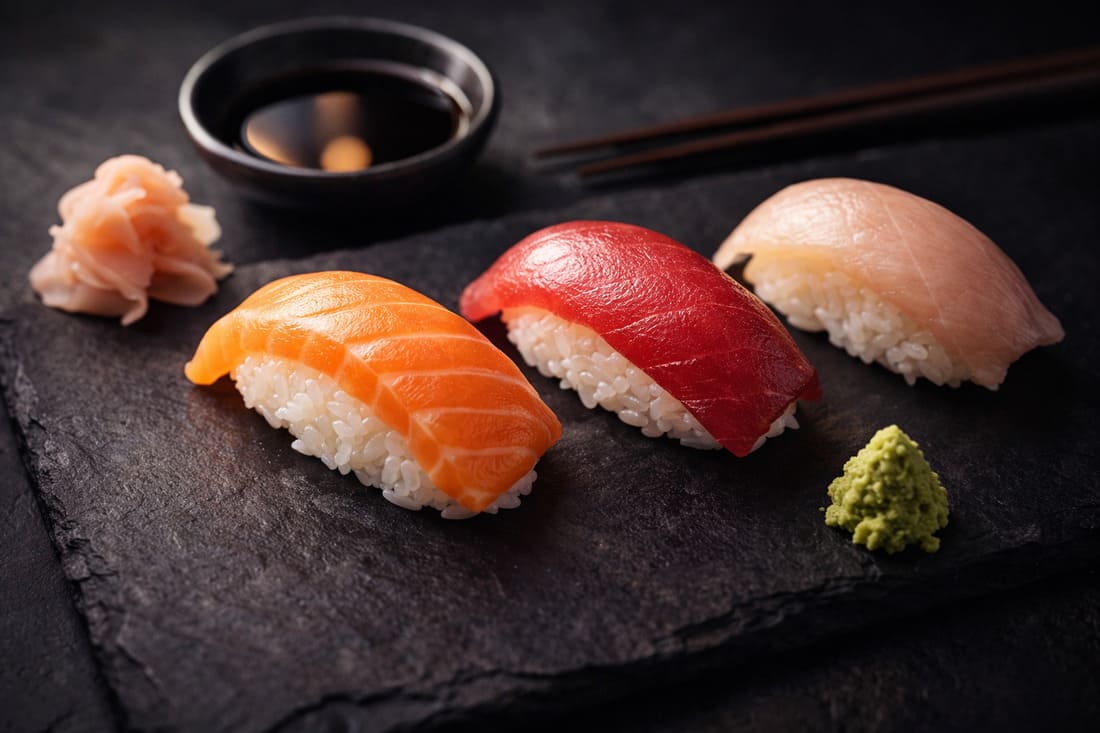
The origin of sushi is a fermented-fish story, not a Tokyo one. Sushi began as a way of keeping freshwater fish in salt and rice, a method thought to come from Southeast Asia, and reached Japan centuries before anyone put fish on a hand-pressed rice mound. The fast, vinegared nigiri most people mean today took shape in Edo, now Tokyo, in the early 1800s.
What the first sushi tasted like
Picture a barrel, not a counter. Gutted fish, packed in salt and cooked rice, weighted down and left. Lactic fermentation in the rice kept the fish edible for months. When the time was up, you ate the fish and threw the rice away.
That is narezushi, and it is the oldest form of the dish. Accounts of where it started point to the river basins of Southeast Asia, the Mekong and the Irrawaddy, though this rests on scholarly inference (Hosking, 1996, is the cited source) and not on a dated document. The earliest written trace is Chinese: a dictionary thought to date from around the fourth century describes salted fish laid in cooked or steamed rice.
The sources do not agree on every detail, and the popular claim that sushi is "2,000 years old" or began in a specific century BCE is a round number, not a record. What the evidence supports is a preservation technique, old and widespread, that traveled north.
How rice and fish reached Japan
Narezushi is usually tied to the arrival of wet-field rice farming in Japan in the Yayoi period. One explanation holds that floods carried fish into paddies, and packing the surplus in rice kept it as protein. That is a plausible story, told in the standard histories, and still a story.
The first Japanese legal text to use the characters now read as sushi is the Yoro Code of 718. It does not say what the food was. It may well have been narezushi, but historians treat that as a possibility, not a fact.
A relative survives near Lake Biwa in Shiga Prefecture: funazushi. The fish is salted, then packed in rice and left for months, in some versions for years. The Kitamura family is reported to have made it since 1619. Authentic versions are said to use nigorobuna, a local fish in the carp family. It tastes nothing like a California roll, and for a long stretch of history it was closer to what "sushi" meant.
Eating the rice too
Sometime in the Muromachi period (1336-1573) cooks began to shorten the wait. This partly fermented style is called namanare, and its rice was eaten along with the fish. Sake and sake lees were used to speed the process, and vinegar later joined them.
Vinegar finished the job in the Edo period (1603-1868). Seasoning the rice with vinegar copied the sour note of fermentation without the months of waiting, and the result is called hayazushi, "fast sushi." A cookbook of 1689 is cited for it, and another of 1728 describes vinegar poured over pressed hakozushi. After that the fish no longer had to ferment at all.
Who invented nigiri? Hanaya Yohei, and a date to be careful with
The standard answer is Hanaya Yohei (1799-1858), a sushi cook in Edo, and the date usually attached to him is 1824. The date needs care. In the account published by Nippon.com in 2020, 1824 is the year Yohei opened a full shop in the Ryogoku district, after starting at a street stall. It is not given as the year the nigiri method was born. Another account puts his invention more loosely in the early Bunsei era, which ran from 1818 to 1830. So "around the 1820s, in Edo" is what holds up.
The nineteenth-century writer Kitagawa Morisada recorded that Edo cooks once pressed sushi into boxes, as Osaka and Kyoto still do with hakozushi, and that nigirizushi replaced the box style in Edo from the early 1800s. His sketches show toppings familiar today, including egg, shrimp, sweet conger eel and tuna. The Nippon.com article gives prices of 8 mon a piece and 16 for the egg, which it converts to less than 100 yen for one piece.
A stand-up snack with cooked and cured fish
Edo nigiri was fast food. Customers stood at night stalls, chose from toppings on display, and ate with their fingers. Sushi was also delivered, in wooden boxes, to people at festivals and flower viewing. Yohei's early product was kohada, a small fish firmed in vinegar, sold from carrying boxes on the night streets.
Raw fish in the modern sense was not the point. There was no refrigeration, so fish from Tokyo Bay was marinated in soy sauce or vinegar, or lightly cooked. Lean tuna was soaked in soy, and the fatty belly was avoided. The pieces sat on rice balls larger than the ones served now.
Yohei's shop ran on in Ryogoku. Business fell off after the Great Kanto Earthquake of 1923, and the shop closed in 1930.
From conveyor belt to California
Sushi stayed a mostly Japanese food well into the twentieth century. Yoshiaki Shiraishi opened the first conveyor belt restaurant, Genroku Zushi, in Higashi-Osaka in 1958, and the format was shown at Expo '70 in Osaka.
Abroad, the record is patchy. Histories report a first US sushi shop in Los Angeles's Little Tokyo in 1906, but sources vary, and an earlier newspaper mention dates from 1904. The first true sushi bar and the invention of the California roll are both disputed. The roll is usually described as a maki that swapped avocado for fatty tuna, likely invented in Los Angeles. Salmon, now a counter staple, entered Japanese sushi only in the late 1980s, through a Norwegian farmed-salmon deal.
Related stories: the grain behind it, in our history of rice, the broader technique in the history of fermentation, another Japanese street-food story in the origin of ramen, and more preserved-food stories in fermentation.
Questions people ask
What is narezushi?
Narezushi is the oldest form of sushi: fish packed in salt and cooked rice and left to ferment for months. People ate the fish and discarded the rice. Funazushi from Lake Biwa in Shiga Prefecture, Japan, is a surviving example, and it bears little resemblance to the vinegared sushi served in restaurants today.
When did sushi start using vinegar?
Vinegar replaced fermentation in the Edo period (1603-1868) in Japan. Cooks seasoned rice with vinegar to imitate the sour taste of fermented rice without the long wait. The quick style is called hayazushi, meaning fast sushi, and a cookbook from 1689 is cited as an early record of it.
Was early nigiri sushi made with raw fish?
Mostly not. In early nineteenth-century Edo, now Tokyo, nigiri fish was usually marinated in soy sauce or vinegar, or lightly cooked, because there was no refrigeration. Hanaya Yohei's early sushi, for example, used vinegar-cured kohada and soy-soaked lean tuna on large rice balls.
Did Hanaya Yohei really invent nigiri in 1824?
Not as a documented fact. A 2020 Nippon.com account says Hanaya Yohei, who lived from 1799 to 1858, opened his full shop in Ryogoku in 1824. Another account puts his development of nigiri in the early Bunsei era, 1818 to 1830, so the 1820s in Edo is the safer claim.
Filed under Origin Stories
Want more stories like this?
One food history story, every week. No spam, just the stories behind what the world eats.