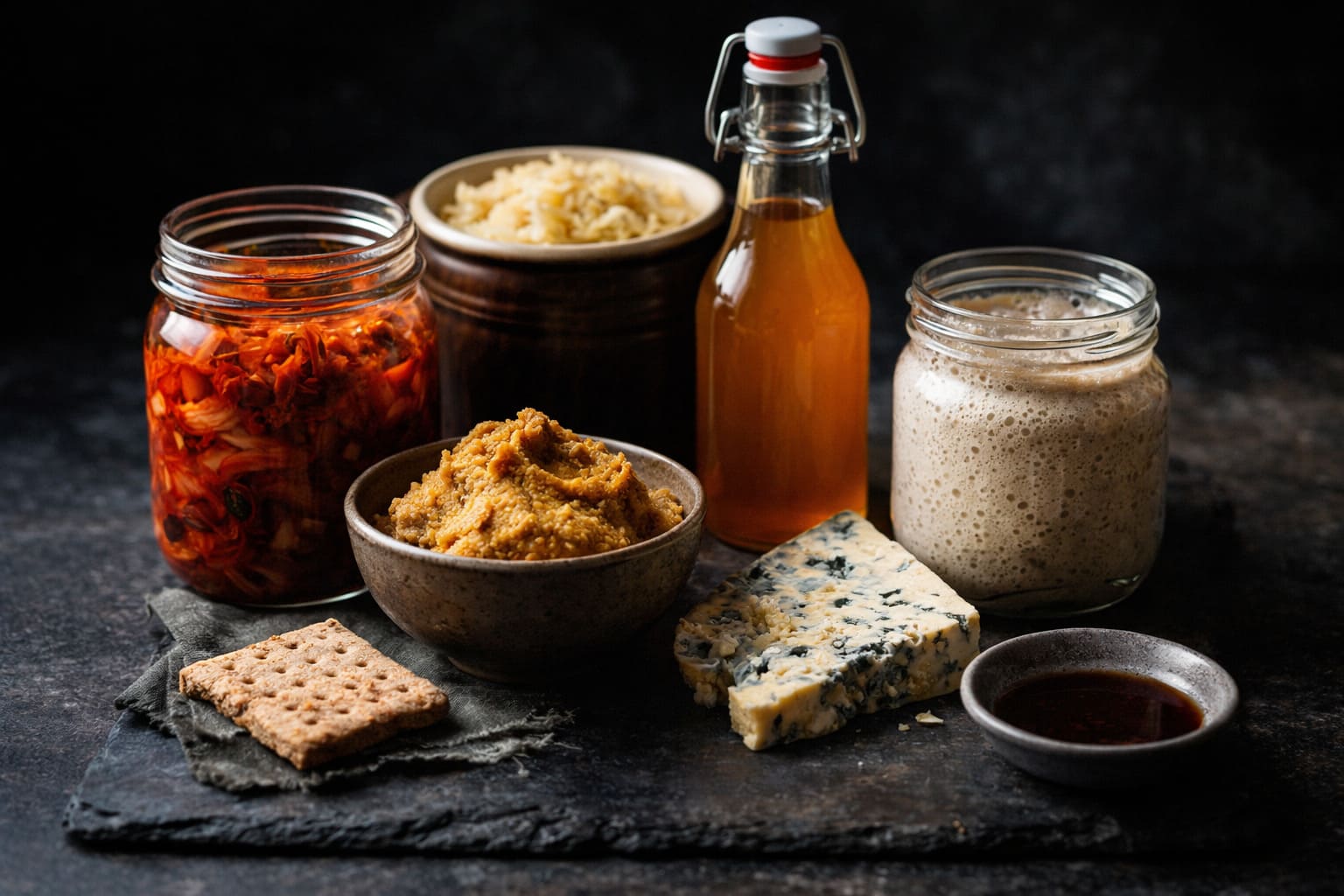
The history of fermentation starts long before anyone knew what was doing the work. The oldest chemical evidence of a deliberately made fermented drink comes from Jiahu, a Neolithic village in Henan province, China, where pottery jars from about 7000 BC held a mix of rice, honey and fruit. The microbes behind it were first described in the 1670s and tied firmly to fermentation only in the late 1800s.
The history of fermentation starts with the Jiahu jars
In 2004 a team led by Patrick McGovern of the University of Pennsylvania Museum published an analysis of pottery sherds from 16 vessels at Jiahu, dug from domestic contexts in the village. The sherds were radiocarbon-dated to three phases running from about 7000 BC to 5500 BC. Thirteen of the 16 gave chemical readings so similar that the team concluded the jars had held the same kind of liquid.
Their reading: a mixed drink of rice, honey and a fruit, either hawthorn or grape. Beeswax compounds pointed to honey, and rice was the only cereal recovered from the site. Hawthorn seeds had also been identified in the early Neolithic layers at the site.
There is a catch, and the paper states it plainly. Alcohol itself is volatile and does not survive, so there is no direct chemical proof of it. Fermentation is an inference, though a sound one. Wine yeast lives in honey and on the skins of sugary fruit, and once honey is diluted or juice leaks from fruit, yeast begins to work within a day or two in warm weather.
So the honest claim is not "the first alcohol." It is the earliest well-analyzed case of a mixed fermented drink, in a region with a long record of making them.
Why a cereal needs a helper
Grain has no sugar to ferment until its starch is broken down, and it carries no yeast of its own. The Jiahu authors note that the honey and fruit would have supplied both the sugar and the yeast. Before a better method arrived, they suggest, grain was probably converted by chewing or malting.
The better method came later and was distinctly Chinese: mold saccharification. Cakes of grain grown over with molds such as Aspergillus and Rhizopus, called qu, break rice and millet starch into sugar, and yeast settles in from the air and the rafters. The McGovern team thinks this system replaced the honey-and-fruit drink somewhere between the late Neolithic and the Shang dynasty, and describes it as still the traditional method in modern China.
Wine in sealed bronze: the Shang evidence
The oracle-bone inscriptions of the late Shang dynasty, around 1200 to 1046 BC, name at least three drinks: chang, an herbal wine, li, a sweet low-alcohol drink, and jiu, a filtered rice or millet wine. The palace had officials who made them, and the king sometimes inspected the product. Offerings of these drinks went to royal ancestors in bronze vessels.
Some of that drink survived. In the Changzikou Tomb in Luyi county, Henan, more than 90 bronze vessels were found, and 52 of the lidded ones were still a quarter to half full of liquid. The bronze lids had corroded shut and sealed the contents for about 3,000 years. When the lids first came off, the liquids smelled fragrant. Analysis found traces of camphor and cedrene, and the researchers suggested resin, flowers or herbs as the source of flavor. A site at Taixi in Hebei yielded 8.5 kilograms of a white residue that held yeast cells, probably the dregs of a brew.
Garum, the Roman fish sauce
Fermentation was not only about drink. Rome's signature ferment was garum, a sauce made by salting fish, usually small fish such as anchovies, sardines or mackerel, and letting them break down in brine. Under good conditions the process is described as taking around two days; the liquid was drained off, and the leftover solids, called allec, were sold separately as a cheaper product.
Pliny the Elder wrote about its origins and tied the Latin word to the Greek gáros. The cookbook attributed to Apicius uses it in many dishes, including as a fish stock for fried mallow leaves. By the time of Augustus, garum from Cartagena and Gades (Cadiz) in southern Spain was rated the best, and factory ruins survive in Spain, Portugal and Morocco.
Pompeii has a name attached to the trade: Aulus Umbricius Scaurus, a major producer, whose name appears on a labeled mosaic jug. In 2008 researchers analyzing garum residue from Pompeii containers found it was made from bogue, a fish that gathers in summer, which supported an August date for the eruption of Vesuvius.
For more on Roman cooking, see ancient Roman recipes.
How kimchi got its red
Korean fermented vegetables are old, but the dish most people picture is quite recent. The Samguk Sagi, the chronicle of the Three Kingdoms of Korea, mentions a pickle jar used to ferment vegetables. In the 13th century the poet Yi Gyubo wrote a poem showing radish kimchi was common in Goryeo.
None of it was red. Chili peppers, which are a New World crop that reached Korea through Portuguese traders, were unknown there until the early 17th century. A book from 1614, the Jibong yuseol, gives the first mention. They became widespread in kimchi only in the 19th century. Napa cabbage arrived at the end of that century, and a cookbook of the period, the Siuijeonseo, describes whole-cabbage kimchi close to today's form.
Britannica describes the modern version as vegetables seasoned with red pepper, onion and garlic and fermented in earthenware jars called onggi, for a few days or weeks depending on the weather. The "ancient kimchi" on a restaurant menu is, in its red cabbage form, a few centuries old at most. Read more in how Korean food went global.
Seeing the microbes at last
Antonie van Leeuwenhoek, a Dutch draper who ground his own lenses, described bacteria and protozoa in letters to the Royal Society in the mid-1670s. Britannica dates Louis Pasteur's decisive experiments to 1864, proving that microbes come only from other microbes, and credits him, among others, with working out the role of bacteria in fermentation.
The argument then shifted. If yeast cells made alcohol, was fermentation a function of life itself? In 1897 Eduard Buchner showed that a yeast extract with no living yeast cells could still turn a sugar solution into alcohol. The action came from substances inside the cells, later called enzymes. The Nobel committee gave him the 1907 chemistry prize "for his biochemical researches and his discovery of cell-free fermentation."
Bread, cheese and sparkling wine each have their own fermentation stories: see the history of bread, the history of cheese and the history of champagne.
Questions people ask
When did people first ferment food?
The earliest well-analyzed evidence is a rice, honey and fruit drink from the Chinese village of Jiahu, dated to about 7000 BC. Chemists found no alcohol directly, since it does not survive, so fermentation is inferred from the residues. Older fermentation is possible, but this is the strongest case on record in the sources used here.
What was garum and how was it made?
Garum was a Roman fish sauce made by salting small fish such as anchovies and sardines and fermenting them in brine. The liquid was drained off, and the solids, called allec, were sold as a cheaper product. Garum from Cartagena and Cadiz in Spain was rated best by the time of Augustus.
Is kimchi really thousands of years old?
Fermented vegetables in Korea are very old, and a pickle jar appears in the Samguk Sagi. But red kimchi is much younger. Chili peppers reached Korea after Portuguese traders brought them, first mentioned in 1614, and napa cabbage arrived only at the end of the 19th century.
Who proved that fermentation does not need living cells?
The German chemist Eduard Buchner did, in 1897. He showed that yeast extract containing no living yeast cells could still form alcohol from a sugar solution. The result pointed to enzymes working inside cells, and it won him the 1907 Nobel Prize in Chemistry.
Filed under Fermentation
Want more stories like this?
One food history story, every week. No spam, just the stories behind what the world eats.