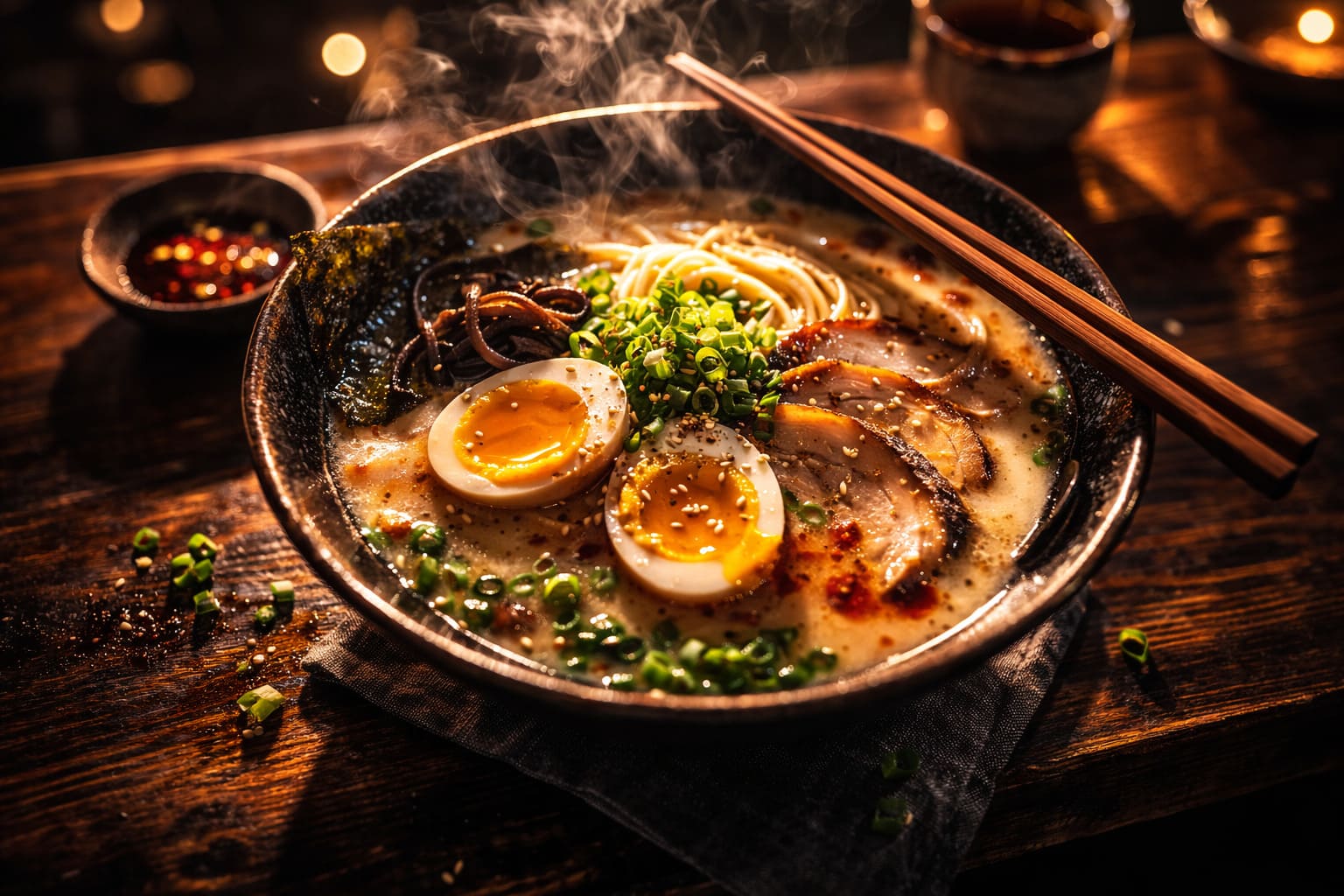
The origin of ramen is Chinese, not Japanese. Chinese noodle soups were being sold in Japan's treaty ports by the 1880s, and the dish spread nationwide after the Second World War, when cheap American wheat flour and street stalls fed hungry cities. The name "ramen" only caught on across Japan after 1958, the year instant noodles went on sale.
Noodles in a Kyoto temple diary, and a legend about a Mito lord
Wheat noodles are old in Japan, and people like to push ramen back as far as they can. The earliest document usually cited is a 1488 entry in a diary kept at the Shokoku-ji temple in Kyoto, which records noodles made with kansui, the alkaline water that gives ramen noodles their spring and yellow color. That is the oldest written trace of kansui noodles in Japan, but it describes a temple meal, not a soup stall.
A second story credits the Chinese scholar Zhu Shunsui, who lived in Japan in the 1600s, with serving ramen-like noodles to the lord Tokugawa Mitsukuni. Accounts of that tale say the noodles were made of lotus-root starch and wheat, which is not the same thing as the noodles in a modern bowl. Historians treat the more plausible beginning as later and less glamorous.
The origin of ramen in Yokohama's Chinatown
By 1884, according to the same account, Chinese noodle soups were popular in Yokohama, Kobe, Nagasaki and Hakodate, mostly among the Chinese residents of those ports. Britannica dates the Yokohama Chinatown to the early 1880s, when Chinese traders arrived after Japan opened to foreign trade and began running restaurants.
A law in 1899 let foreign residents do business outside their designated settlements, and Chinese cooks and their food moved across the country. Around 1900 the typical Chinese restaurant bowl was simple: noodles, a few toppings and a salt-and-pork-bone broth. Vendors also pushed carts through the streets, later announcing themselves with a horn called the charumera. A Nanjing noodle restaurant is recorded in Yokohama's Chinatown in 1903.
If you know the story of dumplings, the pattern is familiar: a dish travels with the people who cook it, and a new country gives it a new name and a new place at the table.
Rairaiken in Asakusa, 1910
In 1910 Kan'ichi Ozaki opened Rairaiken in Asakusa, Tokyo. A ramen expert, Hiroshi Osaki, calls it the first specialized ramen shop, which is an expert's judgment and not a settled fact. Ozaki is reported to have hired twelve Cantonese cooks from Yokohama, and to have changed the name of the dish from Nankin soba, "Nanjing noodles," to shina soba, "Chinese noodles."
So the dish had several names before it had the one we use. Nankin soba came first, then shina soba. After the war "shina" came to be seen as offensive, and the dish was called chuka soba, "Chinese-style noodles." The word ramen itself comes from the Mandarin la mian, "pulled noodles," though ramen noodles are cut, not pulled, and the dish descends from southern, mostly Cantonese cooking. How the word attached itself to it is unclear. One plausible theory is that Japanese repatriates from China, especially from Manchukuo, used it for southern-style noodles that resembled northern la mian. In print, "ramen" appears for this dish in 1947, in a cookbook by Hatsuko Kuroda.
Rice shortage, American flour and the stalls of 1945
In December 1945 Japan recorded its worst rice harvest in 42 years. Wartime production had been shifted to the colonies, and millions of settlers were coming home from China and elsewhere in East Asia. For the American occupation, which lasted from 1945 to 1952, one answer was wheat, and cheap American flour flooded the market. Bread consumption rose from 262,121 tons in 1948 to 611,784 tons in 1951.
Much of the flour leaked into the black market, where noodle soup was a sensible product. The occupation kept the wartime ban on outdoor food vending, so these stalls were technically illegal, and thousands of ramen vendors were reportedly arrested. Accounts also say the black markets were largely run by gangsters. By about 1950 flour controls had been lifted and the rules on vending relaxed, and companies began renting out starter kits for yatai, the mobile stalls. For the wider picture of how war reshapes a national diet, see wartime foods and the story of rice, the grain Japan could not grow enough of that winter.
Momofuku Ando and the ¥35 block
Momofuku Ando's company, Nissin Foods, put Chikin Ramen on sale on 25 August 1958. Each pre-seasoned block cost 35 yen and was ready in two minutes with boiling water. It was a luxury at first: grocers sold fresh noodles for about one sixth of that price. Britannica says Ando had seen people queuing for bowls of ramen in the lean postwar years and decided there was a market for a version people could make at home.
His method was to steam and season the noodles and then dehydrate them by flash-frying in hot oil, which gave them a longer shelf life than frozen noodles. He was not alone in the field. A Taiwanese inventor, Chang Kuo-wen, filed an instant noodle patent in 1956, and some accounts claim he transferred it to Ando in 1961, though that transfer is supposed rather than established. The name ramen spread across Japan after 1958 as Nissin's product did.
Cup Noodles followed. Nissin's own history gives the release date as 18 September 1971, with the first full-scale sales at the Isetan department store in Shinjuku. That November, sampling events in Ginza's pedestrian zone sold about 20,000 servings on good days. Britannica gives 1966 for the cup, which does not match Nissin's page, so we use the company's date.
From stall food to Michelin star
The Shin-Yokohama Ramen Museum opened in 1994, and regional styles became things people traveled for: miso in Sapporo, salt in Hakodate, milky tonkotsu in Hakata, soy-based broth in Tokyo. In 2015 a Tokyo shop, Tsuta in Sugamo, received a Michelin star. Tokyo has about 5,000 ramen shops, and Japan over 24,000. Rairaiken itself had a later chapter: Ozaki's descendants reopened it in 2020 inside the Yokohama museum, and a great-great-grandson was reported in 2026 to have reopened the original in Asakusa.
Ando died on 5 January 2007, at the age of 96.
Questions people ask
Is ramen Japanese or Chinese?
Ramen is a Japanese dish with Chinese roots. Chinese noodle soups were sold in Yokohama, Kobe, Nagasaki and Hakodate by 1884, mostly to Chinese residents, and the word ramen comes from the Mandarin la mian. Japanese cooks later reshaped the soup, and regional styles such as Sapporo miso ramen are Japanese inventions.
What did people call ramen before it was ramen?
Ramen was first called Nankin soba, meaning Nanjing noodles. Around 1910, at Rairaiken in Asakusa, Tokyo, the name shina soba, meaning Chinese noodles, was adopted. After the Second World War, chuka soba replaced it because shina had become offensive. The word ramen spread across Japan after instant noodles launched in 1958.
Why did ramen spread after World War II?
Ramen spread in postwar Japan because of a rice shortage and cheap American wheat flour. Japan had its worst rice harvest in 42 years in 1945, and the occupation brought in flour. Black-market stalls turned flour into noodle soup, and by about 1950 looser vending rules let the stalls multiply.
When was instant ramen invented?
Instant ramen was launched by Momofuku Ando's Nissin Foods on 25 August 1958 as Chikin Ramen, a 35 yen block ready in two minutes. Nissin released Cup Noodles, the first cup-type instant noodles, on 18 September 1971. Other inventors, such as Chang Kuo-wen in Taiwan, filed instant noodle patents earlier, in 1956.
Filed under Origin Stories, Migration Stories
Want more stories like this?
One food history story, every week. No spam, just the stories behind what the world eats.