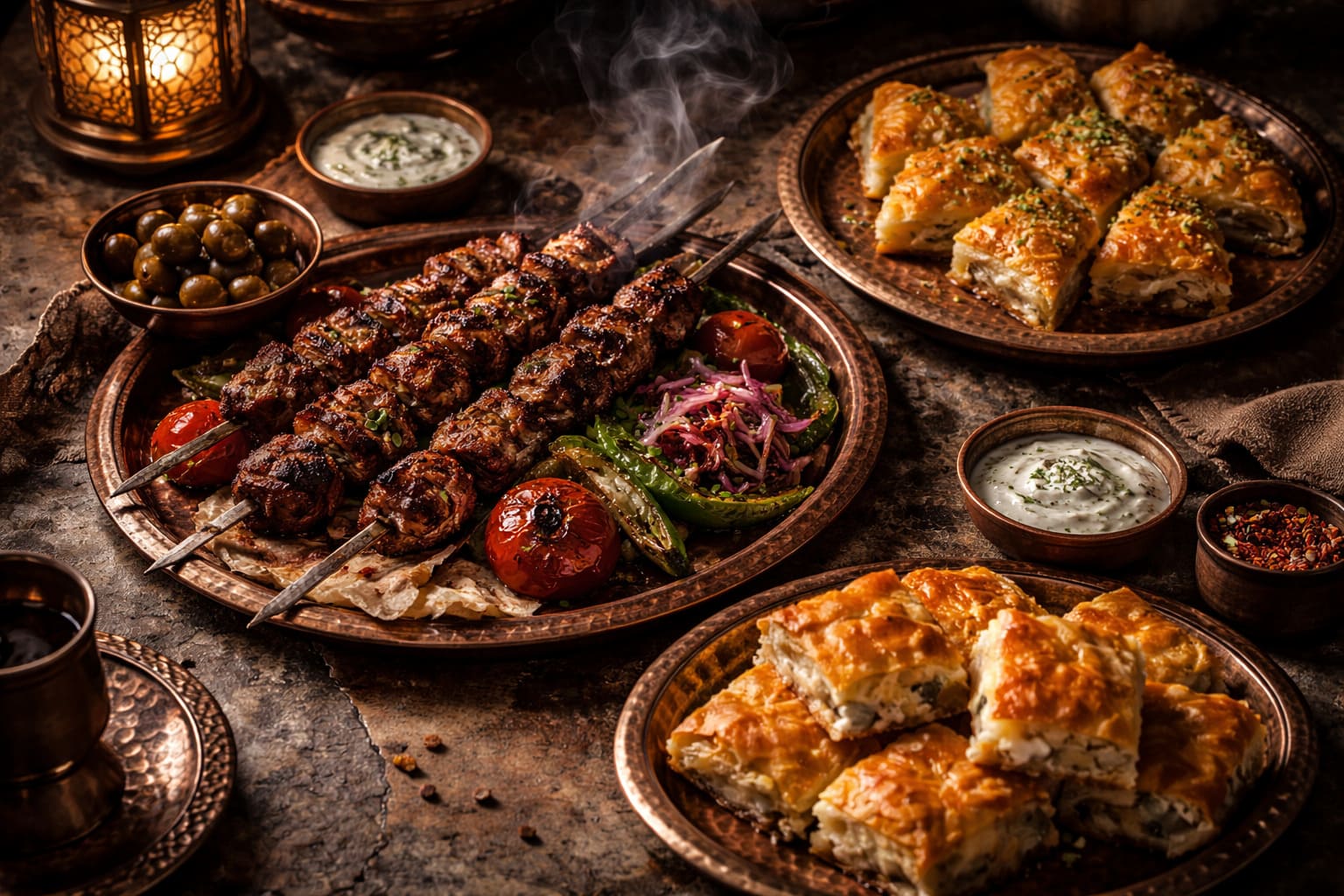
Ottoman street food was the cooked food sold by vendors, stalls and small shops in the empire's cities: grilled kebabs, tripe and trotter soups, sesame rings called simit, pastries, fritters, boza and syrupy sweets. Istanbul, the capital after 1453, is the city the records describe best. The paper trail is price lists, court registers and one famously curious traveler.
What Ottoman street food looked like in Istanbul
The best witness is Evliya Celebi, who wrote his travel book in the 17th century and was happy to count things. He reports hundreds of stalls in Istanbul selling kebab and kofta, among them shish kebab on skewers. He also describes the Fish Market, where by his count 900 cooks worked in 500 shops, frying fish and cooking soup, mussels with rice, oysters and scallops.
Some of what he lists would surprise a modern visitor. Fried lamb liver was a dish in high demand. A court case from Bursa shows boza sellers claiming, by custom, the sole right to sell liver kebab. Sheep's heads, trotters and tripe were boiled into soups in shops across town. Evliya called tripe soup zerafet-u kabahat, "grace and fault", and recommended it as a hangover remedy. He noted that every tripe maker in Istanbul was a Greek.
The numbers come from the registers. In 1726 the walled city and Eyub had 21 trotter shops and 26 trotter-soup shops, and Istanbul, Galata, Tophane and Kasimpasa had 22 tripe shops. A scholar of Istanbul's food history, Arif Bilgin, built these tables from the Istanbul court register, the Sijil no. 24.
The simit and the narh list
Simit has the clearest paper trail of any street snack. Ottoman price-fixing lists, called narh registers, set what bakers could charge. One from late 1525 already prices simit in Istanbul. In 1593 the weight and price of the sesame ring were fixed in the court records of Uskudar, where it appears as simid-i halka, a "round simit".
Evliya counted 70 simit bakeries in the 1630s. Bilgin's figure for the 18th century is 83 bakeries, 59 of them Muslim-owned and 24 non-Muslim. That mix was normal. Fishing and fish cooking, tripe, and much of the water carrying were in Greek hands. Trotters were mostly a Muslim trade. A street meal in Istanbul passed through several communities before it reached your hand.
The same registers show how deep the market went. A 1640 narh list prices 26 kinds of fish. Okra became so popular after it reached the city in the 17th century that an official post, the chief of the okra business, was created to see it unloaded at Eminonu and distributed. In 1726 the city had 276 water carriers who hauled water on their backs, and 27 more who used horses.
A city of eaters
Behind the stalls stood a supply machine. Istanbul was one of the most crowded cities of its age, and most residents bought their food rather than growing it. Meat, grain and butter came from across the empire: butter largely from Crimea and the Balkans, citrus from the Aegean islands, spices mostly from Egypt. The variety of spices in the market grew considerably after the Ottomans conquered Egypt, a thread that runs through the story of the silk road foods.
Mutton was the staple. Evliya wrote that 27,000 sheep were brought into the city and eaten every day, and in a later passage gave 38,000, a number he says was reported to Murad IV. Beef was eaten mainly by non-Muslims and poorer Muslims, since Ottoman medical thinking did not rank it among the healthy meats. That left a great deal of offal and scraps for the soup shops.
Cooking at home was ordinary too, so the street did not replace the kitchen. Bilgin says people ate two meals a day, mid-morning and after the late afternoon prayer, sitting at low tables and sharing dishes from a common platter. Vendors filled the gaps between.
Boza, coffee and the drinks trade
Boza, a thick fermented millet drink, was the winter street drink. Evliya says that in the middle of the 17th century 105 boza makers worked in the city. The best, in his view, was made from Tekirdag millet, white and thick, with a spoon of clotted cream on top. He describes it sold in copper mugs and buckets, dusted with cinnamon, clove, ginger and coconut.
Bursa shows the other side of the trade. Boza houses there were among the most popular public gathering places of the 15th and 16th centuries, until coffeehouses overshadowed them in the 17th. Coffee reached Istanbul in the first half of the 16th century. The state tried for years to ban it, then gave in near the end of the century and taxed the coffee shops instead. The longer story is in the history of coffee. Street food elsewhere tells a different tale, as in Southeast Asia's street food.
Where borek came from
Pastry is harder to date than simit. Borek appears in Turkish sources well before Istanbul was Ottoman: the 13th-century Danishmendname mentions samsa and "well-buttered boreks" at a wedding feast, and a triangular filled pastry, senbuse, shows up in sources of the same century. Nobody can name an inventor, and nobody should.
By the Ottoman centuries the word covered a family. Bilgin's list of flour foods sold in Istanbul markets includes plain and meat boreks, "Damascus" boreks, filled pogaca, fried rings, fritters called lokma, and the flat pancake gozleme. The pastry traveled with Ottoman rule into the Balkans, and the word survives there as burek.
Baklava: a street sweet with a palace story
Baklava is the clearest case of a food whose origin people argue about. Candidates include the Greek honeyed placenta cakes, medieval Arabic lauzinaj, and layered flatbreads from Central Asia. The food writer Charles Perry thinks lauzinaj "was not much like baklava". The word itself appears in English in 1650, and the earliest known mention in Turkish is in a poem by the 15th-century mystic Kaygusuz Abdal. The modern layered form is generally credited to the kitchens of Topkapi Palace.
The best-known ceremony is the Baklava Alayi, the baklava procession. During Ramadan the sultan sent trays of baklava to the Janissaries, reportedly on the 15th. It was a gift and a show of who fed whom.
In the city, baklava was one sweet among many. Palace kitchen records list it beside zerde and kadayif, and the court registers count 24 kadayif shops under the Istanbul judge, fewer than the baklava shops. Bilgin notes that the dishes of the palace shaped what ordinary kitchens aspired to cook, though cooks borrowed in both directions.
Questions people ask
What did people eat on the street in Ottoman Istanbul?
Istanbul vendors sold kebab, liver, tripe and trotter soups, simit rings, boreks, fritters and boza. The 17th-century traveler Evliya Celebi described hundreds of kebab stalls, 70 simit bakeries and a Fish Market with 500 cooking shops.
When was simit first recorded in Istanbul?
Simit appears in an Istanbul price list from late 1525. In 1593 the Uskudar court registers fixed its weight and price, under the name simid-i halka. The 17th-century traveler Evliya Celebi counted 70 simit bakeries in Istanbul.
Who invented baklava?
Nobody knows. Greek honeyed placenta cakes, Arabic lauzinaj and Central Asian layered flatbreads are all proposed ancestors. The earliest known Turkish mention is a poem by Kaygusuz Abdal in the 15th century, and the modern layered pastry is usually linked to Topkapi Palace.
How was food regulated in Ottoman markets?
Authorities issued narh price lists that set what foods could cost, including bread, simit, fish and milk. Registers from 1525 and 1640 survive, and courts such as Uskudar's recorded the fixed weight and price of simit in 1593. Court registers also counted shops by trade and owner.
Filed under Street Food
Want more stories like this?
One food history story, every week. No spam, just the stories behind what the world eats.