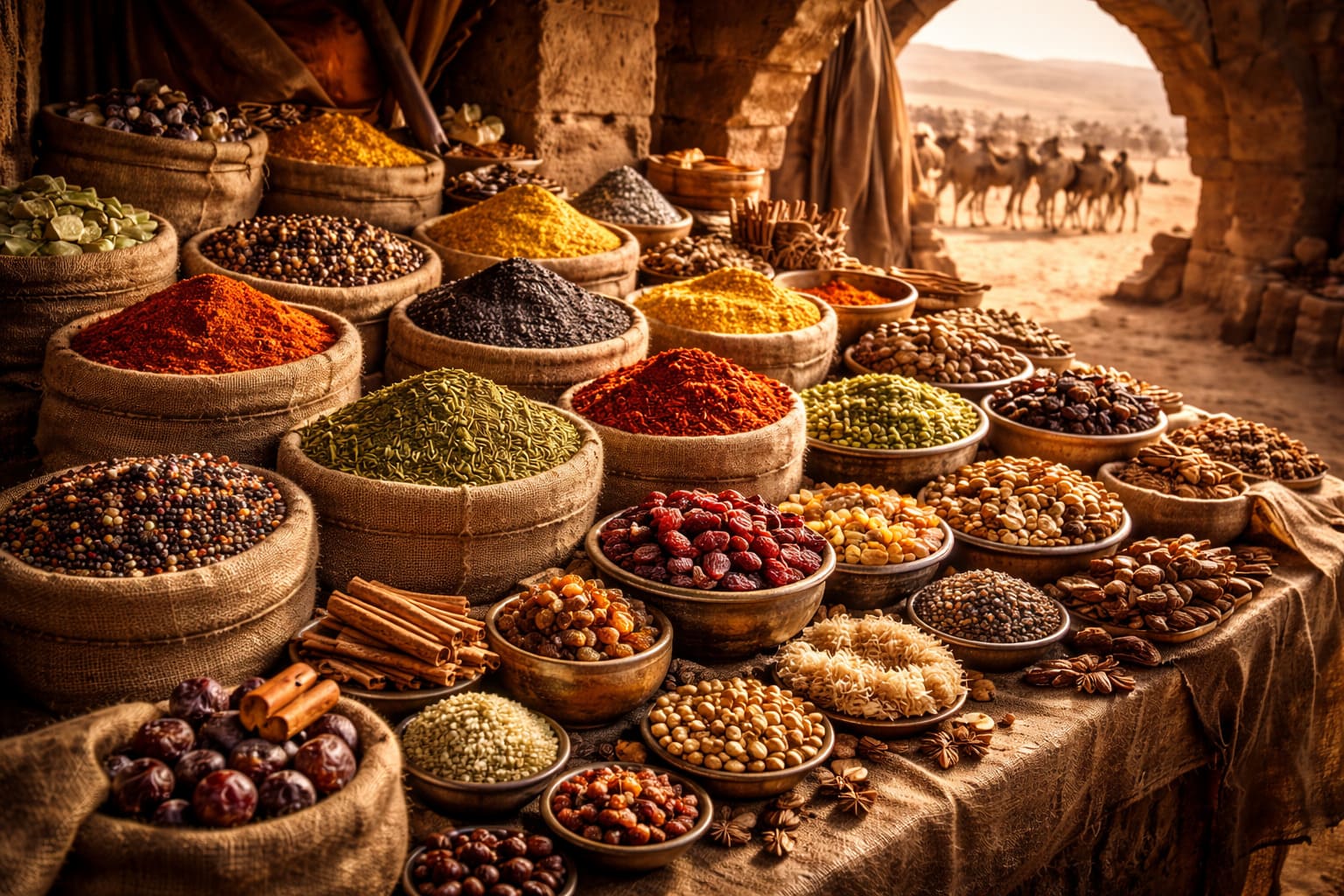
Silk Road foods are the crops and flavors that moved across Eurasia along the trade routes between China, Central Asia, Persia and the Mediterranean, mostly from about 130 BCE onward. Grapes, walnuts, alfalfa, spinach, apples and cucumbers went east into China. Mulberry, rice and soybeans went west. A plant scientist's 2022 survey says the evidence is clear for some of these and shaky for others, and that is where the story gets interesting.
A name from 1877, a road that was never one road
Nobody on the road called it the Silk Road. The German term Seidenstrasse was popularized in 1877 by the geographer Ferdinand von Richthofen, who had made seven expeditions to China between 1868 and 1872. The network itself was a set of overland paths and sea lanes. The northern overland route started at Chang'an (now Xi'an) and split around the Taklamakan Desert, with branches to Kashgar, Turpan and Kokand. The maritime route linked Southeast Asia, India, Arabia and East Africa from the second century BCE to the fifteenth century CE.
Food moved along all of it, mostly without anyone recording who carried what. That makes the record patchy, and it is why so many tidy stories about who brought what are weaker than they look.
What Zhang Qian actually brought home
The standard hero is Zhang Qian, the Han envoy sent west in 138 BCE to seek an alliance against the Xiongnu. He was gone until 125 BCE, and he reported on Dayuan (Ferghana), Bactria and the Yuezhi lands. The account of his travels reaches us through Sima Qian's Shiji, so everything is secondhand.
The plant most firmly linked to him is alfalfa, which he is said to have brought back as horse fodder. Grapes are the usual extra, and popular articles hand him the vines too. The account of his mission describes Dayuan and Anxi as places where people made wine from grapes, which is a long way from saying he planted a vineyard in China. The 2022 plant survey (Wang and colleagues, in BMC Plant Biology) puts grape among the crops that reached China through trade and human migration along the land route, and gives no single carrier.
Silk Road foods by the numbers: 207 crops, some too early
That survey counted 207 domesticated crops moved along the land route. It examined 19 in depth, using archaeology, genetics and genomes together. Its sorting is useful because it removes a few favorites from the Silk Road list.
Wheat and barley were already in China before the road existed. Wheat reached the western Tianshan around 5,500 years ago, and barley and wheat were in eastern China by roughly 2500 to 1500 BCE. Jujube, cultivated for about 7,000 years, was a Chinese fruit that went the other way, reaching Korea and Japan around 100 BCE.
The crops the authors tie to the Silk Road itself are alfalfa, walnut, spinach, grape, pea, apple, cauliflower, mulberry and cucumber, plus mustard, lettuce, buckwheat and chickpea. They also warn that for mustard, lettuce, buckwheat and chickpea the archaeology and the genetics disagree about origin and route. Pistachio and turnip are filed under "ambiguous". Pistachio comes from the dry lands of Central Asia and the Middle East and was grown in Iran for 3,000 to 4,000 years, but when it got to China is unclear.
Some arrows point east to west. The survey puts the apple's ancestry in the Tianshan Mountains, with spread toward Europe along the road. Alfalfa went the other direction, from ancient Persia into Greece about 490 BCE and then with Roman armies, who valued it as warhorse feed.
Apricots, peaches and the word that traveled
The apricot shows how a good story can outlive its evidence. The species name Prunus armeniaca points to Armenia, and for a long time that was taken as the fruit's home. Genetic work now supports the older hypothesis of Nikolai Vavilov, that it was domesticated in Central Asia and China. From there it moved west, and it reached southwest Asia, by way of Iran or Armenia, in the third century BCE.
The English word is a relay of languages. It came into English in the sixteenth century as "abrecock," from French and Spanish forms that go back to Arabic al-barquq, then Byzantine Greek, and finally to a Latin word for "early ripening." The fruit's route and the word's route are two separate trails, and only the second is written down.
Noodles at Lajia: a famous find on the wrong side of the date
If there is one Silk Road food people ask about, it is noodles. The usual claim is that Marco Polo or some earlier traveler carried them from China to Italy. No source consulted for this article supports that, and the best-known ancient noodle find has nothing to do with the road. In 2005, archaeologists reported thin yellow strands in an upturned pot at Lajia in northwest China, dated by radiocarbon to about 4,000 years ago. That is nearly two thousand years before Zhang Qian.
The first report called the strands millet. A 2011 experimental study in the journal Archaeometry (Ge and colleagues) found that millet alone could not be made into noodles, so another starch, perhaps barley or wheat, was probably involved. The find proves long noodles are very old in China. It says nothing either way about pasta in Italy.
Spices, the Mongols and the road's slow end
Spices were a different kind of cargo. Dates, saffron and pistachios came from Persia along the northern route, and the historian Warwick Ball argues that the spice trade with India and Arabia mattered more to the Roman economy than silk did. Much of that trade went by sea. The 2022 survey also notes that peppers from Central and South America changed lifestyles in many Chinese provinces, an arrival that could only come after 1492.
Overland trade got its safest era under the Mongols. After Genghis Khan united the Mongol tribes in 1206, caravans received military protection, tolls were standardized in many regions, and merchants carrying official passports called paiza were protected. The Mongols also expanded the yam, a network of postal and supply stations. The same open roads helped carry the Black Death across Eurasia in the mid-fourteenth century.
Then the order broke. The Ilkhanate fragmented after 1335, and the Yuan dynasty fell to the Ming in 1368. As the overland routes became less secure, Britannica notes, Indian Ocean routes gained importance. Silk itself kept moving until the collapse of the Safavid Empire in the 1720s disrupted it.
You can follow two of the road's best-known flavors in their own stories: black pepper and cinnamon. The grain that fed the oases has its own account in the history of rice, and the sea half of the network turns up in the trade routes section.
Questions people ask
Which foods traveled from China to the West on the Silk Road?
Mulberry, rice and soybeans spread from China to Central Asia, according to a 2022 survey of Silk Road crops. Apricots, now thought to have been domesticated in Central Asia and China, reached southwest Asia by the third century BCE. Jujube, grown in China for about 7,000 years, reached Korea and Japan around 100 BCE.
Did Zhang Qian bring grapes to China?
The sources consulted for this article do not say so. Accounts of his mission credit him with alfalfa seed for horse fodder and note that people in Dayuan made wine from grapes. A 2022 plant survey says grapes reached China through trade and migration along the Silk Road, without naming one person who carried them.
Did noodles travel the Silk Road to Italy?
No source in this article shows it. The oldest known noodles come from Lajia in northwest China, dated to about 4,000 years ago, nearly two thousand years before Zhang Qian's mission. A 2011 study found they were probably not made from millet alone. Whether they link to Italian pasta is not shown by that find.
Was the Silk Road really one road?
No. The name was popularized in 1877 by Ferdinand von Richthofen. The network had a northern route from Chang'an, a southern route through the Karakoram, a southwestern route, and a maritime route that ran from the second century BCE to the fifteenth century CE.
Filed under Trade Routes
Want more stories like this?
One food history story, every week. No spam, just the stories behind what the world eats.