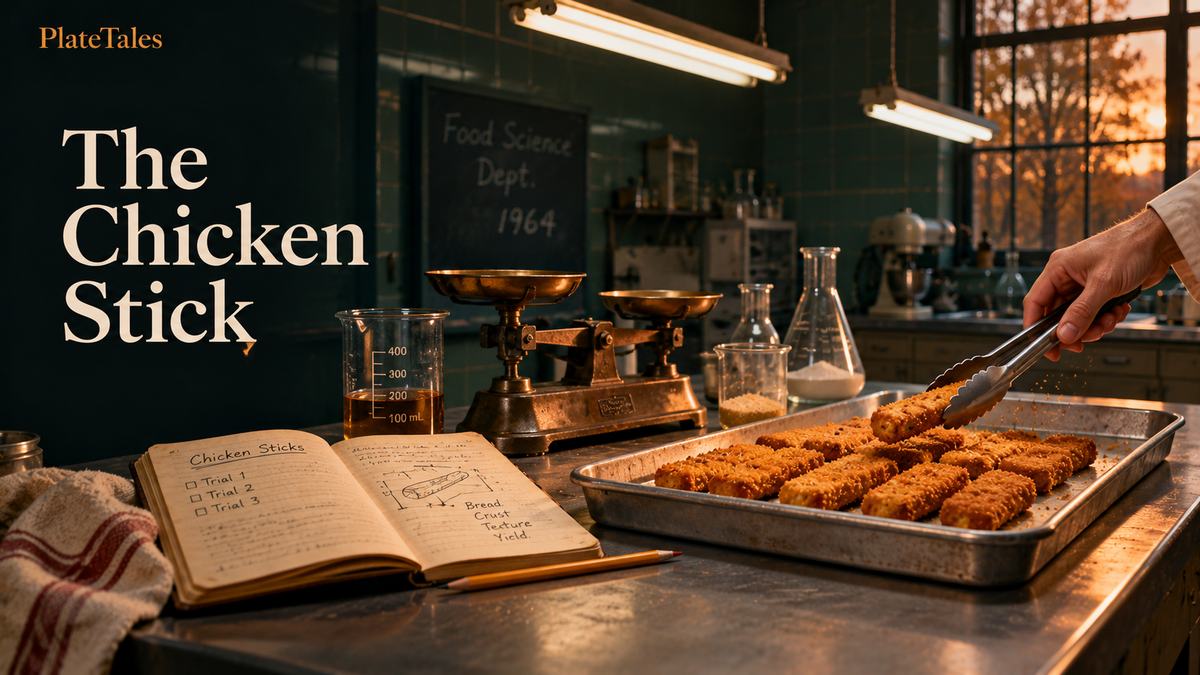
Chicken nuggets were invented by Robert C. Baker, a food scientist at Cornell University, whose frozen, breaded "chicken stick" was described in a Cornell bulletin in April 1963. He never patented it. The nugget most people know came later: McDonald's put its version on sale in 15 restaurants in Knoxville, Tennessee, in March 1980.
The problem Cornell was asked to solve
Baker was a poultry man from Newark, New York. According to Cornell's obituary he was born on December 29, 1921, and joined the Cornell faculty in 1957, when the Department of Food Science was founded. His job, as an alumni account puts it, was to promote the poultry industry of New York State.
Chicken in those years mostly reached shoppers whole or in parts. Steve Striffler, an anthropologist quoted in Maryn McKenna's 2012 profile of Baker in Slate, explains that demand for chicken had been low since the Second World War, which kept prices down. A farmer with a surplus of birds wanted more ways to sell them, and Baker spent his career building those ways: by the time he died, he had developed 47 poultry meat and egg products and published 290 scientific papers, according to the Cornell Daily Sun.
What a chicken stick was
McKenna reports that the work on the stick was done with a student, Joseph Marshall. The two ground raw chicken with salt and vinegar, which draws moisture out of the meat, then added a binder of powdered milk and pulverized grain. The aim was to make the ground meat hold together without forming a skin around it.
The second problem was the coating. Wet batter slides off frozen meat, and frozen meat shrinks. McKenna describes sticks that were frozen first, dipped in an eggy batter with cornflake crumbs, and frozen again to -10 degrees. The second freeze helped the crumb coat stay on through the shrinkage and the hot fat.
Cornell's own obituary puts the achievement in one line: Baker found a way to keep the breading attached during frying.
The 1963 bulletin
Baker did not stop at a recipe. Slate reports that Agricultural Economics Research, a Cornell publication, carried the April 1963 piece, and that it covered the formula, the box design, sales figures and cost estimates for adding a chicken-stick line to a processing plant. Baker and three colleagues even designed the box and a dummy label.
Five local supermarkets sold the sticks for 26 weeks. In the first six weeks they moved about 200 boxes a week, per the same account. Cornell handed these bulletins out free for decades, and one account says about 500 companies received this one.
Baker himself was modest about the early reception. He told The Ithaca Journal in 2004: "When the nuggets came out in the 1950s, they weren't too popular." That date sits oddly beside the 1963 bulletin, and the obituaries do not settle it. The dated document in the record is the 1963 one.
How the McDonald's version came about
The fast-food nugget has its own paper trail, also in Slate's account. Rene Arend, a chef who had cooked for the Queen of England, boned chicken breasts and fried battered pieces. They went over well at company headquarters but took too much hand labor to make by the thousand. Ray Kroc had wanted deep-fried onion chunks, but chairman Fred Turner steered the work toward chicken. Keystone Foods mechanized the chopping, and Gorton's developed the coating.
The test in Knoxville in March 1980 was followed by a plant that Keystone built in 100 days to keep up with orders. The product went nationwide in 1981.
Did the company borrow from Cornell? An Alpha Zeta fraternity profile of Baker, drawing on an earlier chronicler, says McDonald's used Baker's methods in the late 1970s because they were not patented. Slate quotes a McDonald's representative saying the company had no record of contact with Baker. Both statements can be true at once: a free bulletin that reached hundreds of firms may have shaped the work of food technologists who never met him. Bill Roenigk of the National Chicken Council told Slate it was possible that technologists reused Baker's bulletins when they hit the same batter and binding problems.
The man behind the stick
Baker's training was not in poultry at first. The Cornell Daily Sun says he earned a bachelor's degree in pomology, the study of fruit, at Cornell, then a master's at Penn State and a doctorate at Purdue in 1956. He worked briefly for Cooperative Extension in Saratoga County before the faculty job.
In 1970 he founded Cornell's Institute of Food Science and Marketing and became its first director. He retired in 1989, ran a 25-acre plant nursery with his wife and daughter, and was inducted into the American Poultry Hall of Fame in January 2004. Newspapers called him the "Edison of the poultry industry." He died of a heart attack on March 13, 2006, at 84.
His other work was less glamorous and just as practical. Cornell's obituary says he and Joseph Hotchkiss worked out modified-atmosphere and vacuum packaging for chicken, which Frank Perdue later used. Before that, poultry was shipped packed on ice.
Why Baker earned almost nothing from it
Robert Gravani, a Cornell food science professor who studied under Baker, told Slate: "He literally gave ideas away, and other people patented them." Baker's oldest son, Dale, said his father grew up in the Depression and wanted farmers to get the best price for their birds.
The Alpha Zeta profile says Baker gained notoriety but earned very little money from his creation. He turned instead to other work: chicken and turkey hot dogs, cold cuts, vacuum and modified-atmosphere packaging for poultry, and a vinegar-and-egg barbecue sauce he sold at a stand at the New York State Fair. Cornell's obituary says President Bill Clinton stopped at the stand in 1999.
Related stories on this site cover chicken tenders, the older tradition of Southern fried chicken, and another frozen potato invention. The nugget also belongs among the accidental inventions that were really a hunt for a solution to something else.
Per-person chicken consumption in the United States rose from 34 pounds in 1965 to 84 pounds in 2011, McKenna writes.
Questions people ask
When were chicken nuggets invented?
Robert C. Baker's frozen breaded chicken stick appeared in a Cornell bulletin in April 1963, after tests in five local supermarkets. The fast-food nugget came later: it went on sale in 15 Knoxville, Tennessee, restaurants in March 1980 and spread nationwide in 1981.
Did Robert Baker patent the chicken nugget?
No. Baker gave his methods away through free Cornell bulletins. Robert Gravani, a Cornell professor who studied under him, said Baker "literally gave ideas away, and other people patented them." Baker earned very little money from nuggets.
What are chicken nuggets made of?
Baker's prototype chicken stick used raw chicken ground with salt and vinegar, then bound with powdered milk and pulverized grain so the meat held together without a skin. It was frozen, coated in egg batter and cornflake crumbs, and frozen again. Commercial recipes differ by maker.
Did McDonald's invent the chicken nugget?
Not first. Cornell's Robert C. Baker described a frozen breaded chicken stick in 1963, 17 years before McNuggets reached Knoxville in 1980. A McDonald's representative told Slate the company had no record of contact with Baker, so how much his work influenced it is not documented.
Filed under Accidental Inventions
Want more stories like this?
One food history story, every week. No spam, just the stories behind what the world eats.