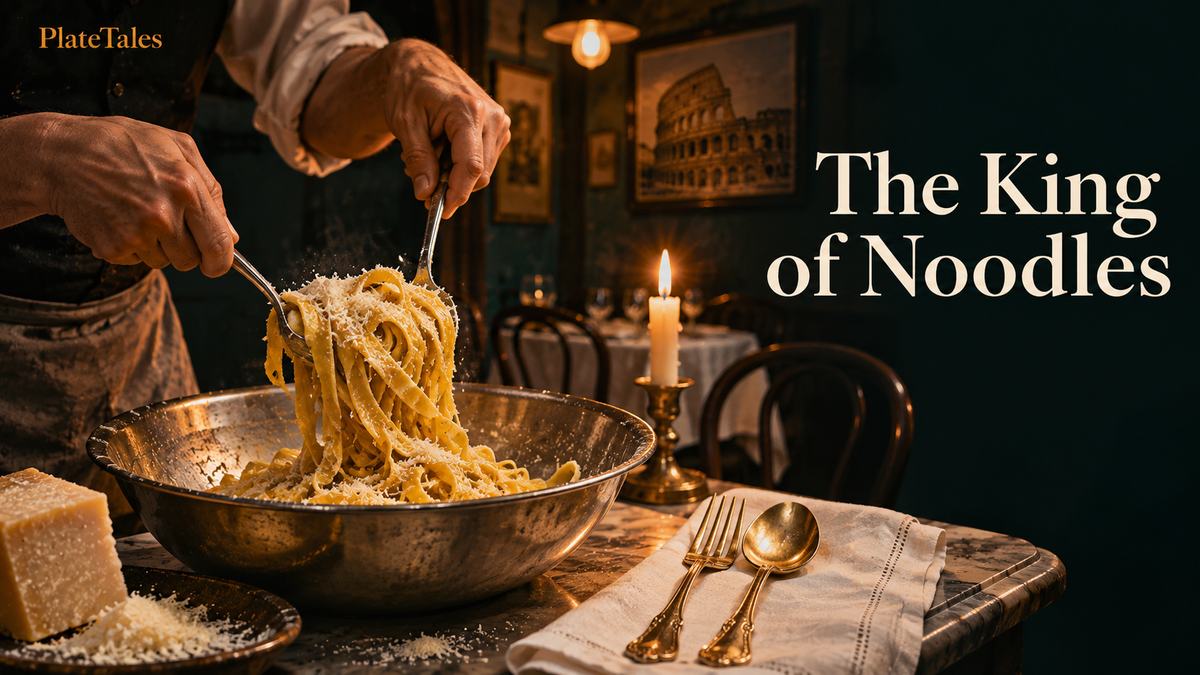
Fettuccine Alfredo was invented, by family account, by a Roman restaurateur named Alfredo Di Lelio around 1907 or 1908, but he did not invent buttered pasta with cheese. Cooks in Italy had been making that for about five centuries. What Di Lelio added was a name, a table-side performance and, after 1920, two American film stars who carried the dish home.
Butter, cheese and pasta, long before Alfredo
The idea is old. Maestro Martino da Como, a northern Italian cook working in Rome, recorded a recipe for "maccaroni romaneschi" around 1460. It calls for pasta, butter, good cheese and sweet spices. Nobody in the 1400s called it Alfredo, obviously, and nobody was dressing it with cream. Butter, cheese and spice on pasta was written down in Rome long before it was a restaurant idea.
That matters for the usual question, which is whether fettuccine Alfredo is Italian. The combination is. The famous name is a twentieth-century Roman restaurant brand, and the version most of the world eats today is something else again. For the wider story of how a pasta tradition grew around the cooking of the old capital, see our look at ancient Roman recipes.
Alfredo Di Lelio and the wife who would not eat
Alfredo Di Lelio was born in 1882 (some accounts say 1883) and, family lore says, started work in 1892 in a restaurant in Piazza Rosa run by his mother, Angelina. That restaurant stood beside what is now the Galleria Colonna.
The origin story comes from the family itself. After his wife, Ines, gave birth to their son Armando, she had no appetite. Alfredo made her fettuccine with fresh butter and young Parmesan. The family's own restaurant website gives the year as 1908 and says Ines liked it and suggested he put it on the menu. Accounts differ between 1907 and 1908, and the first version is called "fettuccine al triplo burro", triple-butter fettuccine.
Treat the tender part with care. It is a family tradition, told by the family, and no document from 1908 that we could find confirms the bedside scene. The part that is better supported is the recipe: fettuccine, young Parmesan, butter, and nothing else. That plainness is the whole appeal. A dish with three ingredients has nowhere to hide, so the quality of the butter and the age of the cheese carry everything, and the work is in the tossing. Stories of secret extras, such as oil in the dough or milk in the cooking water, circulate, but they are not confirmed.
Two restaurants, and a demolished square
Piazza Rosa did not last. The site was cleared for the Galleria Colonna around 1910, and Alfredo opened his own place on via della Scrofa, around 1914. The family's site says Pickford and Fairbanks ate there, on the restaurant's telling.
The name stuck to the street. Today that restaurant is Alfredo alla Scrofa. Alfredo sold it in 1943, during wartime rationing, to two of his waiters. In 1950 he reopened in Piazza Augusto Imperatore with his son Armando, and that restaurant is the one that calls itself Il Vero Alfredo, "the real Alfredo." Two restaurants, both with a claim to the name, both still serving the dish. The family's site tells it as a succession: after the war Alfredo retired and Armando took over via della Scrofa as "Alfredo II", while Alfredo opened the new square. The site is not consistent about which Alfredo is which, a small sign of how tangled the family branding has become.
The honeymoon and the golden fork and spoon
This is the best-known chapter. Mary Pickford and Douglas Fairbanks, the silent-film couple, were on their honeymoon in 1920. They were served the dish in Rome that year, and this helped make it popular in the United States.
The restaurant's account adds a gift. The couple gave Alfredo two sets of solid gold cutlery, each a fork and a spoon, engraved "To Alfredo, the King of Noodles." Another version of the inscription reads "To Alfredo the King of the noodles."
Dates wobble here. The restaurant puts the Fairbanks and Pickford dinner after the move to via della Scrofa. Other accounts place the gold cutlery later in the 1920s. We could not confirm the exact year of the gift from a first-hand record, and the surviving sources disagree on small details. What they agree on is the core: American film stars, a Roman restaurant, gold cutlery with that inscription.
The performance was the point
Alfredo did not simply send a plate to the table. He tossed the pasta with the butter and cheese in front of the guest, with a flourish, and menus advertised "maestosissime fettuccine all'Alfredo". By the 1920s he billed himself as "Il Re delle Fettuccine", the king of fettuccine.
American visitors wrote about it. Sinclair Lewis's novel Babbitt (1922) mentions a trattoria on via della Scrofa. The New York restaurateur George Rector wrote about the ceremony in 1927, and by his 1933 account it had grown violin music and "a fork and spoon of solid gold". The actor Ettore Petrolini left a dedication in the restaurant's first guestbook in 1927.
What it was called before it was "Alfredo"
The name took a while to settle. A 1925 Italian guidebook calls the dish "fettuccine al burro". A 1927 article says "noodles Alfredo". The form "fettuccine Alfredo" shows up in print only around 1957 to 1964.
In Rome itself, the dish never belonged to one restaurant. In 1981 about 50 Roman restaurants served similar pasta, mostly under the name "fettuccine alla romana". The Alfredo name was a brand attached to an old idea.
How the sauce got cream
The cream arrived in America. In 1966 the Pennsylvania Dutch Noodle Company sold dried egg noodles with a package recipe that used Swiss cheese and cream. That is a different dish from Di Lelio's, and a far more forgiving one, since cream keeps a sauce smooth without any need for skill at the pan.
The cream version spread through American restaurants and then through jars on supermarket shelves. It also joined the long list of Italian dishes that changed shape on the way across the Atlantic, a pattern we cover in how immigration changed American food. Critics have objected from both directions. Chef Carla Lalli Music, writing in Bon Appetit, argues that cream dulls the flavor of the cheese. The food writer Gillian Riley called the sauce "gross", saying Roman fettuccine hardly needs it.
Alfredo's descendants followed the dish abroad. Armando opened an Alfredo's near Rockefeller Center in 1977 and another at Epcot, and both have closed. Ines Di Lelio, Alfredo's granddaughter, has licensed the Il Vero Alfredo name to restaurants in Mexico and Saudi Arabia.
So who invented it?
Not a single person, and not entirely Alfredo. Di Lelio did not invent pasta with butter and cheese, which was in a Roman cookbook by about 1460. He did turn it into a house specialty, give it his name, and sell it to travelers who took it home. Since 2005, according to Corriere della Sera, Fettuccine Alfredo Day has been marked on February 7. Alfredo himself died in 1959.
Questions people ask
Is fettuccine Alfredo actually Italian?
The base of it is. Maestro Martino da Como recorded a Roman recipe for pasta with butter, cheese and sweet spices around 1460, and Alfredo Di Lelio served his buttered fettuccine in Rome around 1908. The cream-heavy version most people eat abroad developed later, in America.
Does real fettuccine Alfredo have cream in it?
No. Alfredo Di Lelio's Roman version was fettuccine tossed with butter and young Parmesan, and nothing else. Cream came later in America: in 1966 the Pennsylvania Dutch Noodle Company printed a package recipe for dried egg noodles that used Swiss cheese and cream.
Why did Mary Pickford and Douglas Fairbanks give Alfredo gold cutlery?
By the restaurant's account, the film couple ate Alfredo's fettuccine in Rome on their 1920 honeymoon and gave him two solid gold fork-and-spoon sets engraved "To Alfredo, the King of Noodles." The exact year of the gift is not confirmed, and sources differ on small details.
When did the name "fettuccine Alfredo" first appear in print?
Not right away. A 1925 Italian guidebook calls the Roman dish "fettuccine al burro", and a 1927 article says "noodles Alfredo". The exact phrase "fettuccine Alfredo" shows up in print only around 1957 to 1964.
Filed under Origin Stories
Want more stories like this?
One food history story, every week. No spam, just the stories behind what the world eats.