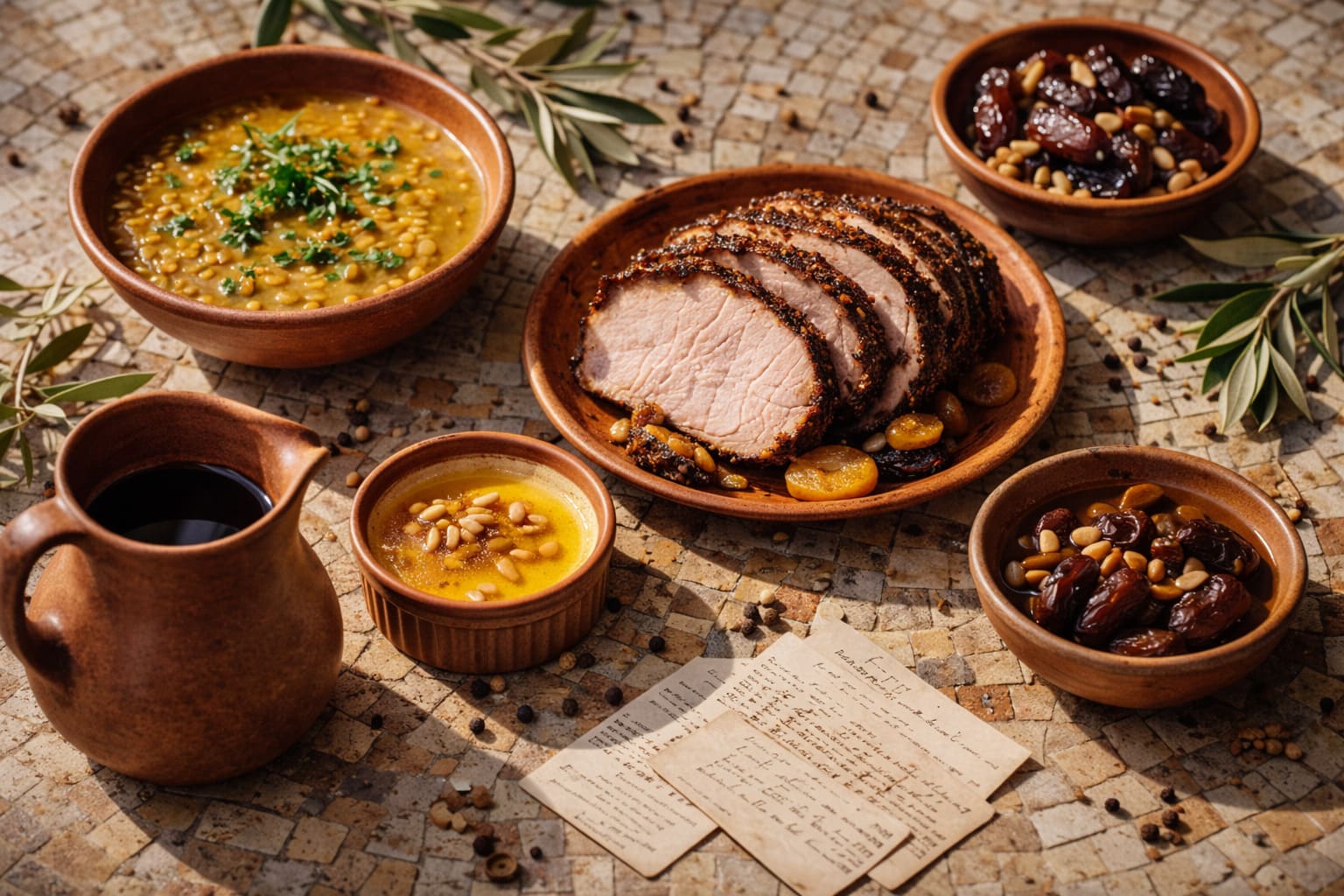
Ancient Roman recipes survive mainly in one book, Apicius, also called De re coquinaria, a ten-book collection that scholars place in the 4th or 5th century AD. It is the only substantial cookbook to come down from the Roman world. Its dishes lean on pepper, honey, vinegar, herbs and fermented fish sauce, and almost none of them would be mistaken for modern Italian food.
The name on the cover is a trick, though. The man who made Apicius a byword for greed lived centuries before the book took the form we have.
The book that carries a gourmand's name
The cookbook is split into ten books with Greek titles: Epimeles (The Diligent), Sarcoptes (The Butcher), Polyteles (The Sumptuous), Halieus (The Fisherman) and so on. Thayer's online edition sorts the contents more plainly, by subject: wines and preservation, minced dishes, vegetables, timbales, legumes, fowl, pork and roasts, game, seafood and sauces.
The author is not known. The text carries the name Apicius, and some scholars read a Caelius Apicius behind it. Others point to Marcus Gavius Apicius, a gourmet who lived under the emperor Tiberius in the 1st century AD. The link to that man cannot be proven. Only seven recipes in the book are named for him. The food historian Bruno Laurioux dates the surviving version to the 5th century and argues its history belongs to the Middle Ages, and its Latin sits closer to the Vulgar Latin of the street than to Cicero. Several cooks over several generations probably fed into it.
The manuscripts are late too. One, from the monastery of Fulda in Germany, dates to about 900 AD and was bought by the New York Academy of Medicine in 1929. A shorter digest by a man called Vinidarius survives in an 8th-century manuscript now in Paris. The book reached print in Milan in 1498 and in Venice in 1500. The first translation was into Italian in 1852, and Joseph Dommers Vehling's English version followed in 1936.
The real Apicius: red mullet, shrimp and a poisoned cup
The man himself is mostly anecdote, and the anecdotes are other people's. Seneca says Tiberius bet on whether Apicius or Publius Octavius would buy a particularly large red mullet, and Octavius won the bidding. Athenaeus says Apicius sailed to the Libyan coast after a report of fine shrimp, found them poor and turned the ship around without landing. Pliny the Elder credits him with an idea for liver: feed pigs dried figs, as geese were fed, and kill them with honeyed wine.
Seneca also supplies the ending. By his account Apicius had spent about 100 million sestertii on his kitchen and his dinners, found he had 10 million left, feared he would starve and poisoned himself. Seneca, who disliked him, says he proclaimed "the science of the cookshop" and corrupted his age. Whether the numbers are exact is anyone's guess, but the story fixed his name in the language as the type of the glutton.
What a Roman kitchen was built on
Roman food was seasoned hard. The basic sauce base was garum, a fermented fish sauce made by salting fish innards, leaving them in the sun and draining the liquid through a fine basket. The solids that remained, called allec, went to flavor the porridge of the poorest. Anchovies were the main fish, though sprats, sardines, mackerel and tuna also went in. Under good conditions fermentation took about 48 hours.
The best garum was thought to come from Cartagena and Cadiz in Spain, and ruins of the fish-sauce works survive at several Spanish sites. At Pompeii the business of Aulus Umbricius Scaurus mattered to the city's economy. In 2008 researchers used residue from garum containers found there to support an August date for the eruption of Vesuvius in AD 79, because the sauce in them was made from bogue, a fish that gathers in summer. The Latin word liquamen meant something separate from garum in the 1st century, but by the 5th century the two were often treated as synonyms. Garum is considered the ancestor of colatura di alici from Campania.
Sugar was not part of the picture. Honey did the sweetening, and it turns up in dishes a modern cook files under savory: roast meat, vegetables, sauces, eggs. A Roman cook also had no tomatoes, potatoes, maize or capsicum peppers; they reached Europe only after Columbus. The red sauces people call Roman today have no ancestors in this book. For that story, see how tomatoes came to Italy.
Pepper, on the other hand, is everywhere. It goes into dishes where nobody would put it now, including sweets. That habit is part of the reason a Roman recipe reads as foreign. The spice's own history is told in the history of black pepper.
Ancient Roman recipes in practice: lentils, pork and a pepper custard
The recipes themselves are short. They name ingredients and say little about quantities, temperatures or times, which is one reason every modern version is partly a reconstruction.
The lentil recipes in the legume chapter are a good example. One version, numbered 184a in Vehling's translation, begins by telling the cook to boil the lentils, skim them, strain them and add leeks and green coriander. Seasoning comes from coriander seed, mint, rue, vinegar, honey, boiled-down grape must and pepper. Others in the same chapter add cumin, or chestnuts. A modern cook would call them sweet and sour. A Roman cook would have called them dinner.
Pork was the favored meat, and the pork chapter runs to dozens of entries: roasts, cutlets, meatballs, ham baked with figs and bay, a suckling pig stuffed with brains, eggs and nuts. The plainest roast, number 266, says to salt the meat generously, bake it and serve it glazed with honey. Another, a pork tenderloin, calls for pepper, nuts, coriander, and fennel seed wrapped in caul fat. There is no single "Roman pork dish" so much as a family of them, shaped by whatever spice or fruit was in the house.
Then there are the sweets, which are barely sweets by present standards. Recipe 301, tyropatinam, is an egg custard sweetened with honey, and its closing instruction is to sprinkle it with pepper and serve it. Another, 302, beats eggs with milk and oil into a fluffy mixture, pours honey over it and adds pepper again. Stuffed dates, in recipe 294, get a nut or two and ground pepper. Pepper on dessert is the single most Roman thing in the book.
Where the popular versions go wrong
A lot of the cheerful modern writing about Roman food repeats claims that the text does not back up. Some details are stated with more confidence than the book allows.
The recipes usually do not supply quantities. Many modern adaptations add garum to dishes where the Latin text, as translated by Vehling, does not name it, so they are best read as interpretations. Silphium, a spice the recipes call for often, may have gone extinct in the 1st century AD, and no one can taste what it actually did. Modern cooks have to substitute something else.
The dormouse is a case of fame outrunning evidence. Dormice were a status food, and some hosts had them weighed in front of guests; a law under Marcus Aemilius Scaurus even banned eating them, to little effect. But the Apicius pork chapter in Vehling's translation has no dormouse, so the dish that lives in popular memory is better known from other writers than from the cookbook.
The Apicius book also is not a record of what ordinary Romans ate. The daily food of most people was puls, a porridge of emmer, water, salt and fat, and bread. From 123 BC the state handed out grain to as many as 200,000 people a month, and Pompeii had at least 33 bakeries when Vesuvius buried it. The cookbook is dinner for the people who could pay for pepper. If you want the bread side of the story, the history of bread covers it, and for what happened to cooking after Rome fell, see forgotten medieval recipes.
Fermentation was the thread that held it together. A cook who understood garum, vinegar and wine was already working with the methods described in the history of fermentation.
The Fulda manuscript, copied about 900 AD in a German monastery, reached the New York Academy of Medicine in 1929.
Questions people ask
What did ancient Romans eat for dinner?
The main Roman meal was the cena, which for the wealthy started around 2 p.m. and could run late into the night. Poorer Romans ate puls, a porridge of emmer, water, salt and fat, along with bread. Rich hosts served pork, fish, game, fruit and honeyed wine, heavily seasoned with pepper.
What was garum made from?
Garum was a Roman fish sauce made by salting fish innards and leaving them in the sun, then draining off the liquid through a fine basket. Anchovies were the usual fish, though sprats, sardines, mackerel and tuna were also used. The leftover solids, called allec, flavored the porridge of the poor.
Did the Romans have sugar?
Roman cooks had no refined sugar, so honey did the sweetening. It appears in meat, vegetable and egg dishes as well as in desserts. In the cookbook Apicius, even a custard sweetened with honey is finished with a sprinkle of pepper, and stuffed dates are filled with nuts and ground pepper.
Did Marcus Gavius Apicius write the Apicius cookbook?
Probably not. Marcus Gavius Apicius was a gourmet who lived under the emperor Tiberius in the 1st century AD, but the surviving cookbook is usually dated to the 4th or 5th century, and the link to him cannot be proven. Several cooks likely contributed to the text over time.
Did the Romans eat tomatoes?
No. Tomatoes, potatoes, maize and capsicum peppers reached Europe only after the Columbian Exchange, long after the Roman Empire ended. Roman cooks seasoned with pepper, cumin, coriander, honey, vinegar and fish sauce instead.
Filed under Forgotten Recipes
Want more stories like this?
One food history story, every week. No spam, just the stories behind what the world eats.