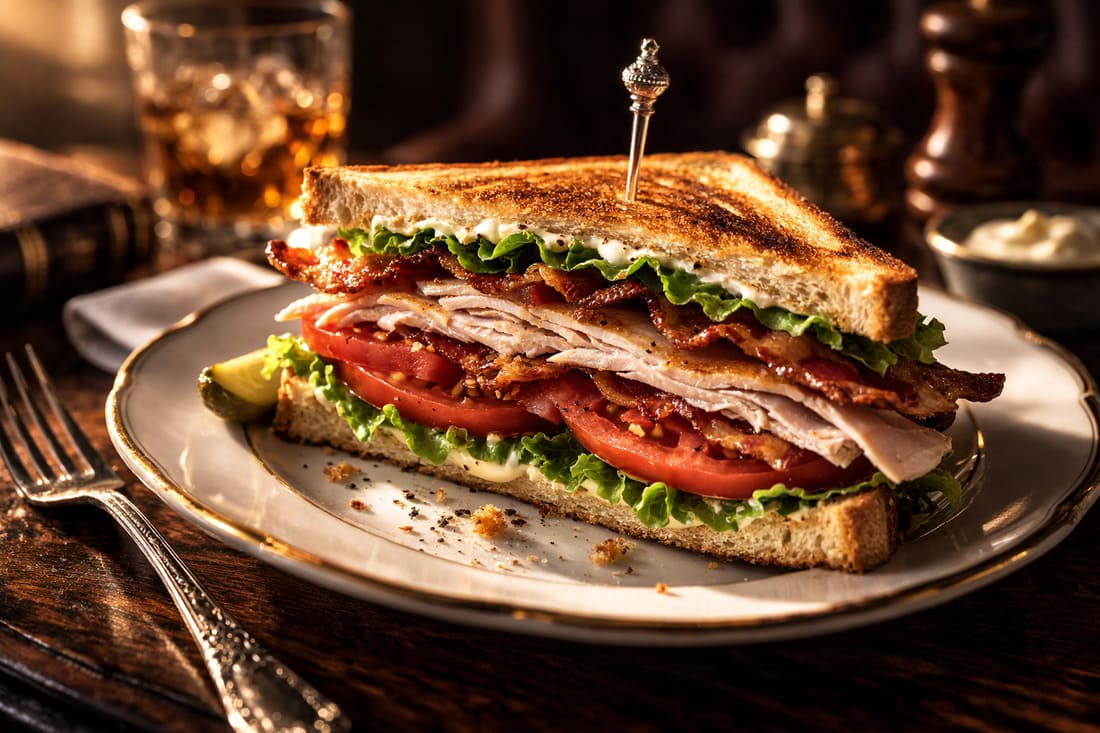
Nobody invented the sandwich in the sense of a single inventor: bread with meat or cheese was eaten long before 1762, and the name comes from John Montagu, 4th Earl of Sandwich, who gave it his title without, as far as anyone can show, designing anything. The famous card-table tale is a rumour from a French travel book, and Britannica calls the story of that night widely thought apocryphal.
What the French travel book actually said
The gambling story reaches us from Pierre-Jean Grosley, a Frenchman who spent a year in London in 1765. His account appeared in French as Londres (Neuchatel, 1770) and in English as A Tour to London in 1772, in Thomas Nugent's translation. In that translation a minister "passed four and twenty hours at a public gaming-table" with nothing to eat but beef between slices of toasted bread.
Notice what is missing. Grosley was a visitor, not a member of the Earl's circle, and he was repeating talk, not describing something he saw. He wrote years after the supposed night. Modern references that repeat the tale put it in 1762, but that date comes through the retelling, not from anyone who was at the table.
The story also asks us to believe a lot from one rumour: a precise length of time, a precise meal, and a nobleman so devoted to play that he would not stand up. Britannica, in its short biography of the Earl, says plainly that the account tying the name to a single 1762 incident is widely thought to be apocryphal.
The Earl with a desk full of work
The man himself was busy in ways that have little to do with cards. John Montagu was born on November 13, 1718, and succeeded his grandfather, the 3rd Earl, in 1729. He studied at Eton and Trinity College, Cambridge, and took his seat in the House of Lords in 1739.
Later came a run of offices. He was First Lord of the Admiralty from 1748 to 1751 and again from 1771 to 1782. He was secretary of state for the northern department in 1763-65 and 1770-71, and postmaster general from 1768 to 1770. His part in the 1763 prosecution of John Wilkes, once his friend, earned him the nickname "Jemmy Twitcher," after a treacherous character in John Gay's The Beggar's Opera. Critics accused him of using the Admiralty to collect bribes and hand out political jobs, though Britannica adds that his administrative ability has been recognized.
That workload is the basis of the rival explanation. The naval historian N. A. M. Rodger, in his 1993 biography The Insatiable Earl, argues that with the navy, politics and the arts all pulling at him, the first sandwich was more likely eaten at his desk. It is a guess about habit, not a document, and it has the same standing as the gambling version: plausible, undated, unproven. The Earl was also a gambler (Britannica calls him a profligate one), so neither story is absurd. Neither is evidence.
The sandwich before the Earl: bread and meat without a word for it
The idea itself is far older. Before "sandwich" existed, the combination seems to have gone by plain names, "bread and meat" or "bread and cheese," which turn up in English plays of the sixteenth and seventeenth centuries. Medieval Europeans used thick slabs of stale bread, called trenchers, as plates for their food, which is a cousin of the idea but not the same thing.
The Netherlands offers a sharper clue. In 1673 the English naturalist John Ray noted that in Dutch taverns beef was cut into thin slices and eaten with bread and butter, with the slices laid on the butter. Ray described it as something worth reporting, which suggests that open bread-and-meat of this kind was not an everyday sight in England.
Older still is a Jewish tradition about Hillel, a sage of the first century BC, who is said to have wrapped the Passover lamb and bitter herbs in matzah. It is told as a tradition, and it is closer to a wrap than to a London supper, but it shows how obvious the move is. Put food on bread, put bread on food, and you are most of the way there. For the staple itself, see our story on the history of bread, and for another food whose name outran its facts, the history of hot dogs.
Where the name fits in
The Earl's contribution was not the food but the label. By the time Johann Zoffany painted The Porter and the Hare in 1768, a sandwich was being shown on canvas, and Thomas Gainsborough's portrait of the Earl followed in 1783. One account of how the sandwich entered polite society is that it began as a late-night meal among the aristocracy before it spread outward. The name stuck to a meal the upper classes were eating, and that is a more modest claim than the story of a man who could not leave a table.
His other namesakes are better documented. As First Lord of the Admiralty he approved funds for the ships used on James Cook's later Pacific voyages, the Resolution, Adventure and Discovery. Cook named the Sandwich Islands, now Hawaii, after him in 1778, and also named the South Sandwich Islands and Montague Island in the Gulf of Alaska. The islands carry the Earl's name by a clear paper trail. The snack carries it through hearsay.
From supper table to street stall
The sandwich proved to be a food for people who could not sit down to a meal. By the nineteenth century, industrial life had made fast, cheap, portable food a necessity, and the sandwich fit. By 1850, at least seventy street vendors in London were selling ham sandwiches.
The next big change came in a bakery. On July 7, 1928, Otto Frederick Rohwedder's automatic bread-slicing machine went on sale at the Chillicothe Baking Company in Chillicothe, Missouri, and for the first time shoppers could buy bread already cut. Some were put off at first by the loaves' disheveled look, but by 1929 his manufacturing operation was running at full capacity, and within another year sliced bread had a national audience through the Wonder Bread label. In World War II the U.S. government banned sliced bread to save packaging materials and labor, and the plan was abandoned within weeks.
The Earl, meanwhile, had died in London on April 30, 1792. His Voyage Round the Mediterranean was published in 1799, seven years later.
Questions people ask
Did the Earl of Sandwich really invent the sandwich?
No. People ate bread with meat or cheese long before him, and English plays of the sixteenth and seventeenth centuries mention "bread and meat." The 4th Earl of Sandwich, John Montagu, gave the food its name, but Britannica says the story tying that name to one night at a gaming table in 1762 is widely thought to be apocryphal.
Where does the gambling story come from?
It comes from Pierre-Jean Grosley, a French writer who spent a year in London in 1765. His book Londres appeared in 1770 and was translated as A Tour to London in 1772. In it a minister spends four and twenty hours at a gaming table, eating only beef between slices of toasted bread.
Was the sandwich really created at his desk?
That is the alternative offered by the biographer N. A. M. Rodger in The Insatiable Earl (1993). He argues that the Earl's work for the navy, politics and the arts makes a desk the likelier setting for the first sandwich. It is an inference about his habits, not a documented event.
Why is Hawaii connected to the sandwich?
Both carry the same name. Captain James Cook named the Sandwich Islands, now Hawaii, after John Montagu, 4th Earl of Sandwich, in 1778, because the Earl, as First Lord of the Admiralty, promoted exploration and approved funds for Cook's later Pacific voyages. The food and the islands share a namesake, nothing more.
Filed under Origin Stories
Want more stories like this?
One food history story, every week. No spam, just the stories behind what the world eats.