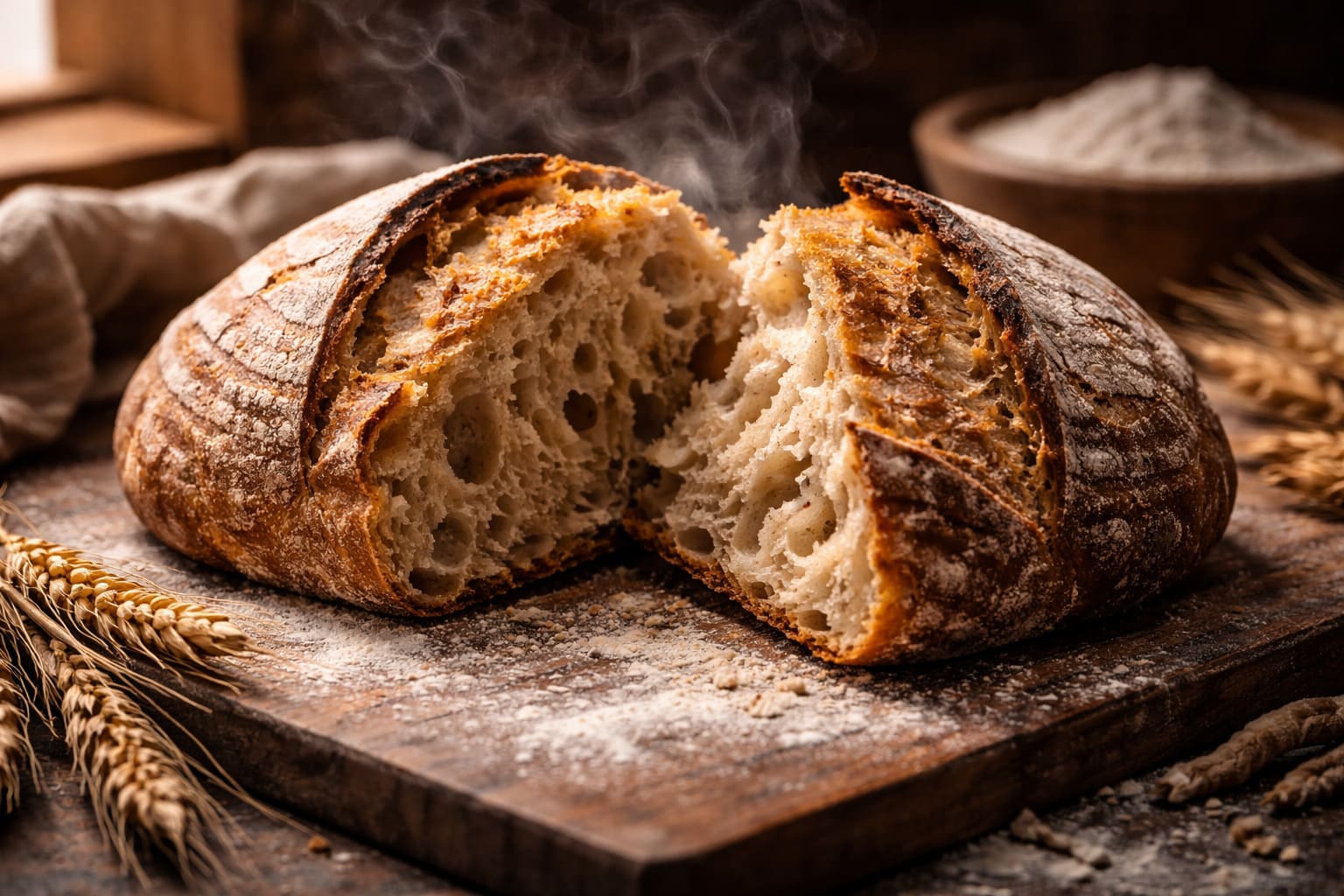
The history of bread begins with a flat, charred crumb of dough from northeastern Jordan, baked about 14,400 years ago by hunter-gatherers who had not yet started farming. Leavened loaves and proper ovens came much later, with the Egyptians. Rome turned bread into public policy, medieval England fixed its price by law, and in 1928 a bakery in Missouri sold the first machine-sliced loaf.
The tidy version of this story says people invented farming, grew wheat, then thought of bread. The evidence says something messier.
The oldest bread was baked before anyone farmed
The site is called Shubayqa 1, in the Black Desert of northeastern Jordan. It was found and briefly dug in the 1990s by Allison Bets, and archaeologists from the University of Copenhagen excavated it for four seasons between 2012 and 2015. The people who lived there were Natufians, hunter-gatherers, and they built a semi-underground house with a basalt flagstone floor. In the middle of it sat a fireplace about a metre across, with a second one built right above it later.
Seven radiocarbon dates from short-lived plant remains in those fireplaces put their use at roughly 14,400 to 14,200 years ago. Inside, the team found more than 65,000 plant remains, about 50,000 of them club-rush tubers, plus 642 charred lumps of food larger than 2 millimetres.
Of 49 lumps examined under a scanning electron microscope, 24 looked like bread. Twenty-two came from the older fireplace. In 2018 Amaia Arranz-Otaegui and colleagues published the result in PNAS: bread-like products predated agriculture by at least 4,000 years.
What it was actually made of
Not what you would buy today. Fifteen of the 24 fragments showed cereal tissue, with wild einkorn wheat among the likely ingredients. At least five also contained tissue from club-rush tubers, a root. The pieces were small, averaging a few millimetres, and the air pockets inside them were tiny, which the authors read as unleavened flatbread. Modern raised bread has holes over a millimetre across.
The flour looks carefully made. Much of the particle size fell in the range of modern flour or semolina, with no chaff or grit, so it was probably ground and sieved with care. With no ovens on sites of that period, the authors suggest the dough was baked in ashes or on a hot stone.
Was it a daily food?
Probably not. The authors point out that Natufian diets leaned on small-seeded grasses, fruit, nuts and roots, and that cereals were rarely used. Bread cost a lot of labour. They suggest it may have been a special food, perhaps for feasts, and that it became an everyday staple only once agriculture was firmly established, around 9,000 years ago. Nobody found a recipe, so what the Natufians thought of it is unknown.
How Egypt got the loaf to rise
Egyptian bread was made almost entirely from emmer wheat, a grain that is hard to mill because the chaff has to be loosened by moistening and pounding. Methods changed over the centuries. In the Old Kingdom, dough went into heavy pottery molds set in embers. In the Middle Kingdom, tall cones stood on square hearths. In the New Kingdom, bakers used a large open-topped cylindrical clay oven.
Britannica says the Egyptians apparently discovered that letting wheat dough ferment produced a light, expanded loaf, and that they developed baking ovens. The yeast was shared with brewing, a craft explored in the history of fermentation. One survey of Egyptian cuisine says the yeast used for bread also made beer, and a lightly baked "beer bread" was made so that the yeasts would survive. Beer was a daily staple and even served as currency.
That is as far as the sources here go. Claims that Egypt was the first place anyone raised a loaf deserve a hedge, because early bread rarely survives, and the surviving record is lopsided toward dry places and tombs.
Rome and the grain handout
Rome's contribution was political, one example of why bread matters in every culture. In 123 BC Gaius Gracchus carried a law letting adult male citizens buy grain every month at below-market prices. In 58 BC Clodius went further and gave free grain to an estimated 320,000 citizens. Caesar cut that number to 150,000, and Augustus raised it to 200,000, though he disliked the idea of a permanent dole.
The handout was grain, not bread, for a long time. Around the third century it changed to bread, probably under Septimius Severus, and the emperor Aurelian (270 to 275) is credited with completing the shift and adding olive oil, salt and pork.
The poet Juvenal, who lived roughly 60 to 140 AD, used the phrase panem et circenses, bread and circuses, to sneer at a public that wanted food and entertainment from its rulers. That is where the line comes from. It was written long after the dole began, and it is a satirist's jab, not an official policy name.
Why medieval English loaves changed size, not price
In 13th-century England, a law known as the Assize of Bread and Ale regulated the price, weight and quality of bread and beer sold in towns, villages and hamlets. The odd part is that the price of a loaf stayed fixed. When wheat got dearer, the loaf got lighter.
The assize gave a sliding scale. When a quarter of wheat sold for twelve pence, the farthing loaf of the best white bread was to weigh a set amount, and each six-pence rise in the wheat price reduced the weight. In the countryside, enforcement fell to the lords of manors, who held courts every three weeks.
So a medieval shopper judged bread by weight and type, and the price on the stall barely moved. The shrinking loaf was the signal that harvests had gone badly.
The 1928 loaf and the 1943 ban
Otto Frederick Rohwedder of Davenport, Iowa, built the first single-loaf bread-slicing machine. A 1912 prototype was destroyed in a fire, and he had a working machine by 1928. On July 7 of that year the Chillicothe Baking Company in Chillicothe, Missouri, sold its first machine-sliced bread, as "Kleen Maid Sliced Bread." Battle Creek, Michigan, claims to have been first, but historians have found no documentation for it.
The early loaves looked untidy, and shoppers hesitated at first. The convenience won them over. By 1929 Rohwedder's factory was running at full capacity, and Wonder Bread, which had been on sale since 1925, began selling sliced bread nationwide in 1930.
Food rationing shaped the loaf too, as in other wartime food stories. In wartime the loaf was briefly banned: Secretary of Agriculture Claude R. Wickard ordered sliced bread off the market as a conservation measure on January 18, 1943, and the order was rescinded on March 8 after public outcry. Wickard said the savings were smaller than expected.
The 1928 advertising slogan was not "the best thing since sliced bread" but "the greatest forward step in the baking industry since bread was wrapped." The sliced-bread idiom came later, and the sources read here do not say who first used it.
The speed-up of 1961
In 1961, three researchers at the British Baking Industries Research Association in Chorleywood, Hertfordshire, developed a process using intense mechanical mixing, extra yeast, fat and vitamin C. It takes flour to a sliced, packaged loaf in about three and a half hours and lets bakers use lower-protein wheat. A figure cited for 2011 puts its share of UK bread at 80 percent, though that number may be out of date.
Questions people ask
What is the oldest bread ever found?
The oldest known bread-like remains come from Shubayqa 1 in northeastern Jordan, dated to about 14,400 years ago. Natufian hunter-gatherers made flat, unleavened bread from ground wild cereals such as einkorn and from club-rush tubers. Archaeologists found 24 charred fragments, most in the older of two fireplaces.
Did bread come before farming?
The Shubayqa 1 evidence says yes. Researchers found bread-like products made by hunter-gatherers at least 4,000 years before agriculture emerged in southwest Asia. The authors caution that bread was probably an occasional or special food then, and became a daily staple only after farming was firmly established.
Who invented leavened bread?
Nobody can name an inventor. Britannica says the Egyptians apparently discovered that fermenting wheat dough produced a light, expanded loaf, and they developed baking ovens. In ancient Egypt the yeast used for bread also served in brewing, so the two crafts shared a method.
When was sliced bread invented?
Otto Frederick Rohwedder's slicing machine went into commercial use on July 7, 1928, at the Chillicothe Baking Company in Chillicothe, Missouri. It sold the loaf as Kleen Maid Sliced Bread. Rohwedder had lost an earlier prototype in a fire in 1912.
Filed under Fermentation
Want more stories like this?
One food history story, every week. No spam, just the stories behind what the world eats.