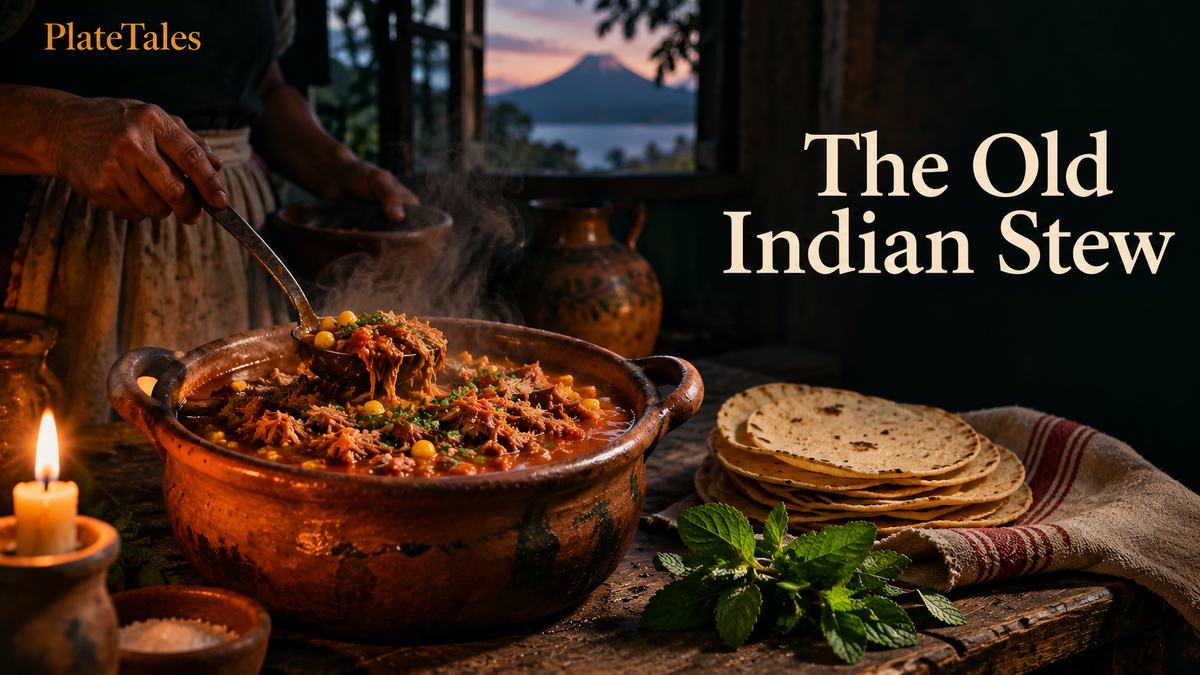
Indio viejo is called "old Indian" because of a story, not a recipe. In the best-known version, a leader on Ometepe Island told two passing Spaniards that the pot held an elderly member of the tribe who had just died, and the visitors declined a bowl. Nobody has produced a dated record of that exchange, so the name is better treated as folklore than as history.
What indio viejo actually is
Indio viejo is a thick Nicaraguan stew of shredded beef and corn. The thickener is maize: one recipe site describes old corn tortillas, cut up, soaked overnight and blended with beef broth, and notes that some cooks use packaged corn flour instead. TasteAtlas lists corn masa. The rest is tomato, sweet pepper, onion and garlic, with sour orange and fresh hierbabuena (a local mint-like herb, according to a commenter on one recipe page) for sharpness, and often achiote for an orange-red color.
The result sits somewhere between a soup and a porridge. It is closer to porridge than to a thin broth, and the Curious Cuisiniere recipe measures a serving at roughly a cup of soup. It is not a weekday bowl. The same recipe page says it is usually made for special occasions: patron saint festivals, weddings and outdoor banquets. A Nicaraguan lodge's blog adds Holy Week to that list.
The beef is shredded into fine strands, which matters for the story that follows. A pot of stringy meat in a corn-thickened broth is exactly the kind of thing you could tell a stranger was anything.
The story of the two Spaniards
Here is the legend in its usual form. Spanish travelers pass through an indigenous community on Ometepe, the twin-volcano island in Lake Nicaragua. They see a pot of stew and ask what is in it. The tribal leader answers that it is an old man of the community who has just died. The Spaniards decline to eat, and the community keeps its food.
The Curious Cuisiniere page tells it this way and says the leader invented the answer to avoid sharing. The page gives no source for it. The number of Spaniards, the date and the leader's name appear nowhere in the pages we opened.
That is the weak point. A good legend travels with a source: a chronicle, a priest's letter, a collected folktale with a name and a year. Here the trail in the pages we read ends at recipe blogs and travel writing, with no named informant and no century attached.
What the written record says about the name
The name translates as "old Indian", and none of the pages we read explains it with anything but the Ometepe legend. Written sources on the dish include Enrique Pena Hernandez's 1968 book Folklore de Nicaragua (page 193), a 2013 Penguin cookbook by Raquel Roque, and a 2005 children's cookbook, Cooking the Central American Way. We did not read those books, so we cannot say what they report about the name.
The lodge blog from Tres Ceibas, which presents the dish as the "Old Indian", says only that Nicaraguan culinary arts go back to pre-Columbian times and that dish names reflect that past. It does not tell the Spaniards story.
So the honest position is narrow. The name is old enough and widespread enough that Nicaraguans treat the Ometepe tale as the explanation. Whether it is the actual origin of the words, or a story attached afterward to a name that already existed, the sources we opened cannot settle.
Maize first, cattle later
The dish itself has a better paper trail than its name, and it points at a problem for the legend. Indio viejo dates to the pre-Columbian era and traces to the Nicarao people of Ometepe Island, who made it before the Spanish arrived. Pre-Columbian versions used native meats such as deer, turkey or iguana, and the dish was eaten widely in the colonial period, when a mortar was used to prepare it.
TasteAtlas makes the same point from the other direction. Maize had been central to the region's food for centuries before the Spanish conquest, it says, while cattle and several of the ingredients now used in indio viejo arrived after European contact. The modern bowl, in other words, is two periods stacked in one pot: a maize base that long predates Spain and a beef that cannot.
This sits oddly against the legend. If the dish already existed on Ometepe before the Spaniards came, the story of fooling them cannot be the reason it was invented. It can only be a reason for the name, and then only if the stew was already being cooked when visitors turned up. A beef version, specifically, would have had to wait for cattle. The tale does not say what the pot actually held besides the old man, and nothing we read says it was beef.
Why a tale like this sticks
We cannot say who first told it, but we can say why it survived. It flatters the cook. In the story the indigenous leader outwits armed visitors with one sentence and a ladle, and loses nothing.
It also explains a name that sounds, to a modern ear, uncomfortable. "Indio" in Spanish was the colonial term for the indigenous people of the Americas, and "viejo" means old. Without the legend the name is just a label. With it, the label becomes a small act of resistance sitting in a soup pot.
If you want a detail to hold on to, hold on to the tortillas. The recipe that uses old corn tortillas, soaked overnight and blended into broth, is the ordinary version of a household habit: nothing from the day before goes to waste. That is the kind of practice that rarely makes a chronicle, which may be why the dish's recorded history is thin and its legend is so full. For the maize side of the story, our history of tacos covers what the tortilla did across Mexico, and our piece on lost recipes from grandmothers looks at why home dishes so often survive as stories first.
Questions people ask
What does indio viejo mean in English?
Indio viejo is Spanish for "old Indian." It is the name of a Nicaraguan stew made with shredded beef thickened with corn. The name is usually explained by a legend set on Ometepe Island, where a leader supposedly told Spanish visitors the pot held a dead elder.
Where does indio viejo come from?
Indio viejo comes from Nicaragua. It dates to the pre-Columbian era and links to the Nicarao people of Ometepe Island, and that it was eaten widely in colonial times. Beef came later, since cattle arrived only after European contact.
What is indio viejo made of?
Indio viejo is made of shredded beef in a broth thickened with corn, either old tortillas soaked overnight and blended or corn masa. Tomato, sweet pepper, onion and garlic go in with sour orange and hierbabuena, and achiote often gives it an orange-red color.
When do Nicaraguans eat indio viejo?
Nicaraguans usually eat indio viejo on special occasions, according to the Curious Cuisiniere recipe page: patron saint festivals, weddings and outdoor banquets. A Nicaraguan lodge's blog also names Holy Week as a traditional time for the stew.
Is the indio viejo legend true?
The legend of the leader and two Spaniards is not backed by any dated record in the pages we opened. It appears on a recipe site without a named source, so it is best treated as folklore about the name rather than documented history.
Filed under Forgotten Recipes, Cultural Identity
Want more stories like this?
One food history story, every week. No spam, just the stories behind what the world eats.