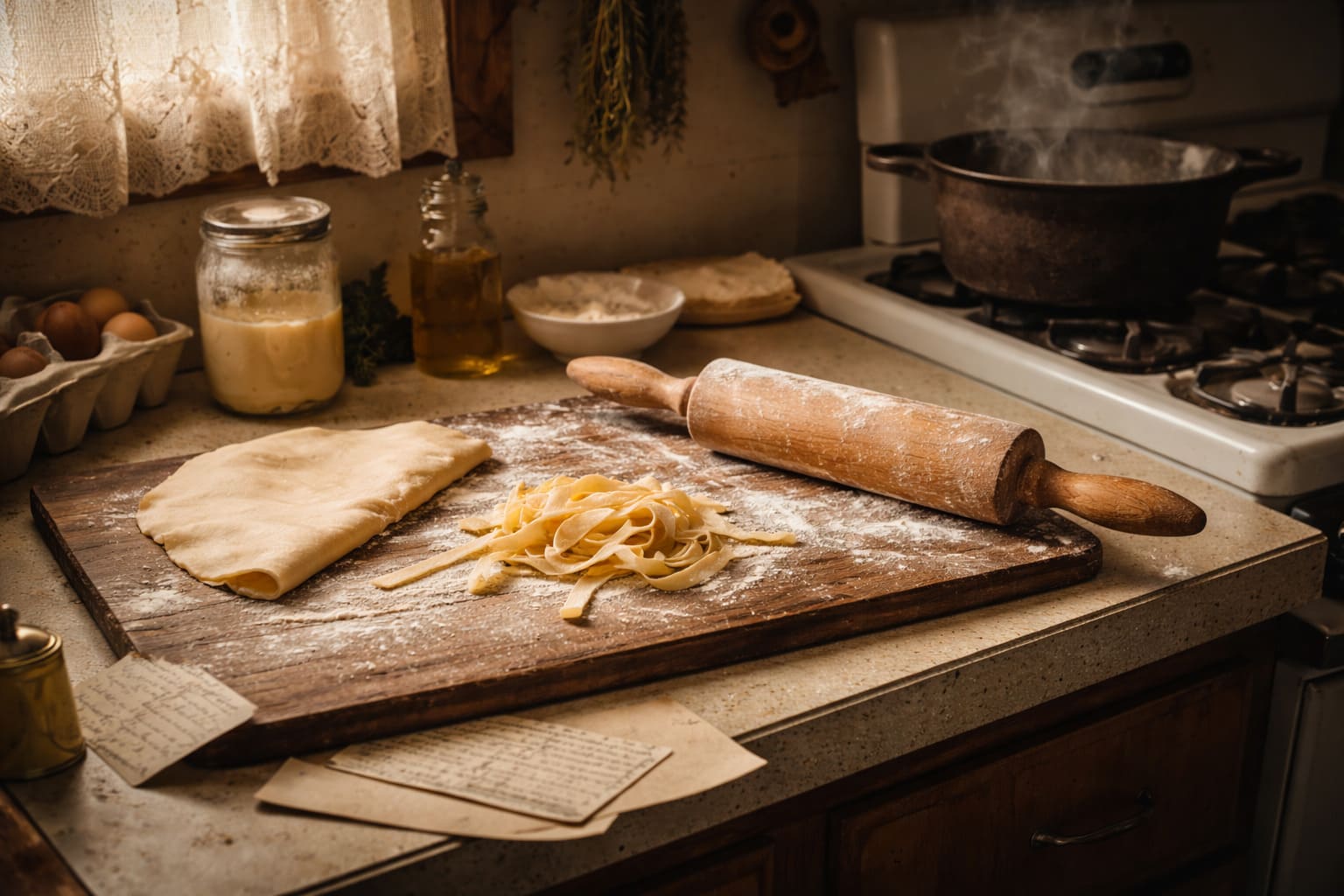
Lost family recipes are the dishes a household cooked for decades without ever writing them down, so that when the cook died, the dish went with her. They are not a myth of nostalgia. Historians have a paper trail for a few of them, and the paper trail shows how a food can fade in a single generation.
This is a story about four such foods, each tied to a different kitchen: an Italian bread soup, the broth left from Southern greens, a Jewish cooking fat, and a Mexican Lenten pudding. None of them is extinct. All of them changed because of who cooked, who wrote, and who stopped.
Pappa al pomodoro and the habit of using what you have
Italians have a name for food made from cheap, ready ingredients: cucina povera, "poor cooking." Pappa al pomodoro is the standard example, an Italian bread soup built from tomatoes, bread, olive oil, garlic and basil. Stale bread is the point of it, not a compromise.
Nobody can say who made the first one. That is typical. Peasant food is poorly documented because the people who ate it rarely wrote about it, and the people who did write often looked down on it. The food historian Ken Albala has noted how peasant diets were stigmatized in earlier centuries, and the stigma helps explain why so little was recorded. A dish that the literate classes considered beneath mention survives only if somebody keeps cooking it.
Italian cooks kept cooking this one, which is why it is still on menus. Most such dishes were less lucky. See also how bread itself shaped the way people ate for the larger background.
Pot liquor, the broth that came after the greens
In the American South, the liquid left in the pot after boiling collards, mustard or turnip greens, or beans, is called pot liquor, or potlikker. It was commonly seasoned with salt, pepper, or smoked pork or turkey. Accounts describe enslaved people drinking it, often crumbling cornpone, a hard patty of cornmeal, salt and water, into the bowl.
A written definition exists from an unlikely author. Huey Long, the Louisiana governor and later senator, described it in his 1933 autobiography Every Man a King as "the juice that remains in a pot after greens or other vegetables are boiled with proper seasoning." Long said it should be taken like any other soup, with the greens eaten as a separate food.
Even the spelling was argued over in print. Zell Miller, the former Georgia governor and senator, defended "potlikker" in a letter that The New York Times ran in 1982 under the headline "Pot Liquor or Potlikker?" A dish with a dispute over its own name is not a lost dish. But the thousands of household versions, with their own cuts of pork and their own opinions about cornbread, were never recorded the way a restaurant recipe would be. For the wider story, see the history of soul food.
Schmaltz in a Lower East Side tenement
Ashkenazi Jewish cooking in northern and central Europe leaned on poultry fat for reasons of religious law. The rules of kashrut ruled out butter with meat and ruled out lard, since it comes from pork, and beef suet is forbidden as well. Olive oil was largely unavailable in northern and central Europe. That left goose and chicken fat, which Ashkenazi cooks called schmaltz. The crisp bits of skin and onion left behind after rendering are gribenes.
The food writer Linda Morel, drawing on Jane Ziegelman's book 97 Orchard, described the next step in a 2010 article in the Jewish Standard. From 1900 to 1910, more than 1 million Jews immigrated to the United States, mostly from modern Ukraine, Poland, Latvia, Lithuania, Moldova and Belarus. Many settled in the tenements of Manhattan's Lower East Side, in apartments with no proper kitchens or running water.
Ziegelman writes that Ashkenazi homemakers there rendered goose skin for cooking fat, and that some raised geese in tenement yards, basements, hallways and apartments, "much to the chagrin of sanitary inspectors," as Morel put it. Ziegelman's line about the cuisine is blunt: potatoes, onions and fat, and the cook explored every permutation of the three. The more fat, the fancier the dish, and the grandest was latkes fried in pools of goose fat.
The 1933 cookbook that replaced it
Goose gave way to chicken. Chicken breeding improved, the smaller bird was cheaper, and chicken fat became the lard of choice. Then a factory product arrived. Procter and Gamble introduced Crisco in 1911, and the company noticed that a vegetable shortening labelled pareve, neither meat nor dairy, could go into both kinds of recipe.
In 1933 the company published Crisco Recipes for the Jewish Housewife, a promotional cookbook in English and Yiddish. Ziegelman called it the demise of poultry fat as a Jewish staple, "bringing to a close a millennium of culinary tradition." That is her judgment, and it is a strong one, but the document is real, and it shows a recipe collection written by a manufacturer replacing the knowledge that had passed from kitchen to kitchen.
Other substitutes came and went. A mostly coconut-oil vegetarian schmaltz called Nyafat was sold in the United States in 1924. Schmaltz has been revived in the twenty-first century, helped by chefs such as Michael Solomonov, but a revival is a new cook working from a printed page, not a grandmother's hand. The same pressure shows up in the story of how immigration changed American food.
Capirotada, a pudding that kept changing
Capirotada is a Mexican bread pudding eaten in Lent, especially Holy Week. The usual base is toasted bolillo soaked in a syrup of piloncillo, cloves and cinnamon sticks, with cheese, nuts and dried fruit added. Many families repeat a story that it began as a way to use up leftovers before Lent. The sources opened for this article treat that as a legend.
What can be shown is older and stranger. The Spanish writer Enrique de Villena mentions capirotadas in his 1423 Arte Cisoria, and early versions were savory, with meats, sausages, bread, cheese and eggs. Sebastian de Covarrubias in 1611 linked the name to the capirote, a conical hood. The dish crossed the Atlantic, turned sweet as New World ingredients and Indigenous practices mixed with the Spanish one, and multiplied into the many family versions cooked today.
Here the lost recipe is not a recipe at all but a whole earlier form, the savory capirotada, that most Mexican grandmothers never made.
Why lost family recipes keep disappearing
Some of the work of saving household food knowledge is done by institutions. The Southern Foodways Alliance runs an oral history program that documents life stories from the American South. Its own page does not give a start date or a count of interviews, so those numbers stay out here.
The record from these four dishes suggests the pattern. The dish survives when somebody keeps cooking it, as with pappa al pomodoro. It survives in many forms and few documents, as with pot liquor. It is displaced by a product, as with schmaltz. Or it quietly becomes another dish, as with capirotada. There is no reliable count of how many family recipes have disappeared. What exists is a handful of documents, and the nonexistent ones can only be guessed at.
For more on food shaped by shortage, read the history of wartime foods.
Questions people ask
What does cucina povera mean?
Cucina povera is Italian for "poor cooking." It describes dishes made from cheap, accessible ingredients, such as pappa al pomodoro, an Italian bread soup made with tomatoes, bread, olive oil, garlic and basil. Food historians note that peasant cooking was often stigmatized and rarely written about, so few records of it survive.
What is pot liquor?
Pot liquor, also spelled potlikker, is the liquid left after boiling greens such as collards, mustard or turnip, or beans. In the American South it was seasoned with salt, pepper or smoked pork. Huey Long defined it in his 1933 autobiography as the juice that remains in a pot after greens are boiled with proper seasoning.
Why did Jewish cooks use schmaltz instead of butter or oil?
Ashkenazi Jewish cooks used schmaltz, rendered goose or chicken fat, because kashrut barred butter with meat and barred lard, and olive oil was largely unavailable in northern and central Europe. In the United States, Crisco, introduced by Procter and Gamble in 1911, later replaced poultry fat in many Jewish kitchens.
Is capirotada really a leftover dish?
Many families say capirotada began as a way to use up bread before Lent, but that remains a legend. The earliest mention found here is Enrique de Villena's 1423 Arte Cisoria, which describes early versions as savory, made with meats, sausages, bread, cheese and eggs. The sweet Mexican Lenten version developed later.
Filed under Forgotten Recipes
Want more stories like this?
One food history story, every week. No spam, just the stories behind what the world eats.