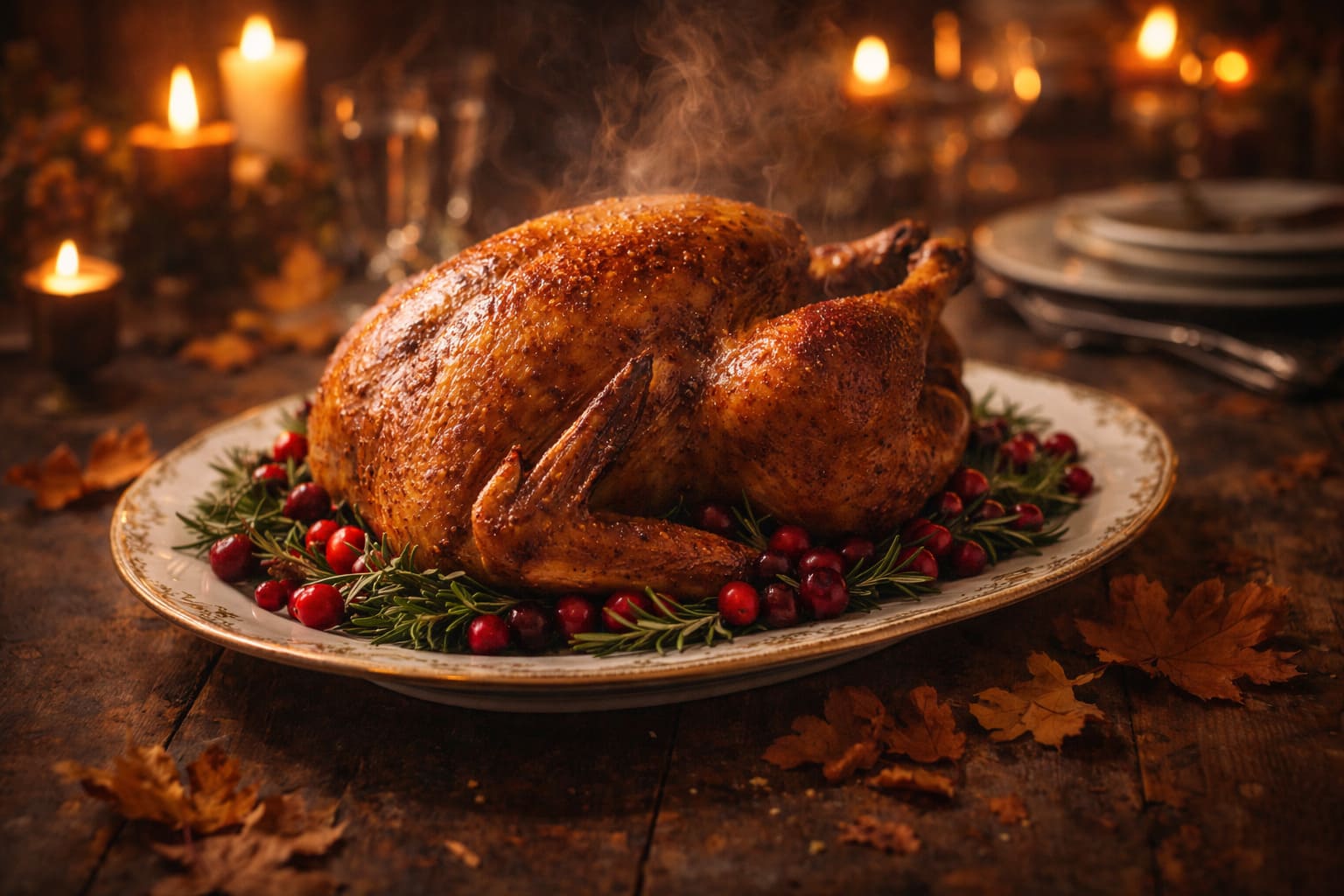
Turkey became the Thanksgiving bird because it was big, plentiful and cheap to give up, and because a novelist and magazine editor made it the picture of the holiday table before the holiday was official. The 1621 Plymouth meal is not the reason. Its two surviving accounts barely mention turkey, and one of them does not mention it at all.
What Plymouth's two eyewitnesses actually wrote
Two texts describe autumn 1621. Edward Winslow wrote that four men went out in one day and "killed as much fowl, as with a little help beside, served the Company almost a week." He names no species. William Bradford, in his history of the colony, wrote that "besides waterfowl there was great store of wild turkeys, of which they took many, besides venison, etc."
Read closely, Bradford says turkeys were around that season and that the colonists hunted them. He does not say they were on the table at the feast. Britannica notes that the "fowl" could technically have been turkeys, which were native to the area, but that historians think ducks or geese were more likely. For the full inventory of that meal, see our story on what the first Thanksgiving food really was. This one starts after Plymouth, with the question of why the bird stuck.
Thanksgivings before there was a feast
Plymouth was not even the model at the time. The historian David Silverman points out that English days of thanksgiving had long been occasions of fasting and prayer, not feasting. Britannica adds that days of thanksgiving were common in New England, that towns held their own, and that few people linked them to the Plymouth settlers.
The link came later. An 1841 collection of Pilgrim writings called the Winslow meal "the first Thanksgiving," and Silverman credits a footnote by the Rev. Alexander Young for the phrase that caught on. Bradford's own journal was reprinted in 1856, according to Britannica, and its line about wild turkeys fed the idea that Pilgrims, turkeys and Thanksgiving belonged together. So the turkey was attached to Plymouth after the fact, not carried forward from it.
Three farmyard reasons
By around 1800, Britannica reports, turkey was already a popular dish for Thanksgiving occasions, and it gives three practical reasons.
The first was supply. One expert it cites estimates at least 10 million turkeys in America when Europeans arrived. The second was what a bird cost the farm. A cow was worth more alive while it gave milk, and a hen while it laid eggs, but a turkey was generally raised for meat, so killing one gave up nothing. That is a plain economic fact, and it is why the bird could be spared for a big autumn dinner when the cow and the laying hen could not. The third was size: a single turkey was usually big enough to feed a family.
None of this is glamorous, and none of it is unique to America. Domestic turkeys descend from birds first kept in central Mexico at least 2,000 years ago, and the Spanish carried them to Europe. They reached Jamestown, Virginia, in 1608. In Britain turkey stayed a luxury until the late 19th century, with goose or beef more common on working-class Christmas tables. In New England the bird was simply nearer to hand.
The novel with a turkey at the head of the table
Britannica calls Sarah Josepha Hale arguably more important than any other writer in fixing the bird to the day. In her 1827 novel Northwood, she gave an entire chapter to a New England Thanksgiving dinner, with a roasted turkey "placed at the head of the table." Other dishes there included gravy, stuffing, chicken pie and pumpkin pie.
Hale then spent years pushing the same holiday in public. She edited Godey's Lady's Book from 1837 until 1877, a magazine that reached more than 150,000 subscribers in the North and South. From 1846 she campaigned for 17 years for a national Thanksgiving, writing to presidents including Zachary Taylor, Millard Fillmore, Franklin Pierce and James Buchanan. Her letter to Abraham Lincoln worked: he backed the holiday in 1863. At that point each state still set its own date, anywhere from October to January, and the holiday was largely unknown in the South.
One limit on this story deserves saying plainly. The sources read for this article show that Hale put turkey in her fiction and campaigned for the holiday. They do not show that she personally dictated what Americans cooked. A novel described a table; readers who already liked the bird recognized it. That is influence, but it is a quieter kind than the legend of a one-woman menu. It also fits the timing: the novel came first, the long campaign followed, and the federal holiday arrived only after both.
Did Dickens help?
Some people credit Charles Dickens and A Christmas Carol (1843) with strengthening the idea of turkey as a holiday meal, Britannica says. The book is English and about Christmas, so any effect on an American November would have been indirect. It is a reasonable guess at a mood of the era, not a documented cause, and the evidence here is thin. Treat it as a possible echo, in the same way that many ritual foods pick up meaning from stories told about them rather than from any one decision.
How turkey got cheap
The reasons above explain why turkey was chosen when most families ate what their own farm produced. A later change explains why it stayed. Britannica notes that the wild turkey was considered endangered in the early 20th century, yet its population is again in the millions. Modern breeding, it adds, has made turkeys both larger and cheaper than ever.
The commercial breed behind that is the Broad Breasted White, selected for size and meat yield. In Britain, intensive farming from the late 1940s sharply lowered turkey prices and put the bird within reach of more households. The American details of that postwar shift were not confirmed in the pages read for this article, so they are left out here.
The result is a habit with very large numbers behind it. One count puts turkeys eaten on Thanksgiving Day in 2019 at 40 million, and an estimate suggests about 85 percent of people who celebrate the day eat turkey.
Questions people ask
Was turkey served at the first Thanksgiving?
Possibly, but no document says so. Edward Winslow's account of the 1621 Plymouth meal mentions only "fowl," and historians quoted by Britannica think ducks or geese were likelier. William Bradford wrote that wild turkeys were plentiful that season, without placing them at the feast.
Who made turkey the traditional Thanksgiving dish?
No single person did, but Sarah Josepha Hale is the most cited. Her 1827 novel Northwood described a New England Thanksgiving with roast turkey at the head of the table, and she campaigned from 1846 for a national holiday that Abraham Lincoln backed in 1863.
Why a turkey and not a chicken or a cow?
A cow gave milk and a hen gave eggs, so killing either cost the farm ongoing output. Turkeys were generally raised for meat, and one was usually big enough to feed a family, according to Britannica. That made the turkey the easiest large animal to give up for a feast.
Did Charles Dickens make turkey a holiday tradition?
Some writers credit Dickens's A Christmas Carol of 1843 with boosting turkey as a holiday meal, but the evidence is thin. The story is English and set at Christmas. Britannica gives Sarah Josepha Hale's American writing and campaigning more weight for Thanksgiving specifically.
Filed under Ritual Foods
Want more stories like this?
One food history story, every week. No spam, just the stories behind what the world eats.